CeriBell (CBLL): supplier relationships, operational posture, and what investors should price in
CeriBell sells an AI-enabled point-of-care EEG system and monetizes through device sales, recurring headband consumables and related service arrangements; its manufacturing model outsources headband assembly to contract manufacturers in China while final assembly and labeling occur in Sunnyvale, California. Revenue accrues from hardware and consumable sales plus clinical services, and the company’s operational economics are shaped materially by a small set of outsourced manufacturers and purchase-order supply agreements documented in its FY2024 disclosure. For investors evaluating supplier risk and partner strategy, the manufacturing relationships and contract posture are the primary drivers of supply continuity and margin stability.
Explore supplier intelligence and counterparty exposure at https://nullexposure.com/.
The supplier relationships, in plain English
-
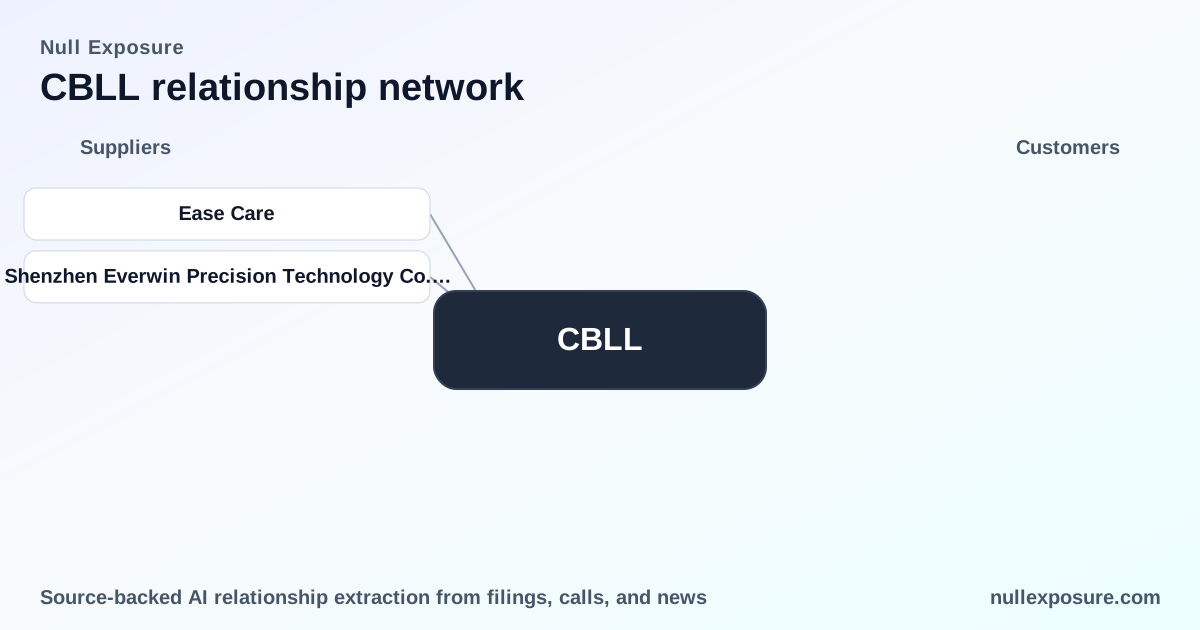
Ease Care — CeriBell entered a corporate supply agreement with Ease Care, a contract manufacturer under the management of Luxen and Kersen in China; the agreement called for CeriBell to begin placing purchase orders for small and large headbands in the second half of 2024. According to CeriBell’s FY2024 Form 10-K, the Ease Care Agreement is structured on a purchase-order basis and is intended to supply headbands for the Ceribell system (FY2024 10-K).
-
Shenzhen Everwin Precision Technology Co., Ltd. — CeriBell has a corporate supply agreement with Shenzhen Everwin for supply of small and large headbands; the Everwin Agreement became effective January 10, 2022 and carried an initial term through January 2025 with automatic one‑year renewals thereafter. The FY2024 Form 10-K describes Everwin as a primary contract manufacturer that assembles headbands and supplies them on a purchase‑order basis (FY2024 10-K).
Why these two names matter to the P&L and continuity
CeriBell’s operating model is manufacturing‑heavy but externally executed: the company outsources primary headband assembly to Chinese contract manufacturers and performs recorder final assembly and labeling in Sunnyvale. That split creates a dependency map where headband supply is both a cost lever and a potential single point of failure. The two relationships documented in the 10‑K — Ease Care and Everwin — represent the principal channels through which consumables flow into CeriBell’s U.S. final assembly, and therefore directly affect product availability and gross margin. According to the FY2024 Form 10‑K, these third‑party manufacturers are integral to delivering the Ceribell System.
Contract posture, concentration and criticality — the constraints story
The company-level disclosures and constraint excerpts in the filing show a mix of durable supplier contracts and concentrated operational exposure:
-
Long-term orientation with automatic renewals is evident: the Everwin Agreement’s initial multi-year term and automatic one-year renewals signal a contracting posture that prioritizes continuity rather than frequent renegotiation, which supports production planning and forecasting. The Everwin Agreement specifics are in the FY2024 10‑K.
-
Geographic concentration in APAC is a core operating signal: contract manufacturers in China assemble the headband, with final inspection and labeling in California; CeriBell explicitly relies on two primary CMs in China for headband manufacturing, which centralizes supply chain risk in the APAC region (FY2024 10‑K).
-
Critical single-source elements are called out: the company states that certain components, sub‑assemblies and services are critical and have relatively few alternative sources, creating materiality and resilience risk in the supply chain (FY2024 10‑K).
-
Mixed maturities in the company’s contract landscape: while supplier agreements show long-term features, other corporate agreements such as financing facilities are short‑dated (for example, a revolving facility maturing in early 2026), which is a separate but relevant cash-flow maturity consideration for operations and procurement commitments (FY2024 10‑K).
Taken together, these signals define an operating model with concentrated supplier exposure, contractual stability on the manufacturing side, and near-term financing maturities that investors must reconcile when modeling working capital and production ramp scenarios.
Operational and investor implications you should price in
-
Supply concentration is the principal operating risk. With two primary CMs in China supplying headbands, a disruption at either supplier could compress output or force expensive short-term sourcing alternatives, pressuring gross margins and near-term revenue recognition. The FY2024 10‑K supports this characterization.
-
Contract structure supports predictability but not full redundancy. Purchase‑order based supply agreements with automatic renewals enable volume planning, however the filing notes relatively few alternative sources for some components — so predictability does not equal resiliency.
-
Geopolitical and logistical exposures are non-trivial. China‑based assembly plus U.S. final assembly creates cross-border logistics and regulatory touchpoints that can impose delays or cost volatility in stressed scenarios.
-
Clinical service relationships add nuance. The company also contracts “directly or indirectly with physicians to provide remote EEG reading services,” which introduces a service counterparty set that is operationally different from manufacturing but relevant to product uptake and clinical utilization (FY2024 10‑K).
If you want detailed counterparty profiles and exposure maps, start your diligence at https://nullexposure.com/.
Practical next steps for investors and operators
- Validate counterparty capacity and dual-sourcing plans: request evidence of alternate suppliers, lead times and minimum order quantities from management.
- Stress-test gross margin under scenarios of 10–30% headband supply disruption and incremental freight/expedite costs.
- Reconcile procurement cadence against near-term financing maturities to ensure production scale isn’t constrained by cash flow.
Access structured supplier exposure intelligence at https://nullexposure.com/ to augment your diligence.
Bottom line
CeriBell’s manufacturing model is outsourced, concentrated, and contractually oriented toward continuity. The two documented supplier relationships — Ease Care and Shenzhen Everwin — are the operational plumbing for headband supply and therefore central to near-term revenue delivery and margin stability (FY2024 10‑K). Investors should price in the benefits of predictable purchase‑order supply arrangements while also stressing the downside from geographic concentration and limited alternative sources. For underwriting and monitoring, focus on counterparty capacity, contract renewal mechanics, and the interplay between procurement timing and short‑term corporate financing.