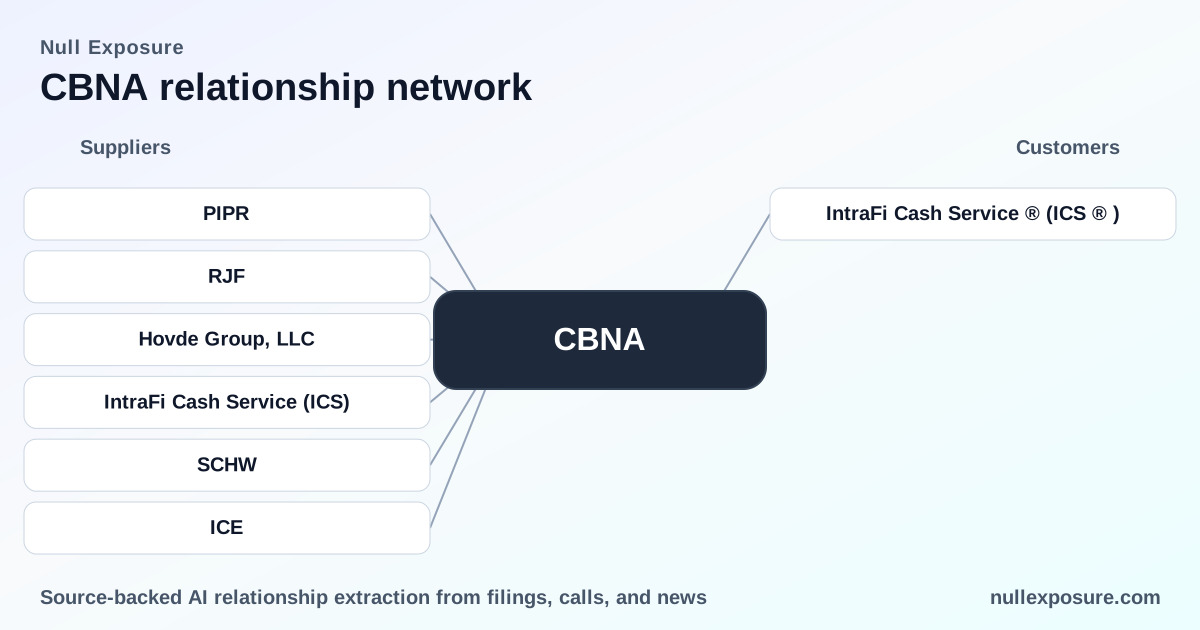
Chain Bridge Bancorp (CBNA): Who the bank leans on as it transitions to a public company
Chain Bridge Bancorp operates as a regional bank holding company for Chain Bridge Bank, N.A., generating net interest income from traditional commercial and personal banking and supplementing earnings with deposit placement and ancillary noninterest activities. The company monetizes by originating and servicing loan and deposit relationships in the Washington, D.C. market, while using third-party broker-dealers and deposit networks to distribute capital and place deposits; the recent IPO activity has crystallized these external dependencies into visible supplier relationships. For a quick institutional view and counterparty mapping, visit https://nullexposure.com/.
What this analysis delivers
This note maps every supplier relationship that surfaces in public news and filings, explains how those ties intersect with Chain Bridge’s operating model, and highlights the revenue and counterparty risks investors should monitor. Key takeaway: Chain Bridge is a small but publicly listed regional bank with concentrated capital markets relationships (bookrunners and brokers) and operational dependence on deposit placement networks.
How Chain Bridge sources capital and distribution
Chain Bridge used a short list of investment banks to underwrite and distribute its initial public offering, and it relies on broker-dealers for retail/wholesale distribution and deposit-placement networks for liquidity management. That contracting posture—outsourcing capital markets execution and deposit placement—creates execution concentration but allows the bank to remain asset-light on distribution infrastructure. Institutional ownership (63.08%) and insider stakes (29.76%) indicate a compact shareholder base that will watch these external partnerships closely.
- Market position and maturity: Newly public following IPO-related activity in FY2024–FY2025, modest market capitalization (~$233 million), and profitable operating margins underline a bank in transition from private, relationship banking to public reporting and capital market scrutiny.
- Critical external dependency: Deposit placement through IntraFi materially affects noninterest income; bookrunners and brokers are essential to capital formation and listing.
Explore a deeper counterparty report at https://nullexposure.com/.
Counterparty map — every relationship found in public sources
Piper Sandler & Co. (FY2025) Piper Sandler acted as a book-running manager for Chain Bridge’s offering in the ceremony and distribution events tied to the IPO in FY2025, confirming its role on the front end of capital formation. According to a PR Newswire release covering the NYSE bell-ringing ceremony in March 2026, Piper Sandler was a principal underwriter for the transaction.
Piper Sandler & Co. (FY2024) Piper Sandler was also listed as a book-running manager when Chain Bridge announced the launch of its IPO in FY2024, demonstrating continuity of engagement through the deal lifecycle. PR Newswire’s FY2024 announcement cites Piper Sandler alongside other managers for the initial offering.
Raymond James & Associates, Inc. (FY2024) Raymond James served as a co-bookrunner when Chain Bridge launched its IPO in FY2024, supporting deal distribution to institutional and retail channels. The FY2024 PR Newswire announcement names Raymond James as one of the underwriting managers.
Raymond James & Associates, Inc. (FY2025) Raymond James continued in the underwriting syndicate through the FY2025 celebration of the IPO, reinforcing that Chain Bridge relied on a small set of banks for capital markets execution. PR Newswire’s FY2025 release listing the NYSE bell-ringing documents Raymond James’ role.
Hovde Group, LLC (FY2024) Hovde Group joined Piper Sandler and Raymond James as a book-running manager at the IPO launch in FY2024, indicating Chain Bridge purposely used mid-sized and regional underwriters for the offering. PR Newswire’s FY2024 announcement records Hovde’s participation.
Hovde Group, LLC (FY2025) Hovde Group is again listed in the FY2025 celebration materials as part of the underwriting team, implying a continuing advisory/distribution engagement through deal closing and listing. PR Newswire’s FY2025 bell-ringing coverage lists Hovde among the managers.
IntraFi Cash Service (ICS) (FY2025) Chain Bridge reported a decline in noninterest income tied to lower deposit placement services income from ICS One-Way Sell deposits placed through the ICS network in Q3 2025, showing direct operational dependence on that deposit-placement channel. A FY2025 earnings summary referenced on StockTitan noted the reduction in deposit-placement income from the ICS network.
Charles Schwab Corp. (FY2026) A recent SEC filing lists Charles Schwab Corp. (3000 Schwab Way) as a named broker for Chain Bridge in FY2026, establishing Schwab as a distribution or custody counterparty used by the bank. The SEC filing text published via StockTitan explicitly names Charles Schwab as the broker on record.
New York Stock Exchange (FY2024) The NYSE approved Chain Bridge’s Class A common stock for listing under ticker CBNA, subject to official notice of issuance, formalizing the company’s transition to a public market listing in FY2024. The FY2024 PR Newswire release documents the listing approval and subsequent NYSE activities.
What these relationships tell investors about risk and execution
- Concentration of capital-markets execution: A triad of bookrunners (Piper Sandler, Raymond James, Hovde) handled the IPO process rather than a broad syndicate; that structure reduces execution friction but concentrates underwriting risk and price discovery influence in a small group of counterparties.
- Operational sensitivity to deposit networks: The ICS linkage is economically meaningful—deposit placement is a line item in noninterest income—and shifts in that channel will affect quarter-to-quarter fee revenue volatility.
- Broker and custody posture: Naming Charles Schwab as broker signals a reliance on established custody/distribution infrastructure to support the company’s retail/institutional workflows.
- Public market scrutiny and governance: NYSE listing and the public float (shares outstanding ~3.3 million) convert formerly private relationships into visible market signals; insider and institutional ownership levels concentrate voting power and attention.
Takeaways for investors and operating partners
- Counterparty risk is concentrated but transparent. A small set of underwriters and deposit networks handle capital formation and liquidity distribution. Monitor fee schedules and distribution terms with these partners.
- Earnings sensitivity is asymmetric. Interest-earning assets drive the P&L, but noninterest income from deposit placement (ICS) and capital-markets activity will accentuate volatility.
- Governance and market liquidity matter. With a small share base and high insider/institutional stakes, supplier relationships will be closely supervised by major holders.
If you’re evaluating CBNA relationships for underwriting, treasury services, or liquidity provisioning, start your due diligence with a focused counterparty review at https://nullexposure.com/. For institutional clients building supplier risk frameworks tied to regional banks, our mapping tools provide the context investors need—learn more at https://nullexposure.com/.
Final assessment
Chain Bridge Bancorp has executed a controlled public transition using a tight group of underwriters and established distribution partners while relying on deposit networks for a portion of noninterest fee revenue. For investors, the central questions are whether the existing supplier mix supports scaling without concentration risk, and whether deposit-placement income stabilizes after the IPO transition. Monitor ongoing filings and quarterlies for changes in underwriting arrangements, broker designations, and deposit-placement throughput as leading indicators of supplier risk and revenue stability.