Capital Bancorp (CBNK): supplier footprint and operational signals investors should price
Capital Bancorp is the holding company for Capital Bank, N.A., a regional commercial bank that monetizes through net interest income, fee income from deposit and lending services, and mortgage servicing/closing activity. The bank’s balance-sheet driven economics are visible in its 2025 figures: $230.0M revenue, a 24.8% profit margin, return on equity of 15.1% and a market capitalization near $477M. For investors evaluating counterparty and operational risk, the visible supplier relationships are concentrated in mortgage settlement and title insurance services — a narrow but material operational footprint that connects the bank to third-party settlement agents and national insurers. Learn more or request deeper supplier mapping at https://nullexposure.com/.
Quick financial posture and what it implies about operations
Capital Bancorp trades at a trailing P/E of 8.46 and a price-to-book of ~1.18, pays a modest cash dividend ($0.46 per share; yield ~1.6%), and shows moderate institutional ownership (41%) alongside significant insider ownership (31.6%). These capital structure signals and profitability metrics indicate a traditional regional-bank profile: earnings driven by lending spreads and fee businesses, with a capital base and governance leaning toward continuity rather than aggressive expansion.
From an operational standpoint, the public supplier evidence is thin and narrowly focused: lender activity that touches title and settlement vendors. The absence of wider supplier disclosures is itself a signal — no supplier constraints were recorded in the constraint feed, which investors should interpret as limited public visibility into contracting posture, supplier concentration beyond mortgage operations, or fixed-cost outsourcing arrangements. That lack of constraint disclosure is a company-level signal about transparency and maturity of supplier governance.
What the public supplier record shows
Below are the supplier interactions captured in public reporting for Capital Bancorp — both items originate from a March 2026 trade publication report covering a courtroom ruling related to a mortgage refinance. Each entry is followed by the source.
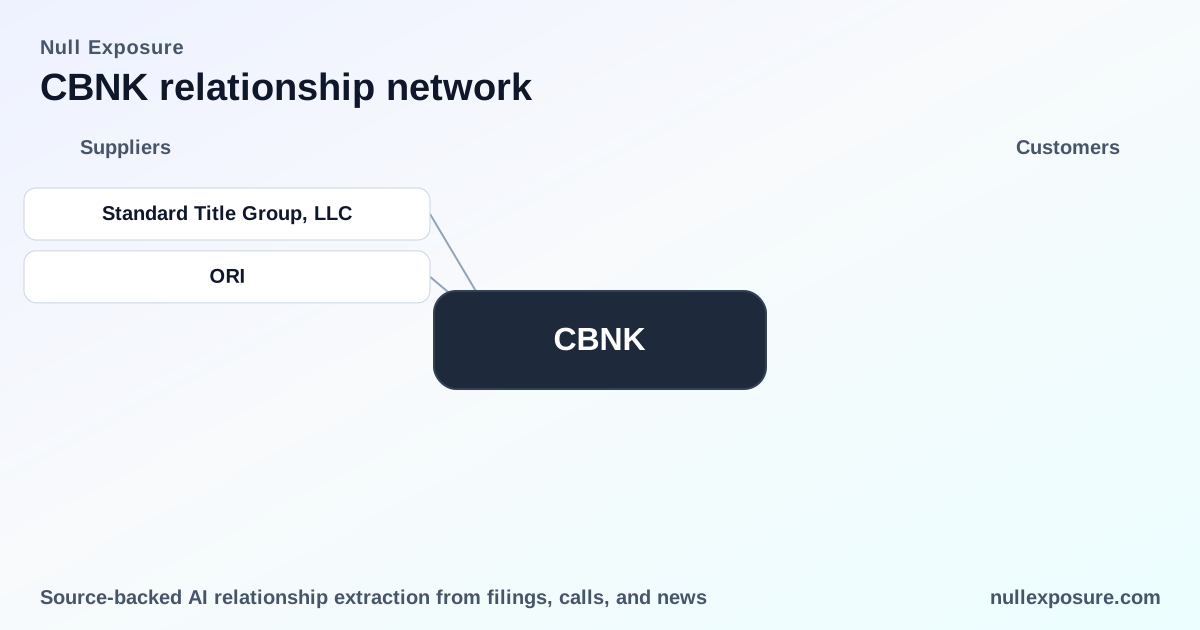
Standard Title Group, LLC — settlement agent role
Capital Bank retained Standard Title Group as the settlement agent in the contested refinance matter described in press coverage, indicating the bank routinely uses third-party settlement firms to manage closings and related workflow. This relationship is transactional and operationally important for mortgage closings. Source: MPA Magazine (March 9, 2026) — https://www.mpamag.com/us/mortgage-industry/industry-trends/dc-court-lets-capital-bank-reclaim-priority-after-botched-refinance/559063
Old Republic National Title Insurance Company — title insurance commitment requested
A title commitment request was made to Old Republic National Title Insurance Company (ORI) by the settlement agent handling the transaction, tying Capital Bank to a national title insurer for post-closing title risk mitigation on mortgage transactions. Using a large insurer like Old Republic reduces insurer-concentration risk versus a small carrier, but links the bank to the insurer’s underwriting and claims-cycle exposure. Source: MPA Magazine (March 9, 2026) — https://www.mpamag.com/us/mortgage-industry/industry-trends/dc-court-lets-capital-bank-reclaim-priority-after-botched-refinance/559063
How to read these relationships into operational risk
The two public relationships are both mortgage ecosystem counterparties (settlement agent and title insurer). That narrow supplier footprint implies:
- Contracting posture: Observable supplier interactions are transactional — the bank uses third-party settlement and title services rather than maintaining vertically integrated closing operations.
- Concentration: The public record shows low breadth of supplier disclosures; mortgage settlement services and title insurance dominate visible third-party sourcing. Investors should treat supplier concentration in mortgage closings as a potential operational dependency, even if overall lending diversification is broader.
- Criticality: Settlement agents and title insurers are operationally critical to the bank’s loan closing cycle — failures, errors, or litigation in that node can directly affect lien perfection and loss severity, as the referenced court action demonstrates.
- Maturity of supplier governance: The absence of recorded supplier constraints or broader supplier metadata is a company-level signal of limited public supplier governance disclosure; governance sophistication should be validated through diligence.
For investors requiring ongoing supplier exposure monitoring, consider establishing a watch on legal and settlement-related press in addition to financial metrics. If you want a tailored supplier-risk brief for Capital Bancorp, visit https://nullexposure.com/ to request a deeper report.
Investment implications — what materially changes the thesis
The supplier evidence combined with financials points to a handful of actionable observations investors should price into models:
- Operational risk is concentrated in mortgage closing workflows. Errors or litigation tied to settlement agents or title commitments can interrupt lien priority and recovery outcomes; the March 2026 court action is a live example.
- Counterparty selection matters. The use of a national insurer (Old Republic) is favorable versus smaller carriers because it reduces insurer-default risk on title policies, but it still exposes the bank to underwriting practices and claims latency.
- Transparency and governance are limited in public records. No supplier constraints were recorded in the constraint feed — treat this as a governance signal requiring proactive due diligence by investors or counterparties.
- Earnings durability still driven by core banking metrics. Despite the operational supplier concentration, the bank’s ROE (15.1%), profit margin (24.8%), and dividend program are the dominant drivers of shareholder returns. Operational supplier events should be viewed as episodic shocks to a balance-sheet centric earnings stream, not as the primary value driver.
Tactical watchlist for the next 12 months
- Track press and court filings tied to loan perfection and title disputes; litigation can move loss recognition and capital outcomes quickly. The March 2026 article is already instructive on this front.
- Monitor changes in the bank’s mortgage origination volume and any shifts toward insourcing settlement operations; that would materially change supplier dependency.
- Check public filings for supplier contracts, vendor concentration disclosures, or procurement policies — absence of such disclosures is itself a red flag to resolve in due diligence.
Bottom line and next steps for investors
Capital Bancorp’s public supplier footprint is narrow and mortgage-centric: settlement services and title insurance are the two visible third-party relationships, both documented in March 2026 reporting. That concentration makes mortgage-closing processes operationally critical to risk management, while the company’s financial profile remains that of a profitable, traditionally capitalized regional bank. The absence of recorded supplier constraints is a company-level signal that investors should demand more direct supplier governance information in diligence.
If you want a concise supplier-risk snapshot or an expanded audit of Capital Bancorp’s counterparty exposures, go to https://nullexposure.com/ for service options and custom briefing requests. For real-time supplier monitoring and deeper commercial mapping, visit https://nullexposure.com/ and arrange a consultation.