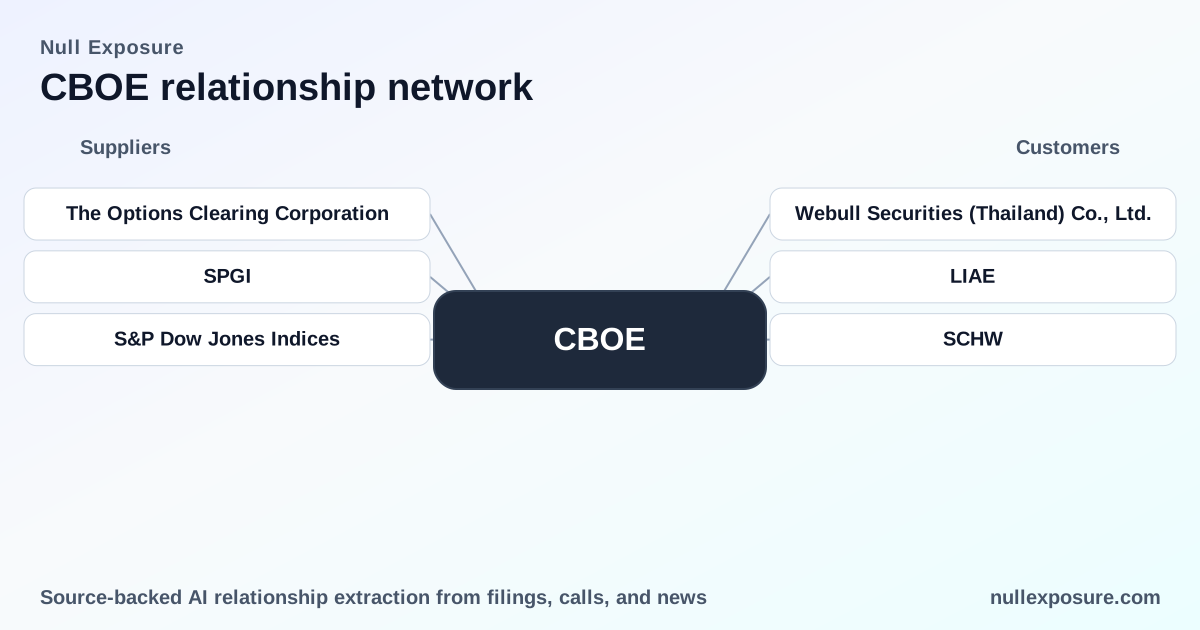
Cboe Global Markets: supplier relationships that define the business model and operational risk
Cboe Global Markets operates as a market infrastructure and data franchisor: it runs trading venues, licenses index and derivative intellectual property, sells market data and connectivity, and collects transaction and listing fees across a diversified set of products. Revenue is driven by trading volumes, recurring data and licensing income, and fees tied to clearing and transaction flow. For investors evaluating Cboe as a supplier to their own operations or as a counterparty, understanding the company’s supplier and partner topology is essential to assess continuity, concentration and contract risk. For an organized view of these supplier relationships and implications, visit https://nullexposure.com/.
How these relationships shape cash flow and operational posture
Cboe’s commercial model mixes recurring, contractually-backed revenue (index licensing, data fees) with volume-sensitive fees (transaction and clearing income). That mix produces attractive margins — reflected in elevated operating margin and EBITDA — while also exposing Cboe to renewal and concentration risk around proprietary index relationships. The company’s supplier footprint confirms a hybrid posture: long-term financial agreements underpin liquidity and credit facilities, while licensing and clearing counterparties are operationally critical to day-to-day market functioning.
- Contracting posture: Company-level disclosures reference a five-year revolving credit facility, signaling established long-term capital arrangements that underwrite operations and M&A flexibility.
- Concentration and renewal risk: Public commentary and filings highlight reliance on proprietary S&P-licensed product streams; this is a business-level concentration issue rather than a single-vendor procurement problem.
- Operational criticality: Clearing and post-trade relationships are core to platform continuity; where a vendor is a clearinghouse, the relationship is strategically critical.
- Spending profile and maturity: Contingent and purchase obligations in recent periods show payments in the $10–100 million band, consistent with material but manageable vendor commitments.
For a concise supplier risk snapshot and comparative analysis, consult https://nullexposure.com/.
Counterparty breakdown — what every investor needs to know
The Options Clearing Corporation (OCC)
Cboe lists securities-based products on its exchange that are centrally cleared by OCC, making OCC a core clearing partner that processes settlement and credit risk for option contracts listed on Cboe Options Exchange. Source: Finviz news item on Cboe product launches (March 9, 2026), https://finviz.com/news/333590/cboe-introduces-innovative-prediction-markets-framework-expanding-choice-beyond-yes-or-no-outcomes.
Additionally, company disclosures explicitly list OCC among the clearing organizations on which Cboe depends, positioning OCC as an operationally critical service provider (company-level constraint excerpt directly names OCC).
Standard & Poor’s Financial Services, LLC (S&P trademarks)
Cboe licenses trademarks and indices associated with S&P — S&P® and S&P 500® marks are licensed for use by Cboe Exchange, Inc., which supports a suite of proprietary and licensed products that generate recurring licensing and listing fees. Source: Cboe trading volume report as summarized by Finviz (March 9, 2026), https://finviz.com/news/330108/cboe-global-markets-reports-trading-volume-for-february-2026.
S&P (analyst and market commentary on concentration risk)
Market commentary highlights a material business risk: concentration in proprietary S&P products and the dependence on long-term renewal of that partnership, which is central to revenue predictability for options and index-based products. Source: SimplyWall.St analysis of Cboe (March 9, 2026), https://simplywall.st/stocks/us/diversified-financials/bats-cboe/cboe-global-markets/news/should-record-volatility-driven-trading-volumes-and-earnings.
S&P Dow Jones Indices (index provider support for new products)
S&P Dow Jones Indices publicly supported Cboe’s development of S&P-linked prediction market contracts, noting the index provider’s role in governance and market integrity for S&P 500–linked products — an endorsement that preserves distribution and trust for those products. Source: Finviz coverage of Cboe’s product announcement (March 9, 2026), https://finviz.com/news/333590/cboe-introduces-innovative-prediction-markets-framework-expanding-choice-beyond-yes-or-no-outcomes.
S&P (duplicate market note / AMP version)
An additional SimplyWall.St AMP syndication reiterated the same concentration and renewal concern around S&P-linked proprietary products. This duplicate coverage underscores the prevalence of that risk in buy-side and sell-side commentary. Source: SimplyWall.St AMP (March 9, 2026), https://simplywall.st/stocks/us/diversified-financials/bats-cboe/cboe-global-markets/news/should-record-volatility-driven-trading-volumes-and-earnings/amp.
Constraints and what they imply about resilience
Cboe’s public filings and disclosures produce several actionable constraints that inform vendor and counterparty risk assessments:
- Long-term financing in place: The company references a five-year, $400 million revolving credit facility, reflecting a multi-year financing commitment that stabilizes balance-sheet liquidity and supports contractual obligations. This is a company-level signal about financial maturity and contracting posture.
- Immaterial Level 3 measurement: The firm reports that measurement uncertainty for certain Level 3 liabilities is immaterial to year-end financials, indicating low reported volatility in complex accounting estimates (company-level disclosure).
- Dual licensing posture: Cboe operates both as a licensee and a licensor — it pays licensors for index use while also licensing its own intellectual property — pointing to reciprocal IP exposure and revenue diversification (company-level signal).
- Service-provider dependence (explicit): The company lists multiple clearinghouses and post-trade processors, including OCC, NSCC, DTC and others; because OCC is explicitly named, the clearing relationship is identified as operationally critical.
- Mid-range spend commitments: Contingent payments recently totaled approximately $13.9 million for certain acquisitions, consistent with a $10–$100 million spend band on acquisition-related or recurring contractual obligations.
These constraints show a business with established finance arrangements, concentrated licensing exposure to major index providers, and operational dependence on a small set of clearing and market infrastructure partners. Investors should treat index-license renewal timelines and clearinghouse continuity plans as the highest-value due diligence priorities.
Investment implications and recommended next steps
- Monitor S&P license renewals and contract terms closely. These relationships underpin a sizeable portion of recurring revenue; changes would alter the cash-flow profile.
- Validate clearing continuity plans with OCC and secondary clearing partners. Given clearing is operationally central, review contingency arrangements and margin/credit frameworks.
- Assess disclosure around contingent and purchase obligations. The $10–100M spending band signals non-trivial contractual commitments tied to acquisitions and licensing.
For investors or operators wanting structured supplier intelligence and tailored counterparty scoring, see the research hub: https://nullexposure.com/.
Cboe’s franchise is durable: high-margin, recurring licensing and data revenue plus volume-driven trading fees. That durability is counterbalanced by concentrated dependency on index providers and critical clearing partners. Active monitoring of those relationships — and the company-level constraints that frame them — is the prudent path for investors and counterparties evaluating exposure to Cboe Global Markets. For a bespoke supplier risk report or to run scenario analysis, begin with https://nullexposure.com/.