Cracker Barrel (CBRL) — supplier footprint, distribution risk, and what investors should price in
Cracker Barrel Old Country Store operates a dual revenue model: full-service restaurants combined with a branded retail store line, monetizing through restaurant food sales, in-store merchandise and licensed products across the U.S. The company sources restaurant food largely through a single principal distributor and supplements retail assortments with direct vendor purchases—including significant sourcing from the People’s Republic of China—and local specialty suppliers. For investors and premium finance partners, the commercial profile is defined by high operational centralization in distribution, material retail sourcing concentration, short payment terms, and a mix of regional specialty suppliers that support brand experience.
Explore supplier exposures and monitoring tools at https://nullexposure.com/.
How Cracker Barrel actually contracts and why that matters to lenders and investors
Cracker Barrel’s procurement posture is operationally aggressive and cash-efficient: restaurant inventories through the principal food distributor are effectively net-zero days, while local purchases use short trade credit (30 days or less). That contracting posture reduces working capital on the balance sheet but increases reliance on the distributor’s continuity and service. Company disclosures show that approximately one-third of retail items in 2025 were purchased from vendors in the PRC, which raises geopolitical and logistics complexity for a retail channel that represents roughly 80% of retail inventory warehoused in a single distribution facility.
Taken together, these facts create a concentrated risk profile:
- Distribution centrality — the majority of retail items are warehoused at a single retail distribution center, making the business vulnerable to a localized disaster or operational outage.
- Short-term supplier terms — suppliers and distributors operate on tight payment cycles, which compress working capital but transfer operational continuity risk outward.
- Sourcing concentration — a meaningful share of retail merchandise originates in APAC, increasing exposure to trade disruptions, tariffs, or shipping volatility.
These company-level constraints are pulled from recent corporate disclosures and the FY2025 reporting period and should be treated as firm-level signals about concentration and criticality, not isolated supplier incidents.
Suppliers mentioned on the record (what was said and where)
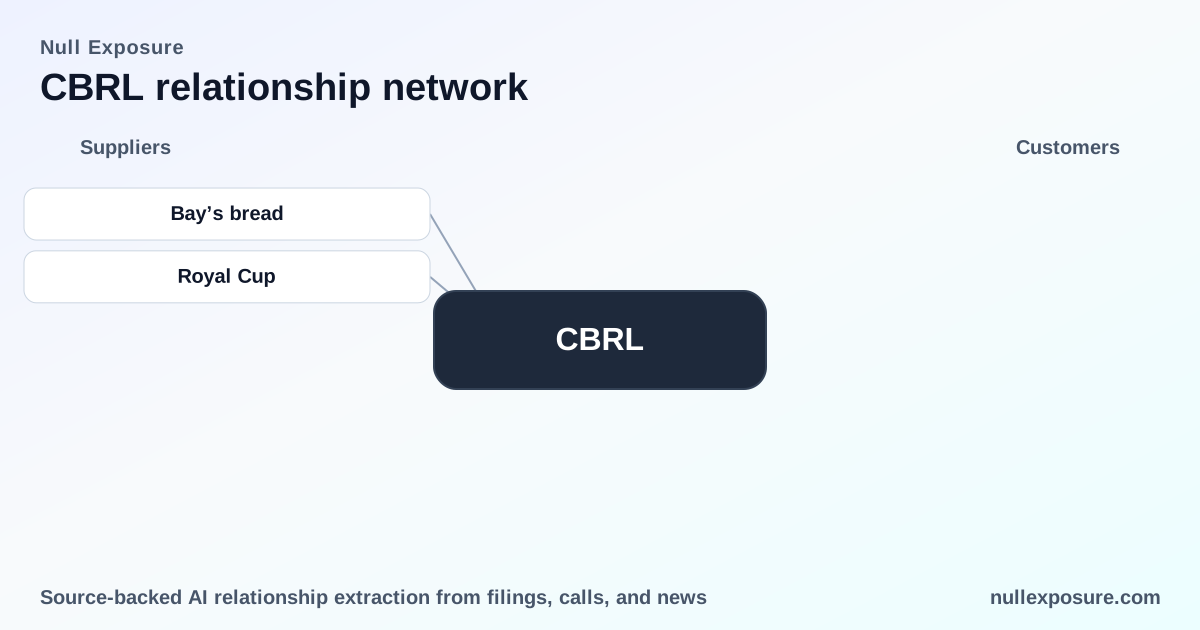
The company highlighted two named specialty suppliers during recent remarks; both are small, brand-oriented vendors that feed Cracker Barrel’s differentiated in-store and menu experience.
-
Bay’s bread — Cracker Barrel referenced Bay’s bread as its sourdough bread maker based in Lebanon, Tennessee, signaling a localized, specialty bakery relationship used to reinforce menu authenticity. (InsiderMonkey Q1 FY2026 earnings call transcript, Mar 9, 2026: https://www.insidermonkey.com/blog/cracker-barrel-old-country-store-inc-nasdaqcbrl-q1-2026-earnings-call-transcript-1658528/)
-
Royal Cup — The company named Royal Cup as its coffee and tea maker in Birmingham, Alabama, indicating a regional supplier partnership for beverage products that supports the dining experience. (InsiderMonkey Q1 FY2026 earnings call transcript, Mar 9, 2026: https://www.insidermonkey.com/blog/cracker-barrel-old-country-store-inc-nasdaqcbrl-q1-2026-earnings-call-transcript-1658528/)
Both mentions are short and functional: they confirm Cracker Barrel’s strategy of combining national distribution with local specialty suppliers to maintain a rustic, regional brand positioning.
The distributor relationship and distribution footprint: the backbone you must underwrite
Company disclosures describe a commercial relationship with an unaffiliated principal food distributor that operates custom distribution centers across multiple U.S. hubs (Lebanon, McKinney, Gainesville, Elkton, Kendallville, Rock Hill, Shafter). The firm purchases the majority of food products and restaurant supplies on a cost-plus basis through this distributor, which is responsible for placing orders, warehousing and delivering products to stores, and effectively sets the operational cadence of restaurant inventory flows.
- Why this matters: the distributor is operationally critical; service disruption or contract renegotiation would have an immediate, measurable impact on store fill rates and margin management.
- Payment dynamics: the distributor arrangement yields net-zero days for many restaurant inventories, compressing receivables but increasing the reliance on timely supplier performance.
Treat the distributor relationship as a high-criticality, high-frequency operational dependency when evaluating credit terms or contingent financing structures.
Practical implications for premium finance and investors
The supplier picture drives practical underwriting consequences:
- Collateral and concentration limits: given that ~80% of retail items flow through one distribution center, loan covenants should address inventory concentration risk and require business-continuity plans or insurance evidence for the site.
- Working capital volatility: short supplier terms reduce on-balance sheet working capital but increase sensitivity to abrupt demand downdrafts; stress tests should model sudden store closures and shipping delays.
- Geographic supply chain exposure: with a material portion of retail goods sourced from the PRC (FY2025 disclosure), ocean freight, tariff risk, and lead-time inflation are tangible downside scenarios that require liquidity buffers and supplier substitution clauses.
- Supplier maturity and single-vendor items: local specialty suppliers like Bay’s bread and Royal Cup contribute to customer differentiation but are operationally lower in scale and potentially less resilient—monitor substitution pathways and multi-sourcing options.
For a deeper view of supplier risk and monitoring frameworks, visit https://nullexposure.com/.
Monitoring priorities and red flags for the next 12 months
Investors and operators should prioritize the following actionable items:
- Distribution center resilience: validate insurance, alternative warehousing plans, and contingency logistics.
- Distributor contract terms: review renewal schedules, cost-plus escalation language, and exclusivity clauses.
- APAC sourcing disruption scenarios: quantify inventory lead times and stock-to-sales coverage for retail items sourced from China.
- Supplier concentration at store level: identify any single-supplier SKUs that would be difficult to replace quickly.
- Margin sensitivity: model 10–20% freight or tariff shocks against gross margin and liquidity.
Each of these is a practical monitoring lever for both equity investors and financing partners.
Bottom line: how to price CBRL’s supplier exposures
Cracker Barrel combines efficient, short-term procurement with a highly centralized distribution model and a mix of regional specialty suppliers that support brand differentiation. That configuration produces strong operational leverage in normal conditions and elevated supply continuity risk under stress. Underwriting should reflect concentrated inventory warehousing, APAC retail sourcing exposure, and the operational criticality of the principal distributor.
For a supplier-risk scorecard, monitoring templates, and ongoing supplier intelligence tailored to CBRL-style exposures, go to https://nullexposure.com/.