Commerce Bancshares (CBSH): supplier posture and what investors should price in
Commerce Bancshares operates as a regional banking holding company that monetizes through net interest income, fee income from retail and corporate services, mortgage origination, trust and asset management fees, and investment product revenue. The company scales by combining a deposit-funded balance sheet with fee-bearing consumer and commercial lines, and preserves margin with active interest‑rate hedging and secured short-term funding. This supplier snapshot focuses on how vendor relationships and disclosed contracting behavior influence operational continuity and strategic execution for investors evaluating CBSH as a counterparty or portfolio holding.
Learn more about supplier intelligence at the source: https://nullexposure.com/
How Commerce runs the bank: business model signals that matter to counterparties
Commerce is a classic regional bank: highly deposit-funded, fee-accretive, and actively hedged. Revenue TTM of roughly $1.71 billion and a trailing EPS of $4.04 show a profitable franchise with a return on equity near 16% and a profit margin over 33%, indicative of a controlled cost structure and healthy spread management. Market capitalization around $7.1 billion and a price-to-book below 2x underscore a mature, cash-generative regional operator.
From the company’s disclosures, several operating constraints define how Commerce contracts and runs third‑party relationships:
- Contracting posture — both long and short tenor exposure: Commerce holds forward-starting interest rate floors with a combined notional of $2.0 billion, each with six-year terms, signaling deliberate, long-dated hedging commitments in the derivatives book. Conversely, the bank carries large short-term secured funding via repurchase agreements totaling roughly $2.8 billion in gross recognition, showing active use of overnight and short-dated liquidity markets. (According to the company’s disclosures as of December 31, 2024.)
- Counterparty profile — large financial institutions plus small-business channels: The company routinely transacts with large institutional dealers for swap offsets and repo counterparties, while a licensed small business investment company within the group holds private equity exposure to smaller portfolio concerns. These dual counterparty types create a mixed concentration profile across funding and investment activities.
- Materiality and risk allocation: The firm discloses that credit valuation adjustments related to the interest-rate floors are not significant relative to the floors’ fair value, which investors should read as derivative valuation risk being non-material at present.
These characteristics translate into a supplier posture where some vendor/contract commitments are strategic and multi-year (hedges, platform agreements), while funding and liquidity relationships are transactional and short-term. That duality drives different diligence standards for investors and counterparties.
Vendor relationships investors should know about
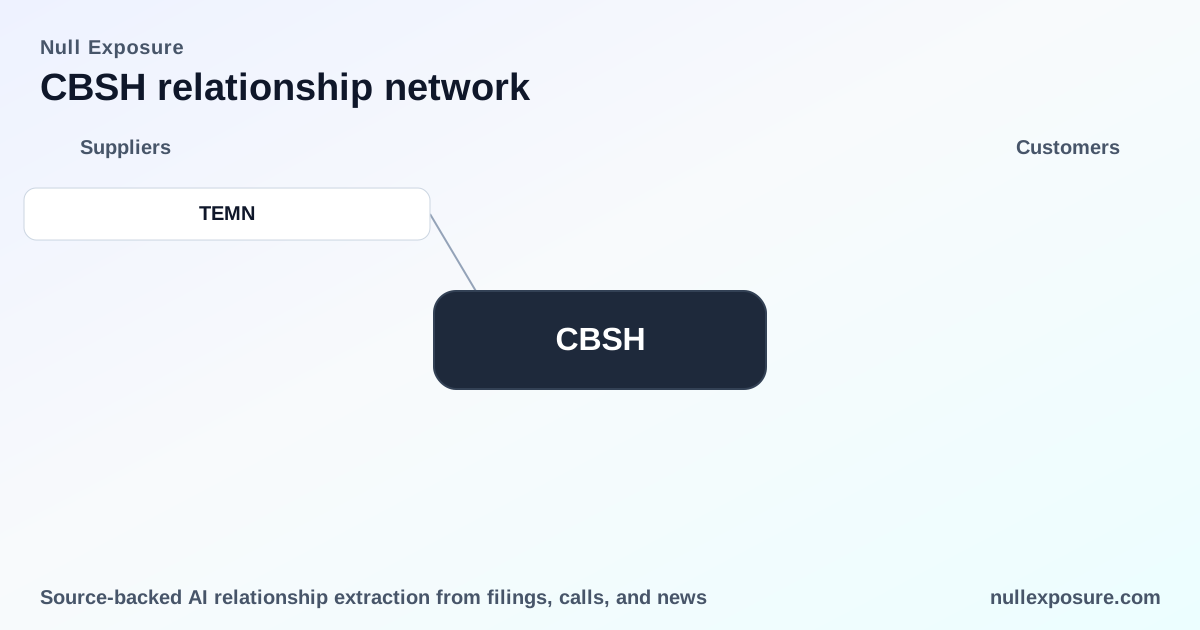
Temenos: Commerce went live on a commercial loan origination platform
Commerce Bank has gone live with Temenos’ Infinity loan origination solution, an implementation positioned to increase operational efficiency and deliver a more personalized customer experience. This is a visible modernization step for the bank’s credit front office and distribution channels. (Temenos press release, March 9, 2026.)
What the Temenos relationship implies operationally
The adoption of a third‑party loan-origination platform signals front-to-back process modernization and potential vendor dependence for loan lifecycle workflows; platform stability and data integrity therefore become mission-critical for credit delivery and customer servicing. The Temenos press release documents go‑live status on March 9, 2026, which confirms the relationship is active and in production.
Risks and concentration investors should price into the valuation
Several supply-side and counterparty signals from Commerce’s disclosures warrant explicit investor attention:
- Liquidity sensitivity via short-term repos: The bank recognizes roughly $2.8 billion in repurchase agreements across overnight and short-dated buckets, which exposes the balance sheet to market funding stress and requires active intraday and term liquidity management. (Company disclosures as of December 31, 2024.)
- Long-dated hedge commitments: The six-year interest-rate floors with $2.0 billion notional show the bank is locking in protection against declining rates on floating-rate commercial loans, creating multi-year derivative counterparty exposure. (Company disclosures as of December 31, 2024.)
- Counterparty concentration and counterpart types: Commerce’s derivative and repo counterparties are largely large financial institutions, producing concentrated exposures to institutional credit and dealer market behavior, while its small-business investment subsidiary introduces a distinct, less liquid asset class into the group’s balance sheet.
- Valuation and model risk is described as immaterial for these floors: The company reports the credit valuation adjustment component of the floors is not significant versus the floors’ fair value, signaling limited present mark-to-market sensitivity from counterparty credit spread movements.
All of these are actionable signals for due diligence: funding structure, hedge duration, vendor change controls, and counterparty credit procedures should be prioritized in vendor and counterparty review.
Practical checks for investors and counterparties
Before entering or expanding a relationship with Commerce, investors and counterparties should verify operational guardrails and contract mechanics. Key items to validate:
- Confirm the term and break clauses on major platform contracts and hedges, including SLA and support escalation pathways for production incidents.
- Review liquidity contingency plans and the composition/tenor of repurchase agreements to assess stress resilience.
- Inspect counterparty substitution and collateral arrangements for long-dated swaps and floors.
- Request independent evidence of platform controls, disaster recovery, and data migration validation associated with the Temenos implementation.
These checks translate supply-side signals into quantifiable counterparty risk assessments that can be modeled into liquidity stress tests, pricing of credit lines, or vendor concentration limits. For full supplier analysis resources, visit https://nullexposure.com/
Bottom line: where this influences valuation and engagement
Commerce Bancshares presents as a structurally profitable regional bank with active balance-sheet management that combines long-dated hedging with substantial short-term wholesale funding. The recent go‑live on a major loan-origination platform is a strategic operational upgrade that elevates the importance of vendor governance and production resiliency. Investors should treat the bank’s repo footprint and derivative commitments as the principal external supply risks that influence funding cost and operational continuity.
For investors or operators conducting counterparty diligence, focus on contract tenure, liquidity buffers, and vendor contingency mechanics when sizing exposure or negotiating terms. To explore comprehensive supplier intelligence and ongoing monitoring, return to the hub: https://nullexposure.com/
Final takeaway: Commerce’s supplier posture is a mix of long-term strategic commitments and high-frequency funding relationships; both need distinct governance and pricing discipline from investors and partners.