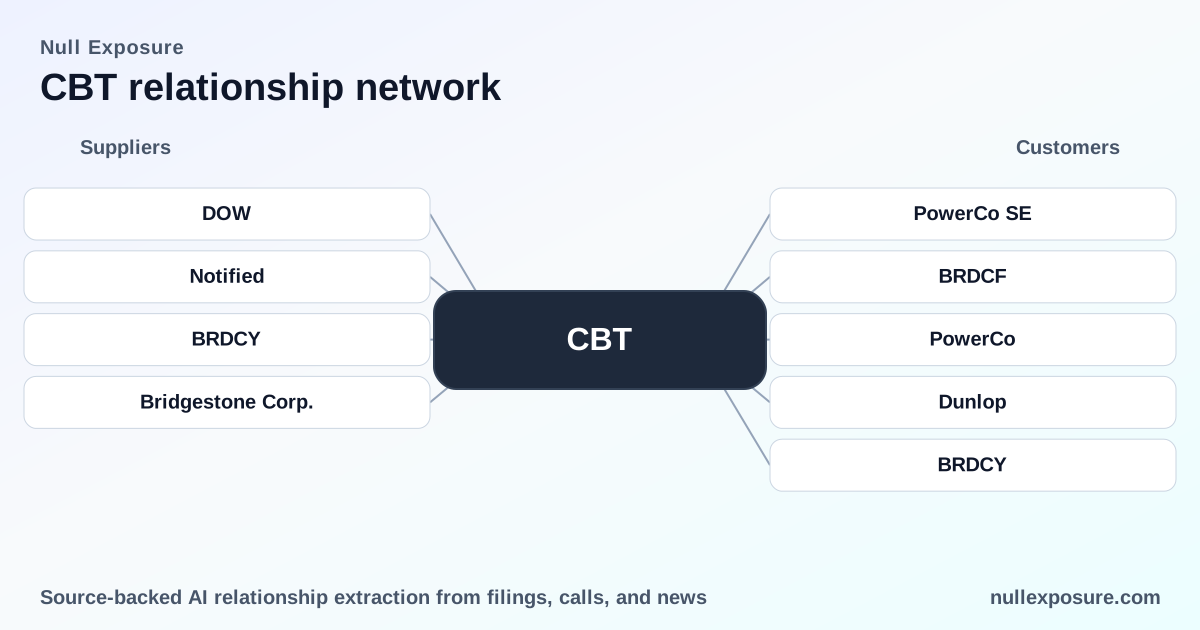
Cabot Corporation (CBT) — Supplier relationships that shape margins and resilience
Cabot Corporation is a global specialty chemicals company that monetizes proprietary materials (carbon blacks, fumed silica, specialty compounds) through long-term supply contracts and integrated manufacturing, selling into tires, plastics, coatings and electronics. Its operating model relies on upstream feedstock security and plant-level integration to protect margins and meet customer specifications. For a detailed supplier-risk and counterparty map, visit https://nullexposure.com/ to see how these relationships affect operating leverage and procurement exposure.
How Cabot’s supplier posture translates into investable signals
Cabot runs a procurement model built around long-term, volume-based purchase agreements for critical raw materials and energy. That contracting posture creates predictable input costs and supports customer commitments, but it also creates lock-in and concentration exposures that investors need to price into valuation and risk models.
- Contract duration and maturity: Cabot discloses multiple long-term procurement arrangements that extend supplier visibility years into the future. These contracts reduce short-term input-price volatility and support reliable manufacturing cadence across segments.
- Buyer concentration and spend scale: Raw-material purchases under long-term arrangements have been substantial — $262M, $280M and $370M in fiscal 2025, 2024 and 2023, respectively — indicating a material and recurring capex-to-OPEX link between procurement and margin stability.
- Operational criticality: Many feedstock arrangements are with fence-line partners and adjacent plant operators, which creates operational synergies but also raises contagion risk if a neighbor shuts down or changes production.
- Contracting posture impact on valuation: With Cabot’s EV/EBITDA at ~5.85 and operating margin around 15%, procurement certainty supports durable cash flow; however, concentration in raw-material spend implies downside if contract performance or market conditions shift.
These company-level signals justify active monitoring of counterparty events and contract expiries; more on specific counterparties below. If you manage supplier risk or procurement exposure in your portfolio, start your tracking at https://nullexposure.com/ for contemporaneous supplier intelligence.
Counterparty relationships that materially influence Cabot
Dow — fence-line partner and compensable disruption
Cabot operates a fumed silica plant adjacent to Dow’s siloxanes plant in Barry, Wales and the two firms exchange feedstock and materials under a long-term agreement that runs through the end of 2028; when Dow announced the siloxanes plant closure Cabot negotiated compensation for any contract nonperformance or underperformance. This arrangement highlights operational interdependence with Dow and contractual mitigation for supplier-driven shutdowns, as disclosed on Cabot’s Q4 2025 earnings call in March 2026 and echoed in the Q1 FY2026 transcript coverage. (Source: Cabot Q4 2025 earnings call, March 2026; Q1 FY2026 earnings transcript coverage, March 2026.)
Bridgestone — supplier-to-owner transition strengthens integration
Cabot agreed to acquire Bridgestone’s reinforcing carbon plant in Mexico, a facility that sits close to Cabot’s Altamira site and formalizes a long-standing supply relationship into ownership to secure volumes and proximity; Cabot has long supplied Bridgestone with reinforcing carbon products and says the acquisition will strengthen the partnership via long-term supply from the acquired plant. This transaction was announced in the Q4 2025 call and reported by industry press in early February 2026. (Source: Cabot Q4 2025 earnings call, March 2026; European Rubber Journal, Feb 2, 2026.)
Notified — webcasting and investor communications provider
Cabot uses Notified to webcast its earnings calls and investor events, directing investors to the company website for access to webcasts. While this is a non-manufacturing relationship, it governs regulatory communications and investor access, which are material to transparency and market perception. The webcast arrangement was disclosed in Cabot’s FY2026 announcement of first-quarter operating results. (Source: GlobeNewswire press release via Cabot, Jan 9, 2026.)
What these relationships mean for investors and operators
The relationships above reveal an operating model that privileges supply assurance, adjacency advantages, and contractual remedies.
- Risk mitigation through contract structure: Long-term arrangements plus compensation clauses (as with Dow) lower tail supply risk and preserve revenue continuity when counterparties alter operations.
- Strategic M&A to de-risk supply: The Bridgestone plant acquisition converts a supplier dependency into owned capacity, improving logistical efficiency and customer alignment while creating integration and capital allocation risk during transition.
- Material spend that moves margins: The magnitude of raw-material purchases (hundreds of millions annually) makes supplier terms a direct lever on profitability; procurement shocks will flow through to margins without offsetting price pass-through or operational improvements.
Practical monitoring checklist for investors
Monitor the following signals to assess whether Cabot’s procurement advantage strengthens or deteriorates:
- Contract expiration and renewal windows for long-term feedstock agreements.
- Adjacency and fence-line partner status changes (plant closures, debottlenecks).
- Integration milestones and synergies from the Bridgestone plant acquisition.
- Year-over-year raw-material spend trends and pass-through clauses in customer contracts.
For an operational view that ties these signals to cash-flow scenarios and counterparty concentration metrics, see operational intelligence at https://nullexposure.com/.
Bottom line: positioning and action
Cabot’s supplier relationships show deliberate risk management through long-term contracts and targeted M&A to internalize critical supply, which supports a predictable margin profile relative to cyclical peers. However, concentration of spend and adjacency-driven operational links remain the primary threat vector that can compress margins if counterparties change production or if integration execution stalls.
Investors focused on procurement and operational resilience should prioritize tracking contract expiries, acquisition integration updates, and fence-line partner events. For continuous supplier-risk signal coverage and to align procurement exposure with portfolio risk limits, visit https://nullexposure.com/ and subscribe to monitoring updates.