Cibus Global (CBUS): supplier relationships, capital markets posture, and what investors should price in
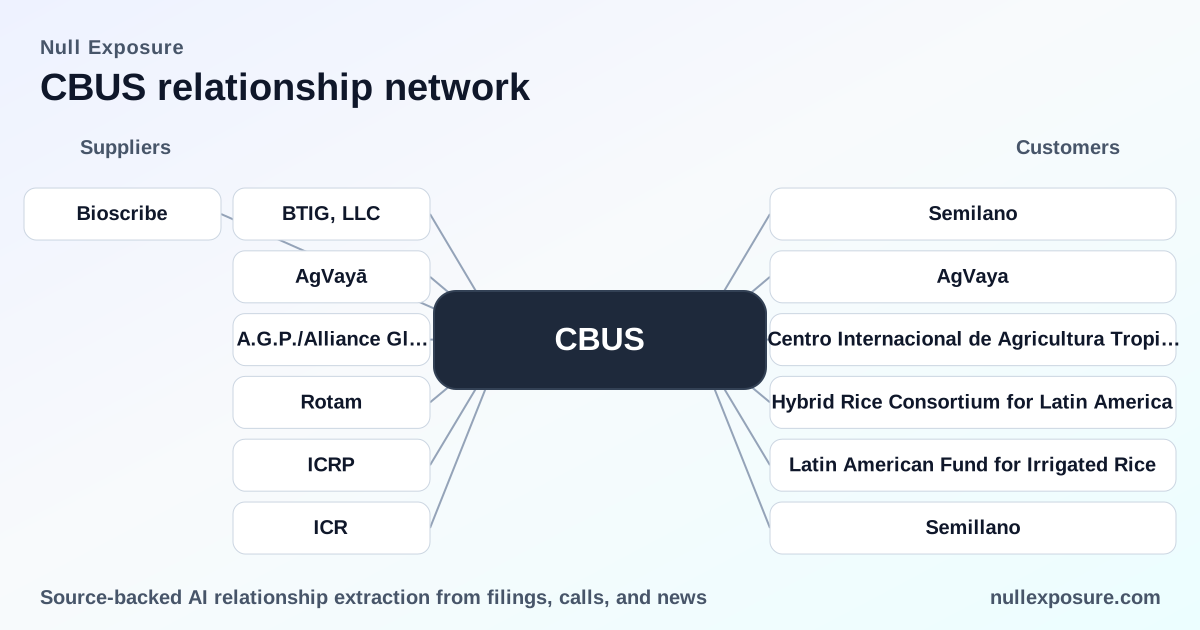
Cibus Global develops and licenses gene‑edited plant traits to seed and crop companies and monetizes through licensing, strategic product partnerships, and equity raises to fund R&D and commercialization. Revenue today is modest and comes primarily from licensing and collaborative product initiatives, while capital markets activity and placement agents supply necessary operating capital. For investors evaluating supplier relationships, the record shows a mix of commercial partners (for manufacturing and market access), capital‑markets intermediaries, and retained IR/PR firms that shape market perception and access to financing.
Explore a structured view of Cibus’ counterparties and supplier posture at https://nullexposure.com/ for more supplier‑level context and diligence resources.
How Cibus runs its supplier network and why it matters to investors
Cibus operates as a biotech licensor and product collaborator rather than a large integrated seed manufacturer. That operating model drives a supplier profile characterized by:
- Outsourced commercialization and manufacturing partners for product registration and distribution rather than captive production.
- Heavy reliance on capital markets intermediaries to fund the long lead times of trait development.
- Contracting with individuals and small specialist firms (scientists, consultants, advisors) for R&D and IP work, which concentrates intellectual property risk around key personnel and service providers.
Company‑level signals from filings and public excerpts reinforce this posture: Cibus’ agreements include confidentiality and IP assignment contracts with employees, consultants and outside collaborators, indicating dependence on individual scientific contributors and external service providers. Separately, disclosed rent expenses of roughly $7.0 million in 2024 versus $4.5 million in 2023 imply a corporate real‑estate spend in the $1M–$10M band, which is material for a company of Cibus’ current revenue base and should be factored into fixed‑cost sensitivity analysis.
Supplier relationships: what the public record shows
BTIG, LLC — underwriting the March 2026 offering
BTIG acted as the sole underwriter on public offering transactions announced in March 2026, handling both the proposed offering and the subsequent pricing and close. These engagements make BTIG a direct enabler of Cibus’ near‑term capital infusions. (StockTitan, March 9, 2026)
A.G.P. / Alliance Global Partners — placement agent role in FY2025
A.G.P./Alliance Global Partners served as the sole placement agent for an offering closed in FY2025, which demonstrates Cibus’ use of placement agents to access institutional and private placement capital ahead of broader public listings. (Yahoo Finance, FY2025 closing announcement)
ICR — investor relations retained across FY2025–FY2026
ICR is listed repeatedly as Cibus’ investor relations contact in FY2025 and FY2026 disclosures, indicating a retained agency relationship for investor communications and capital‑markets outreach. That continuity suggests a strategic emphasis on professionalized market messaging. (StockTitan and Yahoo Finance press items, FY2025–FY2026)
AgVayā — strategic advisory for the Indian market (FY2025)
Cibus announced an agreement with AgVayā to develop market entry and commercialization strategies for Indian rice productivity, reflecting market development through local advisory partnerships rather than direct on‑the‑ground operations. This aligns with a licensing/partner commercialization model. (Agribusiness Global, FY2025)
Rotam — manufacturing and product registration partner (historical FY2014 interaction)
Cibus and Rotam collaborated to launch non‑transgenic SU Canola products, combining Cibus’ trait development with Rotam’s manufacturing and registration capabilities, an example of outsourced production and regulatory execution for specific product lines. (Agribusiness Global, FY2014)
Bioscribe — media relations support cited in FY2025 filings
Bioscribe is listed as a media relations contact in FY2025 press material, indicating use of specialized PR firms to manage public disclosures and external communications. This supports Cibus’ broader market narrative and news distribution infrastructure. (Yahoo Finance, FY2025)
What these relationships imply for investors
- Capital access is an active part of the business model. Multiple engagements with underwriters and placement agents across FY2025–FY2026 show Cibus routinely taps markets to fund operations; investors should treat future dilution risk as a recurring feature of the capital plan.
- Commercialization is partner‑centric and non‑integrated. The Rotam and AgVayā examples demonstrate that Cibus licenses traits and leverages third parties for manufacturing, registration, and local market execution, reducing capital intensity but increasing dependence on partner execution and regulatory coordination.
- Communications are outsourced to professional firms. Retained IR/PR providers (ICR, Bioscribe) indicate disciplined messaging aimed at institutional channels, which affects liquidity and investor perception ahead of financings.
For supplier‑level diligence, review counterparties for exclusivity terms, revenue share mechanics, milestone sequencing and regulatory responsibilities; the commercial outcomes of those clauses will determine the value capture for Cibus investors.
Learn more about supplier‑level risk scoring and counterparty intelligence at https://nullexposure.com/.
Key risks and opportunities for an investor evaluating these suppliers
- Risk — financing dependence: Repeated use of underwriters and placement agents creates a structural need for external capital and potential dilution pressure. BTIG and A.G.P. engagements are direct manifestations of that reliance.
- Risk — partner execution: Outsourced manufacturing and local commercialization mean product revenue realization depends on third‑party regulatory approvals and distribution execution (Rotam, AgVayā).
- Opportunity — capital lever for scale: Active capital markets access enables Cibus to accelerate trials or commercial launches without the fixed costs of owning manufacturing capacity.
- Opportunity — flexible cost base: The licensing and partner model reduces upfront capex and allows the company to scale margins if licensing deals land and regulatory pathways clear.
Final takeaways and next steps
Cibus runs a capital‑intensive science business with a partner‑centric commercial model and professionalized market communications. Suppliers and advisors such as BTIG, A.G.P., Rotam, AgVayā, ICR and Bioscribe play discrete roles in financing, manufacturing, market access, and messaging that collectively determine execution risk and value capture for shareholders. The company‑level signals — contractual dependence on individuals and consultants, and a meaningful real‑estate spend band — further refine the risk profile: intellectual property and personnel continuity are as material as financing cadence.
For investors and operators conducting counterparty due diligence or monitoring supplier concentration, start with contract milestones, exclusivity windows, and financing covenants tied to each partner engagement. For a deeper supplier‑level assessment and ongoing monitoring tools, visit https://nullexposure.com/ and consider tailored intelligence to track counterparties and financing activity in real time.