Coastal Financial (CCB): How the GreenFi deal reshapes supplier risk and revenue optionality
Coastal Financial Corporation operates as the banking holding company for Coastal Community Bank, generating revenue primarily through net interest income on loans and deposits and complementary fee income from consumer and small-business products. The company is now expanding its product set through the January 2026 acquisition of the GreenFi consumer brand; Coastal will monetize the acquisition by integrating GreenFi into its retail distribution and cross-sell channels while preserving operational continuity through a vendor partnership with the brand’s former operator. For investors and operators evaluating Coastal’s supplier posture, the GreenFi transaction changes both revenue optionality and operational dependency in measurable ways. Learn more about supplier exposures and relationship signals at https://nullexposure.com/.
What the transaction actually is and how the vendor relationship functions
Coastal purchased the GreenFi brand from Mission Financial Partners on January 9, 2026, and simultaneously contracted Mission to continue operating and marketing the GreenFi program using Mission’s existing technology platform. This structure gives Coastal immediate product scale without an immediate tech build, while outsourcing front-line operations to the legacy operator (news report, StockTitan, Jan 2026: https://www.stocktitan.net/news/CCB/coastal-financial-corporation-acquires-green-fi-brand-expanding-zyh1zj4wlcfy.html; vendor partnership cited on Intellectia, 2026: https://intellectia.ai/en/stock/CCB/news).
According to Coastal’s public release of fourth-quarter 2025 results, the company is evaluating strategic alternatives for GreenFi but will maintain the operating partnership with Mission Financial Partners to ensure continuity of service and a consistent customer experience during the transition (GlobeNewswire press release, Jan 29, 2026: https://www.globenewswire.com/news-release/2026/01/29/3228407/0/en/Coastal-Financial-Corporation-Announces-Fourth-Quarter-2025-Results.html). A secondary posting of the same release is available at Sahm Capital (Jan 2026: https://www.sahmcapital.com/news/content/coastal-financial-corporation-announces-fourth-quarter-2025-results-2026-01-29).
Relationship roundup: every supplier tie extracted from public reporting
Mission Financial Partners
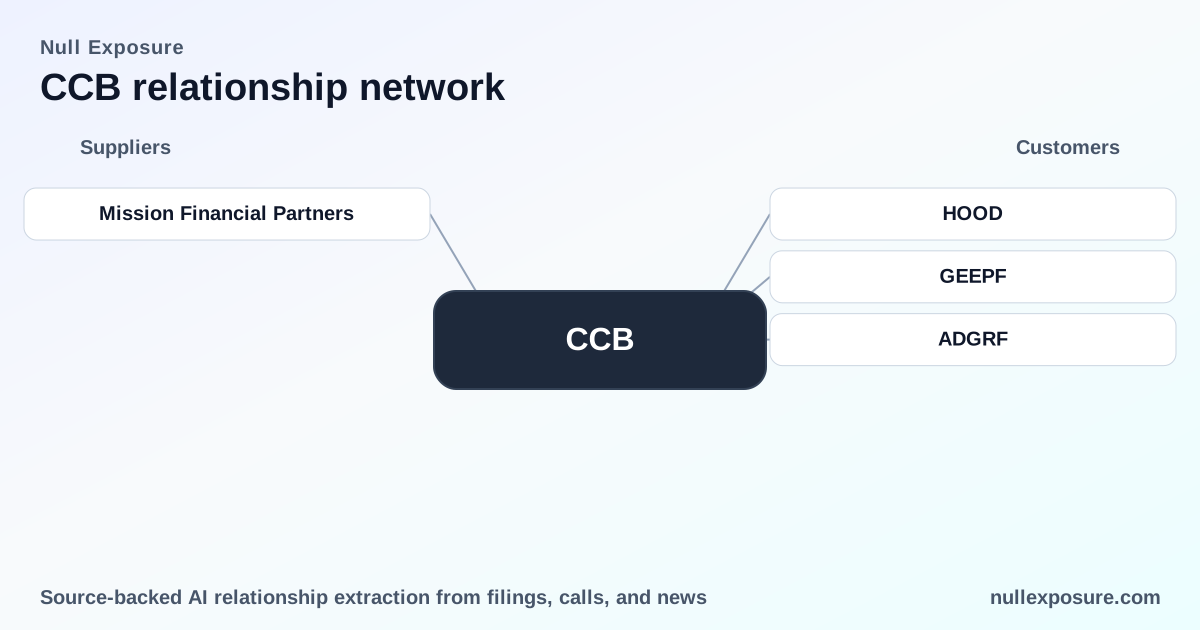
Coastal acquired the GreenFi brand from Mission Financial Partners on January 9, 2026, and Mission will continue to operate and market GreenFi under contract using its technology platform to preserve customer continuity (StockTitan and Intellectia reporting, Jan–Mar 2026; Coastal press release via GlobeNewswire, Jan 29, 2026).
Why this supplier relationship matters to investors
The combined transaction and operating agreement creates near-term revenue acceleration with relatively low capital outlay because Coastal buys the brand and retains Mission as the operating vendor. That structure delivers faster go-to-market for climate-focused consumer products while keeping the bank’s balance sheet exposure concentrated in traditional lending and deposit channels. However, the deal substitutes one form of investment (building an in-house platform) for another form of operational dependency (outsourcing to Mission), which has direct implications for margin capture, contract negotiation leverage, and operational resilience.
A central commercial upside is the potential for higher cross-sell rates and non-interest income as GreenFi customers are folded into Coastal’s retail deposit and payment products. On the flip side, the operating model leaves Coastal exposed to vendor performance and integration execution risk until Coastal either internalizes operations or secures a durable, well-specified SLA.
Explore supplier analytics and materiality screening at https://nullexposure.com/ to benchmark Coastal’s vendor posture against peers.
Company-level operating model signals and constraints
The public disclosures and transaction structure produce several clear company-level signals:
- Contracting posture — transactional plus transitional. Coastal executed an acquisition while negotiating an operating services contract that transfers day-to-day execution to the seller; this is a hybrid buy-and-outsourced-operate posture rather than a full insource or long-term captive arrangement.
- Concentration — single-operator dependency for a new product line. GreenFi’s operations are concentrated with Mission Financial Partners during the initial phase, increasing supplier criticality for that product.
- Criticality — product-level criticality but limited enterprise exposure. GreenFi is strategically important for consumer product growth, yet the broader bank remains diversified across core lending and deposit activities.
- Maturity — nascent integration phase. The acquisition is recent (FY2026) and therefore the relationship lifecycle is early; operational transition and contract specifics will govern the speed at which Coastal converts brand value into recurring revenue.
No contractual constraints were extracted from the available supplier reporting; the operational risk profile therefore depends on the actual terms and SLAs in the Mission–Coastal contract, which Coastal has not fully disclosed in public filings to date.
Practical monitoring checklist for investors and operators
Investors and bank operators should monitor a short list of high-impact indicators to track whether the vendor relationship is an asset or a latent liability:
- Vendor performance and SLAs: measure time-to-resolution for consumer complaints, uptime of the platform Mission operates, and reconciliation accuracy.
- Integration milestones: track timelines for any planned insourcing or migration off the Mission platform.
- Revenue realization: follow GreenFi customer acquisition costs, deposit conversion rates, and upstream fee capture.
- Contractual controls: ensure audit rights, termination clauses, and transition assistance are present and robust.
- Regulatory posture: monitor exam feedback related to third-party risk management and consumer protection.
Each of these controls materially affects Coastal’s ability to capture the economic value from GreenFi without inheriting disproportionate operational risk.
Bottom line and investor action points
The GreenFi acquisition plus an operating agreement with Mission Financial Partners is a strategic shortcut to product expansion: it accelerates consumer-facing revenue opportunities while creating an identifiable vendor concentration and short-term operational dependency. Investors who favor growth into climate-aligned consumer banking should value the revenue optionality and short lead time; investors focused on operational resilience should demand disclosure on contract terms and transition plans.
For a practical next step, review Coastal’s supplier exposure relative to peers and model sensitivity to vendor interruption at https://nullexposure.com/. If you are evaluating CCB for portfolio inclusion, prioritize management commentary on SLAs, transition roadmaps, and metrics that convert GreenFi KPIs into deposit and fee income.