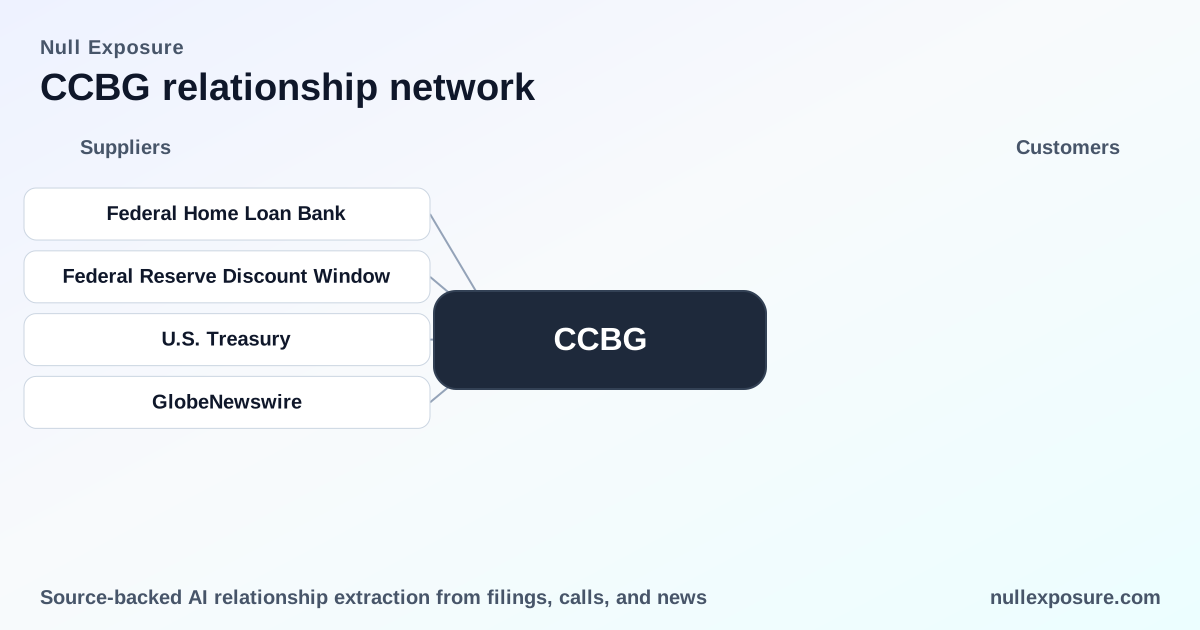
Capital City Bank Group (CCBG): Supplier relationships that anchor liquidity and operations
Capital City Bank Group is a regional bank that monetizes a classic banking spread: it funds operations primarily through customer deposits and selectively through short- and long-term borrowings, then invests in loans and securities to generate net interest income and fee revenue. Supplier relationships for CCBG are therefore concentrated where they affect liquidity and operational continuity — funding lines, central bank facilities, and information distribution — and those relationships materially influence balance-sheet flexibility and reputational reach. Learn how these supplier ties work in practice at https://nullexposure.com/.
How CCBG’s suppliers fit into the business model
CCBG’s core economics hinge on matching funding costs to asset yields while maintaining deposit stability and regulatory compliance. Suppliers here are not just vendors; they are funding sources (Federal Home Loan Bank, Federal Reserve facilities), guarantors of liquidity, and channels for corporate communications (press distribution). That mix creates a dual set of priorities for investors: preserve access to low-cost liquidity and limit operational vendor concentration that could interrupt customer-facing services.
The supplier map — one-line takeaways and sources
Below are every relationship surfaced in the review, each summarized in plain English with a concise source reference.
Federal Home Loan Bank (FHLB)
Capital City Bank Group reports the ability to access FHLB borrowings as an element of over $1.523 billion in incremental liquidity at December 31, 2025, while also reporting no outstanding advances from the FHLB at year-end 2025 — highlighting both membership access and conservative draw usage. Source: company fourth-quarter 2025 disclosures distributed via GlobeNewswire and a TradingView summary of the company's SEC reporting (January–March 2026).
Federal Reserve Discount Window
CCBG lists the Federal Reserve Discount Window among the formal backstop funding sources available to generate additional liquidity, described alongside federal funds lines and brokered deposits in its year-end liquidity statement. Source: company fourth-quarter 2025 results (press release distribution and news summaries, January 27, 2026).
U.S. Treasury (and government securities portfolio)
CCBG’s securities portfolio explicitly includes debt issued by the U.S. Treasury and other government agencies, indicating a conservative liquidity allocation into high-quality, sovereign instruments that support both earnings stability and regulatory liquidity ratios. Source: company fourth-quarter 2025 results as distributed on January 27, 2026 via GlobeNewswire.
GlobeNewswire (press distribution partner)
CCBG uses GlobeNewswire for official investor and earnings communications, including the January 27, 2026 fourth-quarter 2025 results release and earlier earnings announcements; this relationship supports investor transparency and consistent market messaging. Source: GlobeNewswire press releases (January 27, 2026; October 14, 2025).
What the constraints reveal about operating posture and counterparty risk
The extracted constraints illuminate the company-level characteristics of CCBG’s supplier relationships and operational posture:
-
Contracting posture — a mix of long-term and short-term commitments. The company records operating leases for branch locations with remaining terms up to 42 years, reflecting long-term fixed commitments for physical presence; funding is managed through a blend of short-term federal funds and long-term borrowings, indicating deliberate maturity matching in funding strategy.
-
Framework relationships govern critical services. CCBG calls out service level agreements and external vendor frameworks as potential single points of disruption; this signals standardized service contracts that are central to daily operations and are monitored at the enterprise level.
-
Counterparty concentration skews to government counterparties and large financial institutions. The portfolio includes U.S. Treasury and federal agency securities; regulatory membership in the FHLB of Atlanta creates direct reliance on a government-sponsored liquidity counterparty. (The FHLB is explicitly named in the company’s disclosures about regulatory compliance and borrowing sources.)
-
Materiality and criticality are recognized at the corporate level. Vendor failures are flagged as potentially material, which positions certain supplier relationships as mission-critical rather than commoditized.
These constraints combine into an operating signal: CCBG runs a conservative, bank-style supplier portfolio — long-lived infrastructure commitments and high-quality government funding sources coexisting with defined third-party service frameworks that are operationally material.
Implications for investors and operators
CCBG’s supplier mix produces a clear set of investment and operations implications:
-
Liquidity resilience is a strategic advantage. Access to FHLB borrowings and Federal Reserve facilities, plus a heavy allocation to U.S. Treasury securities, creates a resilient liquidity profile that supports lending and deposit volatility management.
-
Operational vendor risk is material. The firm’s emphasis on SLAs and service provider reliance signals a need for continuous vendor oversight; operational failures would have outsized reputational and financial impacts.
-
Funding flexibility without heavy draw usage. The company’s disclosure that there were no outstanding FHLB advances at year-end yet the ability to draw significant liquidity indicates prudent usage of backstops rather than dependence on them.
For deeper diligence on counterparty exposure and governance, visit https://nullexposure.com/ to see how supplier intelligence changes the investment equation.
Risks versus upside — what to watch in the quarter ahead
- Risk: Concentration in funding relationships means regulatory or market stress that affects FHLB or brokered deposit markets would compress CCBG’s options, even though current usage is moderate.
- Upside: Low interest-rate sensitivity on the securities sleeve (heavy U.S. Treasury and agency holdings) supports capital and interest income stability in turbulent markets.
- Operational watch: Vendor SLAs should be tracked in filings and earnings commentary — any escalation in third-party incidents would shift the risk profile quickly.
Bottom line and investor action items
Capital City Bank Group runs a classic regional banking model supported by high-quality government funding sources, conservative securities holdings, and durable physical infrastructure commitments. Supplier relationships are central to liquidity and operations; investors should prioritize disclosures about FHLB access, use of Federal Reserve facilities, and vendor risk governance in upcoming filings.
For periodic supplier-risk screens and to integrate these signals into your investment workflow, go to https://nullexposure.com/ and sign up for supplier-focused surveillance.