CCC Intelligent Solutions: supplier relationships, capital moves and what operators need to know
CCC Intelligent Solutions Holdings Inc. monetizes a data- and software-driven position at the intersection of auto repair, claims processing and insurance underwriting by licensing valuation and estimation tools and delivering cloud-native claims workflow software to insurers and body shops. Revenue is driven by recurring SaaS and data-licensing contracts plus transactional services; the company reported roughly $1.06 billion in trailing revenue with a healthy gross margin and an operating margin above 18% (TTM metrics). For investors and procurement teams evaluating CCC as a supplier or counterparty, the strategic picture is one of long-term contractual exposure, high commercial stickiness and active capital-market maneuvering.
Explore supplier intelligence at Null Exposure
How CCC makes money and why that matters to buyers and partners
CCC sells software and analytics that replace manual estimating, streamline repair workflows and standardize vehicle valuation across carriers and repair networks. The business model is subscription-centric, supported by licensing of proprietary data and periodic transaction fees for valuation and total-loss services. The company’s scale—over $1 billion in revenue and gross profit margin near 75%—creates a structural advantage when negotiating enterprise contracts with insurers that value continuity, accuracy and integration. CCC’s operating leverage shows through its positive operating margin and recurring revenue profile, which gives counterparties predictability but also creates dependence on long-term platform uptime and data licensing stability.
Contracting posture, concentration and maturity signals
Company filings make it clear that CCC maintains long-term agreements across licensing, outsourced data center, disaster recovery and SaaS arrangements that extend through 2031, signaling multi-year vendor commitments that drive predictable supplier spend and implementation cycles. According to the company’s SEC filing as of December 31, 2024, CCC disclosed future minimum obligations on supplier agreements totaling approximately $202.6 million (reported as $202,625 in thousands), which places the firm inside the $100M+ spend band for future contractual commitment. The firm’s role as a licensor of proprietary valuation data is explicit in disclosures, reinforcing its position as a critical upstream provider for insurers and repair vendors. These are company-level signals drawn from the most recent annual disclosures.
Who CCC works with — the relationships you should track
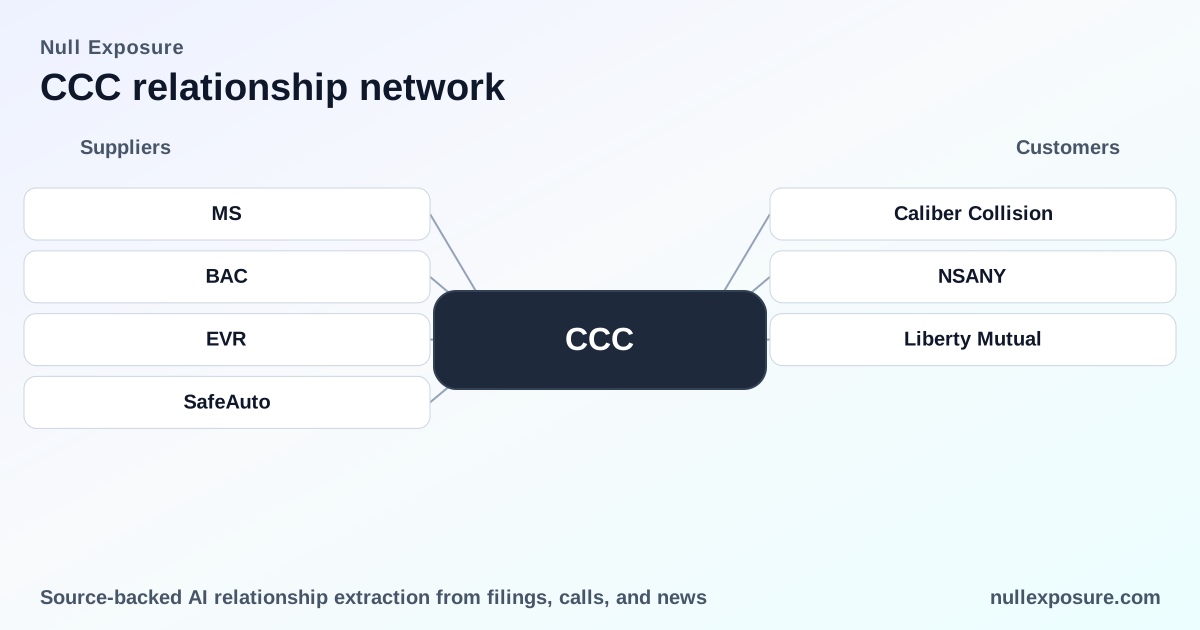
Below are the principal counterparties surfaced in recent reporting and filings. Each relationship is summarized in plain English with the source cited.
Morgan Stanley
Morgan Stanley is advising CCC in a strategic process as the company explores a possible sale, with the bank helping manage talks with potential acquirers and buyout firms. This engagement underscores a formal strategic review that concentrates decision-making and can accelerate change in ownership or capital structure (PE Insights, March 9, 2026 — pe-insights.com).
Bank of America
CCC authorized a new $500 million share repurchase program and executed a $300 million accelerated share repurchase (ASR) with Bank of America, signaling active capital redistribution to shareholders and a financing relationship with a major investment bank. The ASR transaction with Bank of America both reveals balance-sheet capacity and introduces an important counterparty for capital markets execution (Simply Wall St coverage, March 2026 — simplywall.st).
Evercore Group
Evercore Group served as a financial adviser to CCC in a prior transaction, reflecting a history of engaging top-tier advisory firms for strategic or transactional work. That prior advisory tie indicates CCC’s consistent use of boutique/independent advisory expertise in M&A or capital strategy (Insurance Journal reporting, February 3, 2021 — insurancejournal.com).
SafeAuto
In litigation and valuation contexts, CCC’s market valuation reports are being used by insurers and their subsidiaries; for example, a customer payment tied to a CCC valuation was reported in litigation involving SafeAuto. This illustrates that CCC’s valuation output is operationally embedded in claims settlements and legal outcomes, making its models commercially consequential for policyholders and insurers (Repairer Driven News, July 30, 2024 — repairerdrivennews.com).
What these relationships imply for risk, sourcing and ops
- Strategic review and potential ownership change: The Morgan Stanley engagement signals a deliberate review of strategic alternatives that could change supplier governance or contractual posture. A sale can bring renegotiation risk for long-term customers if a buyer seeks different margin or integration strategies.
- Capital return and balance-sheet choices: The $300M ASR with Bank of America and the $500M repurchase authorization communicate that management prioritizes shareholder returns and has access to capital markets counterparties—this reduces near-term insolvency risk but can constrain R&D or integration spending if buybacks remain a priority.
- Operational criticality: The SafeAuto example demonstrates that CCC outputs feed claims workflows and legal settlements, which elevates operational criticality; customers should expect high dependency on model accuracy, uptime and auditability.
- Contract maturity and spend concentration: Long-term contracts through 2031 and material future obligations place CCC in the role of a strategic licensor where switching costs are meaningful. Procurement teams should budget for multi-year arrangements and embed service-level and disaster-recovery clauses in master agreements.
Assess supplier concentration and counterparty health on Null Exposure
Practical takeaways for investors and operator buyers
- If you are an insurer or large repair network: treat CCC as a strategic vendor; negotiate strong SLAs, access to historical valuation outputs for audit, and clear change-of-control protections given the active M&A advisory activity.
- If you are an investor: the active capital-return program alongside sale advisory suggests management is optimizing both for near-term shareholder returns and strategic alternatives—monitor any buyer indications, as ownership change can reset growth priorities and margin targets.
- If you are a procurement professional: prepare for multi-year commitments and quantify the operational cost of switching given CCC’s deep embedment in claims workflows.
For a deeper supplier risk and concentration assessment, visit Null Exposure and request a tailored relationship brief: https://nullexposure.com/
Bottom line
CCC is a highly embedded licensor and SaaS provider in the auto-insurance ecosystem with significant contractual commitments and active capital-market activity that directly affects its supplier posture. Long-term agreements, material future obligations and engagement with top-tier financial advisers and banks create both stability and points of strategic inflection that investors and operators must monitor closely. For ongoing monitoring and counterparty analytics, explore Null Exposure’s supplier intelligence offerings: https://nullexposure.com/.