Cryo-Cell International (CCEL): Supplier Relationships, Contract Risk, and Strategic Implications
Cryo-Cell International operates a dual commercial model: it collects, processes and cryogenically stores umbilical cord blood stem cells for family use while monetizing through processing fees, recurring storage contracts and strategic asset acquisitions that expand its public cord blood inventory and distribution channels. Investors should value CCEL as a niche healthcare supplier with recurring revenue characteristics but concentrated manufacturing and contractual exposure that can rapidly swing financial outcomes. For a quick view of supply-chain and counterparty exposure, visit https://nullexposure.com/.
Why supplier relationships matter to CCEL’s valuation
CCEL’s business depends on two intertwined vectors: biological inventory access and reliable manufacturing of processing units. The company has grown inventory both organically and by acquisition, and it partners with external manufacturers and lenders to operate at scale. That combination creates three operating-model constraints investors must price into CCEL: legal/licensing complexity tied to university IP, supplier concentration for critical processing inputs, and funding covenant dynamics that shape cash flexibility.
- Contracting posture: CCEL holds at least one high-stakes license originating from a university counterparty and has amended bank credit arrangements, indicating active contract negotiation rather than passivity.
- Concentration and criticality: Management discloses dependence on a small set of manufacturers for the PrepaCyte CB units—this is a single-point supply risk for core processing capability.
- Maturity and financial exposure: The company has disclosed potential legal damages in excess of $100 million connected to licensing disputes; that level of exposure is large relative to CCEL’s reported market cap and cash flow profile.
These constraints are drawn from company disclosures and SEC filings. The licensing relationship with Duke University is explicit in CCEL’s filings; other supplier concentration signals are company-level disclosures. For further supplier intelligence, check https://nullexposure.com/ for structured coverage.
Supplier and counterparty entries investors should track
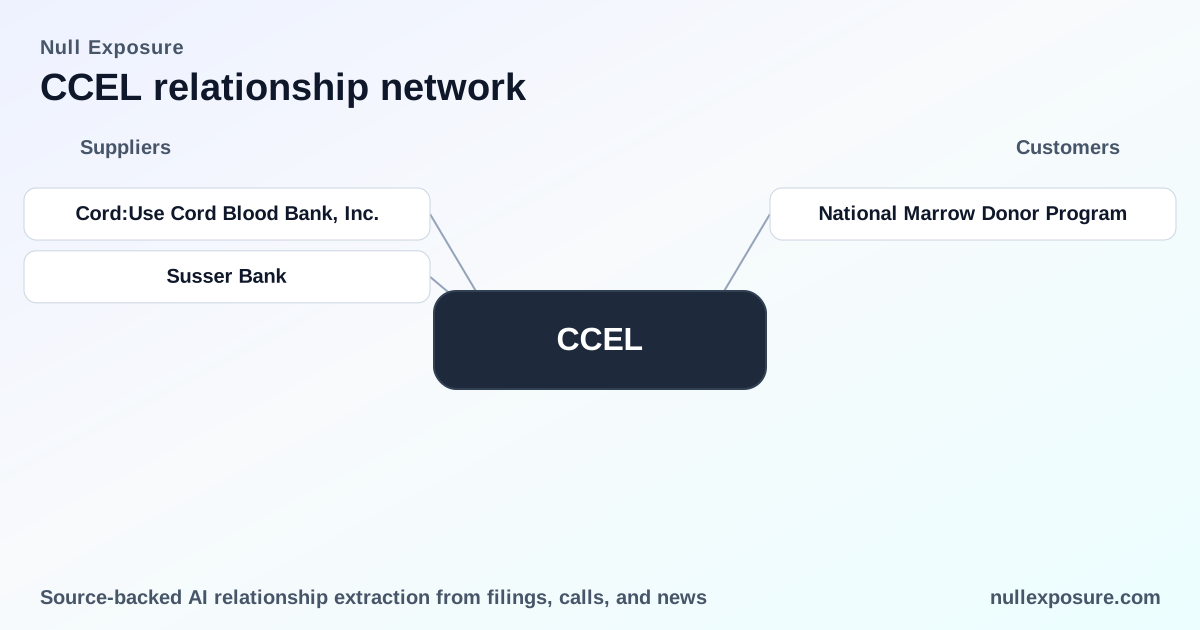
Cord:Use Cord Blood Bank, Inc.
Cryo-Cell acquired assets from Cord:Use to enhance its public cord blood inventory, emphasizing increased ethnic diversity and distribution through the National Marrow Donor Program; this transaction augments CCEL’s public inventory and its positioning in transplant supply channels (TradingView recap of CCEL SEC 10‑K, FY2026).
Susser Bank
SEC filings captured on StockTitan (FY2026) record amendments to CCEL’s Credit Agreement with Susser Bank, signaling active lender negotiations that affect liquidity, covenants and short-term financing capacity (StockTitan capture of CCEL SEC filings, FY2026).
(These two relationships are the supplier/counterparty links surfaced in the latest relationship extraction; the company’s larger contract profile is described below.)
What each relationship implies for operations and margins
Cord:Use asset acquisition is a strategic inventory play. By folding Cord:Use’s public units into CCEL’s repository and using the National Marrow Donor Program for distribution, CCEL improves utilization potential of its inventory and broadens clinical reach — a direct route to incremental revenue without incremental manufacturing capacity. The immediate implication is better inventory leverage and improved unit economics for public bank operations (TradingView, FY2026 SEC 10‑K summary).
Susser Bank’s amended credit agreement is a financing signal. Amendments to bank facilities typically accompany covenant drift, liquidity smoothing or refinancing; for CCEL, this indicates the company is actively managing near-term financing terms rather than relying solely on operating cash flow. Investors should treat the Susser relationship as critical to short-to-medium term working capital (StockTitan SEC filing capture, FY2026).
Constraints that shape CCEL’s supplier strategy
-
Duke License — explicit IP relationship: CCEL disclosed entering a Patent and Technology License Agreement effective February 23, 2021, under which Duke University granted CCEL an exclusive license to certain products and processes with sublicense rights. The filing also details counterclaims and litigation posture, and the company has notified Duke that it believes damages could exceed $100 million; the company acknowledges that an unfavorable resolution could negatively and materially impact the business (Company SEC filing / Duke License Agreement text, effective 2021; company disclosure in FY2026 filing).
Implication: IP and litigation risk is a material operating lever. The license underpins certain product rights, and large asserted damages introduce a tail risk to equity valuation and to any revenue streams tied to the licensed technology.
-
Supplier concentration for PrepaCyte CB units: Management discloses dependence on three suppliers for the supply and manufacturing of PrepaCyte CB units. That is a clear operational concentration and a source of execution risk if any single supplier fails to perform.
Implication: Manufacturing interruptions would directly constrain processing throughput and revenue; investors should model sensitivity of revenue to supply outages.
-
Materiality and spend-band signal: The company represents potential damages in excess of $100 million related to litigation—a sum far larger than CCEL’s reported EBITDA and comparable to market capitalization. This is a company-level financial exposure signal that must be treated as a potential balance-sheet shock in downside scenarios.
These constraints together create a profile where contractual rights, manufacturing continuity, and financing arrangements are the principal drivers of near-term investor outcomes.
Practical watchlist for investors
- Legal docket updates on the Duke license and any counterclaim resolution; monitor filings for indemnity provisions and potential settlements that would crystallize the >$100M exposure.
- Operational continuity for PrepaCyte CB manufacturing: track disclosures naming suppliers, any single-source stopgaps, and inventory burn-rate metrics.
- Bank covenant language and maturity timetables tied to Susser Bank amendments; covenant waivers or tighter terms materially change liquidity runway.
- Integration performance of Cord:Use assets — assess conversion of additional public inventory into transactable revenue via the National Marrow Donor Program.
Bottom line and action items
Cryo-Cell is a focused storage-and-processing supplier with recurring revenue upside from inventory expansion but with concentrated counterparty and legal risk that materially affects valuation. Investors evaluating CCEL should price three risk buckets into models: IP litigation exposure (Duke license), manufacturing concentration for PrepaCyte CB units, and near-term financing dynamics (Susser Bank amendments).
If you want a concise supplier-risk report and ongoing monitoring for CCEL and comparable small-cap healthcare suppliers, visit https://nullexposure.com/ for tailored coverage and alerts.
For portfolio managers and operators, the immediate practical move is to stress-test CCEL under scenarios that include a manufacturing outage and a legal settlement in the >$100M range; both are plausible given the company’s own disclosures. For continuing coverage and supplier relationship intelligence, see https://nullexposure.com/.
Key takeaway: CCEL’s commercial upside is real, but its valuation is dominated by a small number of high-impact supplier and contract relationships — those are the levers that will determine whether growth translates into durable shareholder value.