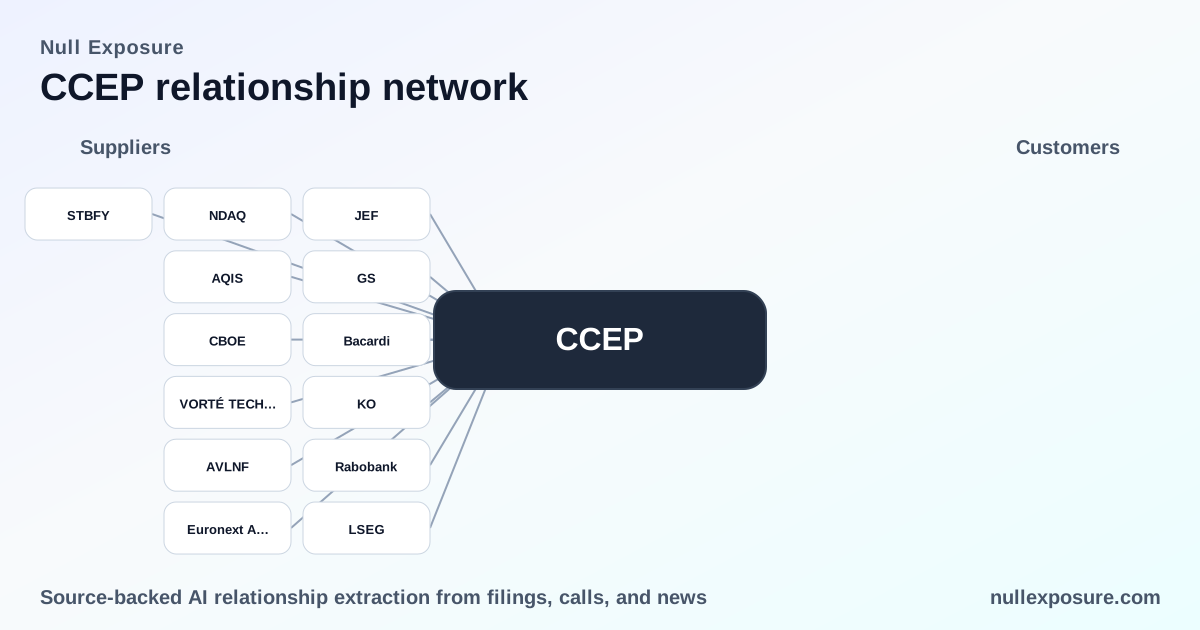
CCEP Supplier Landscape: Who Powers Coca‑Cola Europacific Partners?
Coca‑Cola Europacific Partners (CCEP) is the downstream execution arm for global beverage brands: it manufactures, bottles, distributes and sells ready‑to‑drink non‑alcoholic beverages under franchise or distribution agreements, and monetizes through retail sales, distribution margins, category management services and targeted channel pricing. Revenue flows come from unit volumes, route‑to‑market premiums and value‑added services (co‑marketing, logistics), supplemented by balance‑sheet actions such as coordinated share buybacks. For a structured view of supplier risks and counterparty exposure, visit https://nullexposure.com/.
How CCEP’s operating model shapes supplier risk and bargaining power
CCEP operates as a high‑volume, capital‑intensive bottler with a franchisor relationship at its core. The company’s key characteristics for investors are:
- Contracting posture: CCEP functions primarily as a franchisee and regional bottler — contracts with brand owners (notably The Coca‑Cola Company) determine product portfolios and marketing obligations, while CCEP controls manufacturing, logistics and customer execution.
- Concentration and criticality: The Coca‑Cola Company relationship is strategically critical; the brand‑franchisor split concentrates strategic risk even as CCEP retains operational leverage in distribution and retail execution.
- Maturity and diversification: CCEP shows mature market footprints (Europe + Asia‑Pacific) and is actively shifting local distribution partners (e.g., Bacardi replacing Suntory in Australia), which reduces single‑counterparty operational concentration over time.
- Financial plumbing and counterparties: CCEP uses major investment banks to execute capital returns and liquidity programs, and leverages supply‑chain finance with Rabobank to influence supplier ESG behavior and working capital.
No explicit supplier constraints were provided in the source set; this absence is itself a company‑level signal that public reports emphasize programmatic partner actions (buybacks, supply‑chain finance, distribution changes) rather than hard contractual disclosures. For deeper counterparty scoring, review the full supplier map at https://nullexposure.com/.
Supplier relationships: concise line‑by‑line exposure
Below are every supplier/partner relationship captured in the public results, each summarized in plain language with source attribution.
Jefferies International Limited
CCEP reported purchases of ordinary shares executed on London trading venues that included 25,000 shares purchased from Jefferies International Limited as part of the company’s buyback disclosures. (ActusNews, Transactions in Own Shares notice, 9 Dec 2025: https://www.actusnews.com/en/amp/coca-cola-europacific/pr/2025/12/09/transactions-in-own-shares)
Goldman Sachs & Co. LLC
CCEP confirmed that on 25 February 2026 it bought 105,000 ordinary shares on US trading venues and 54,879 on London venues from Goldman Sachs & Co. LLC, indicating GS’s role as principal liquidity provider for the buyback programme. (Reuters/Stockopedia report, 26 Feb 2026: https://www.stockopedia.com/share-prices/coca-cola-europacific-partners-LON:CCEP/news/reg-coca-cola-ep-plc-transactions-in-own-shares-urn:newsml:reuters.com:20260226:nRSZ4458Ua/)
Bacardi
CCEP announced a new multi‑year distribution agreement with Bacardi for premium spirits and ARTD brands in Australia, which began towards the end of the fiscal year and replaced prior arrangements. (CCEP FY2025 financial results, company site: https://www.cocacolaep.com/news-and-stories/ccep-fy-2025-financial-results/)
Goldman Sachs & Co. LLC and Goldman Sachs International (programme arrangement)
CCEP disclosed an arrangement with Goldman Sachs & Co. LLC and Goldman Sachs International to enable purchases of ordinary shares across both US and London trading venues as part of the initial period of its buyback programme. (Reuters/Stockopedia, 17 Feb 2026: https://www.stockopedia.com/share-prices/coca-cola-europacific-partners-LON:CCEP/news/urn:newsml:reuters.com:20260217:nRSQ2405Ta/)
Jefferies LLC
On 8 December 2025 CCEP confirmed the purchase of 36,515 ordinary shares on US trading venues from Jefferies LLC, showing multiple Jefferies entities executing share transactions for CCEP. (ActusNews, Transactions in Own Shares notice, 9 Dec 2025: https://www.actusnews.com/en/amp/coca-cola-europacific/pr/2025/12/09/transactions-in-own-shares)
Goldman Sachs International
Goldman Sachs International was specifically named as a seller in the coordinated buyback activity, reinforcing the dual‑entity execution model (US and international GS affiliates) used by CCEP for market liquidity. (Reuters/Stockopedia, 26 Feb 2026: https://www.stockopedia.com/share-prices/coca-cola-europacific-partners-LON:CCEP/news/reg-coca-cola-ep-plc-transactions-in-own-shares-urn:newsml:reuters.com:20260226:nRSZ4458Ua/)
The Coca‑Cola Company (KO)
Industry coverage and CCEP filings underline the franchisor‑bottler split: The Coca‑Cola Company focuses on concentrate and brand strategy, while CCEP handles bottling, distribution and last‑mile availability across its territories. (Ad‑Hoc News analysis, FY2026 commentary: https://www.ad-hoc-news.de/boerse/ueberblick/coca-cola-europacific-partners-quiet-rally-big-cash-story-for-us/68613105; Globe and Mail press release summary, FY2026: https://www.theglobeandmail.com/investing/markets/stocks/CCEP/pressreleases/37131306/)
Rabobank
CCEP is expanding a supply‑chain finance programme with Rabobank that incentivizes suppliers to improve ESG performance, demonstrating active use of working‑capital instruments to drive supplier behavior. (CCEP supply chain update, FY2025: https://www.cocacolaep.com/news-and-stories/a-grade-supply-chain-action-at-ccep/)
VORTÉ TECHNOLOGIES
CCEP highlighted a prototype from VORTÉ TECHNOLOGIES as an example of partner innovation being piloted to improve supply‑chain performance. (CCEP supply chain feature, FY2025: https://www.cocacolaep.com/news-and-stories/a-grade-supply-chain-action-at-ccep/)
Avalo (AVLNF)
CCEP stated it is piloting breakthrough technology with Avalo to reduce supply‑chain emissions, reflecting procurement emphasis on decarbonization partners. (CCEP supply chain feature, FY2025: https://www.cocacolaep.com/news-and-stories/a-grade-supply-chain-action-at-ccep/)
The Coca‑Cola Company (TCCC) — contractual/franchisor note
SEC‑style filings reviewed by Stocktitan referenced the strategic relationship with TCCC and other franchisors, noting this dynamic as a governance and shareholder discussion point in FY2026. (SEC current report (6‑K) summary on Stocktitan, FY2026: https://www.stocktitan.net/sec-filings/CCEP/6-k-coca-cola-europacific-partners-plc-current-report-foreign-issuer-81d369cb6c36.html)
London Stock Exchange / Nasdaq / Aquis / CBOE Europe Limited
CCEP’s €1bn coordinated buyback programme was designed to run across multiple trading venues — Nasdaq and other US venues plus the London Stock Exchange, CBOE Europe Limited (BXE/CXE) and Aquis — indicating a multi‑market execution strategy to optimise liquidity. (Reuters/Stockopedia, preliminary results, 17 Feb 2026: https://www.stockopedia.com/share-prices/coca-cola-europacific-partners-LON:CCEP/news/urn:newsml:reuters.com:20260217:nRSQ2405Ta/)
Euronext Amsterdam
CCEP confirmed listing and trading arrangements that include Euronext Amsterdam as part of its multi‑exchange presence, relevant to investor access and trading liquidity. (Company listing disclosure in Reuters/Stockopedia, FY2026: https://www.stockopedia.com/share-prices/coca-cola-europacific-partners-LON:CCEP/news/urn:newsml:reuters.com:20260217:nRSQ2405Ta/)
Suntory
CCEP reported the exit of Suntory alcohol distribution in Australia mid‑year, which created capacity for TCCC portfolio expansion and the subsequent Bacardi distribution agreement. (CCEP FY2025 financial results, company site: https://www.cocacolaep.com/news-and-stories/ccep-fy-2025-financial-results/)
Investment implications and where the risk lives
- Operationally critical relationships: The Coca‑Cola Company franchise is the single largest strategic dependency and the main determinant of product mix and promotional spend; supplier shifts (Suntory → Bacardi) illustrate active portfolio rebalancing at the regional level.
- Market execution partners: Major banks (Goldman Sachs, Jefferies) act as principal execution agents for capital returns, meaning buyback execution risk and timing are outsourced to large counterparties — a liquidity risk lever for investors.
- Supply‑chain leverage: Rabobank’s supply‑chain finance scheme gives CCEP financial tools to influence supplier behavior and ESG performance, a positive for operational resilience and reputational risk control.
- Innovation and decarbonization: Pilots with VORTÉ and Avalo signal a procurement strategy that funds early‑stage partners to reduce emissions and logistics cost, which is consistent with margin protection and regulatory compliance goals.
For a detailed counterparty risk scorecard and premium finance implications, see our platform at https://nullexposure.com/.
Bottom line: where to focus diligence
CCEP is a mature bottler with high operational leverage to brand franchisors and structured use of financial markets for capital allocation. Investors evaluating supplier relationships should prioritize diligence on franchise terms with TCCC, the operational scale‑up following distribution changes in Australia, and counterparties executing buybacks and supply‑chain finance. Those three vectors—franchisor contracts, distribution partner stability, and financial counterparties—drive near‑term upside and downside for equity holders.
Explore an expanded supplier risk map and counterparty analytics at https://nullexposure.com/ to convert this overview into investment action.