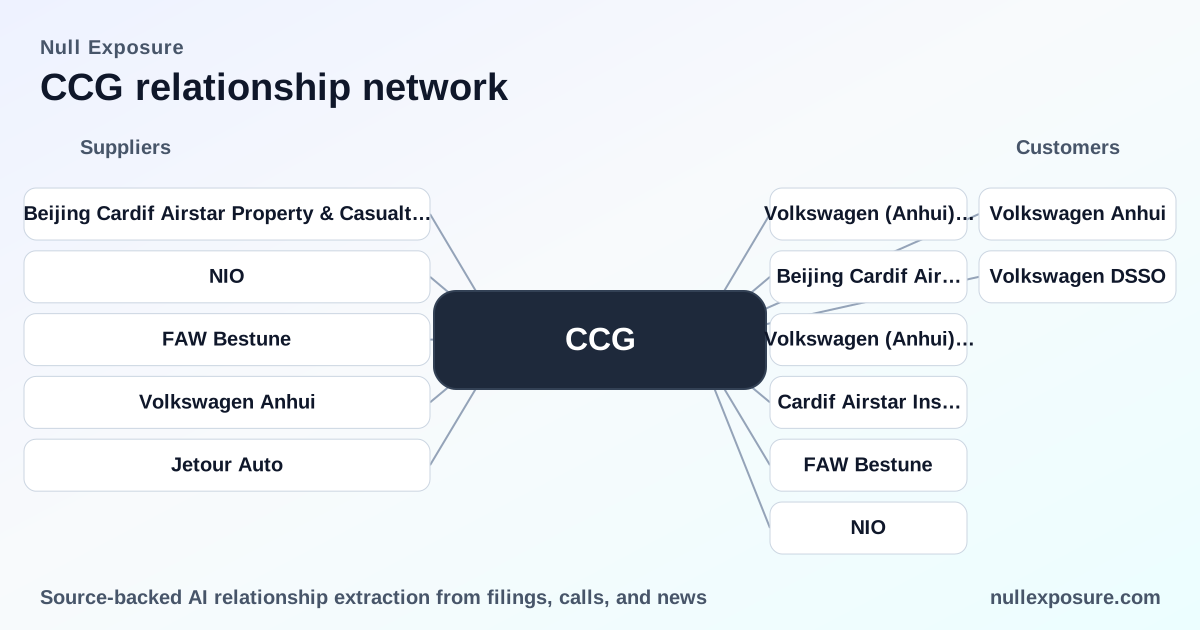
Cheche Group (CCG): Supplier relationships that underwrite its distribution engine
Cheche Group operates as a distribution-first fintech and embedded insurance platform, monetizing by licensing its embedded insurance SaaS, capturing platform fees and revenue-share from policies placed through partner channels, and selling digital one‑stop solutions to insurers and OEMs to drive customer acquisition and ancillary insurance revenues. For investors and operators, the supplier list is a direct read on distribution scale, integration risk, and where incremental monetization will land.
If you want a clean supplier map and risk scoring for CCG, visit https://nullexposure.com/ for more analysis.
How Cheche actually makes money and why suppliers matter
Cheche’s business model is partner-dependent: its technology and distribution are sold into two classes of partners — insurance underwriters that supply product and capital, and original equipment manufacturers and dealership channels that supply customer flow. Revenue is generated through platform licensing, integration/implementation fees, and shares of insurance premium economics when policies are distributed through embedded workflows. Public filings and recent press activity show Cheche is executing commercial rollouts in 2025–2026 rather than running pilots, so supplier relationships are both distribution levers and risk focal points.
The company’s public metrics reinforce this operating posture: Revenue TTM ~3.18 billion, slim gross margins (gross profit ~162 million) and negative operating cash flow metrics indicative of an early-commercial growth phase where partner growth must scale faster than operating leverage.
The partner roster — who Cheche is integrating with (and why that matters)
Below are every supplier relationship reported across the available news coverage and filings, with a concise investor-facing takeaway and the original source noted.
Beijing Cardif Airstar Property & Casualty Insurance Co., Ltd.
Cheche will supply its embedded insurance SaaS and one‑stop digital solution while Cardif Airstar provides product design and underwriting — a classic distribution-underwriter split that lets Cheche monetize its platform without holding insurance risk. According to a March 2026 company announcement on Yahoo Finance, Cardif Airstar will provide underwriting services while Cheche delivers the digital integration (Yahoo Finance, Mar 9, 2026).
NIO
Cheche has deepened an insurance partnership with NIO tied to the automaker’s delivery and ownership journey, positioning the platform as a channel for high-value EV customers. StockTitan coverage documenting a FY2026 partnership update highlighted expanded NIO insurance collaboration alongside accelerating NIO deliveries (StockTitan, FY2026).
FAW Bestune
FAW Bestune integrated Cheche’s insurance workflows into its digital delivery stack, enabling insurance offers directly inside vehicle purchase and delivery processes — a distribution move that increases attach rates on vehicle sales. A StockTitan report from FY2026 described a December partnership launch integrating insurance into the digital delivery workflow (StockTitan, FY2026).
Volkswagen Anhui
Cheche expanded services with Volkswagen Anhui to support risk management for new-energy vehicles (NEVs), indicating productization for fleet and manufacturer-level risk workflows beyond point-of-sale insurance. StockTitan coverage in FY2026 noted a September partnership expansion focused on NEV risk management services (StockTitan, FY2026).
Jetour Auto
Cheche was selected to power Jetour Auto’s digital insurance rollout, reinforcing the company’s role as the embedded distribution engine across multiple OEMs rather than a single-manufacturer solution. Insurance Business Magazine reported the digital insurance rollout relationship in FY2025 (Insurance Business Asia, FY2025).
What the relationship mix signals about operating constraints
There were no supplier-specific constraints explicitly reported in the collected materials; that absence is itself a company-level signal. From the relationship set and public metrics, the following operating model characteristics are clear and germane to supplier risk analysis:
- Contracting posture: Partner- and OEM-facing commercial contracts focused on SaaS delivery and revenue-share arrangements rather than balance-sheet underwriting. This places negotiation leverage with larger OEMs and tier-one insurers.
- Concentration: The roster shows a small number of major OEM relationships (NIO, FAW Bestune, Volkswagen Anhui, Jetour) — concentration risk is elevated because a handful of partners supply much of the distribution runway.
- Criticality: Supplier integrations are critical for policy placement and revenue capture; disruptions or slow integrations directly reduce premium flow and platform monetization.
- Maturity: The presence of multiple FY2025–FY2026 rollouts signals early-commercial scale rather than pilot-stage experimentation; revenue recognition should reflect active deployments but profitability depends on scale and pricing discipline.
If you want a side‑by‑side comparison of partner exposure and contract maturity, check the supplier intelligence hub at https://nullexposure.com/ for structured reports.
Investment implications — what investors and operators should watch
- Upside: Cheche’s model leverages OEM customer flows to scale policy distribution efficiently; successful execution across the reported OEMs expands addressable premiums without taking underwriting risk.
- Key risk: Partner concentration and integration execution are single points of failure — missed delivery integrations or adverse contract repricing with a major OEM could meaningfully compress revenue growth.
- Regulatory and insurer counterparty risk: Because Cheche distributes insurance products but does not underwrite them, insurer counterparty stability and regulatory oversight of embedded distribution are critical to long-term economics.
- Operational cadence: Watch quarter-to-quarter announcements for new OEM rollouts, expansion of underwriting partners, and any disclosures on revenue-share economics or platform pricing.
Major takeaway: Cheche’s supplier map shows deliberate scaling through OEM and insurer partnerships, providing a credible path to monetization — but success is binary at the partner level: integrations either unlock recurring premiums or leave the platform underutilized.
If you’re evaluating exposure or sourcing partners for an embedded insurance program, the supplier profiles and risk scores are available at https://nullexposure.com/ to support due diligence.
Next steps for investors and operators
Request contract-level disclosure on revenue-share economics, integration SLAs, and customer attach rates for each OEM. Monitor quarterly partner announcements — particularly any changes to underwriting partners or material expansions with automakers — as the clearest leading indicators of revenue trajectory.
Bottom line: Cheche is an embedded distribution platform executing commercial rollouts with tier-one insurers and automakers; its growth path depends on scaling those supplier relationships while controlling concentration and integration risk.
For detailed partner-by-partner exposure analytics and risk scoring, visit https://nullexposure.com/ to download supplier profiles and decision-ready intelligence.