Cohen Circle Acquisition Corp. II (CCII): What investors should know about its supplier relationships
Cohen Circle Acquisition Corp. II (CCII) is a special purpose acquisition company that raised capital through an initial public offering and monetizes by combining that trust capital with a target private company in a business combination. CCII generates value by underwriting and listing equity units, then deploying the proceeds through a merger or acquisition that converts public capital into equity stakes in an operating business. Its current profile is typical of a SPAC: no operating revenue, a market capitalization driven by market sentiment and trust-account holdings, and a shareholder base dominated by institutions.
If you evaluate financial counterparties and exchange relationships as drivers of transaction execution risk and market access, this brief review isolates the actual supplier links disclosed in public coverage and what they imply for deal execution. For deeper monitoring and counterparty mapping, visit the NullExposure homepage: https://nullexposure.com/.
Market context and the commercial model CCII completed a conventional SPAC IPO in mid‑2025, listing units and subsequently splitting securities to provide public liquidity for both common shares and warrants. The company’s economics are concentrated on successfully identifying and closing a business combination within the SPAC timeline and on the reputation and execution capability of its underwriting and listing partners. Deal execution hinges on three commercial vectors: the underwriter(s) who place the IPO, the exchange where liquidity is provided, and the sponsor/management team that sources targets.
Key company-level signals investors should note
- High institutional ownership (85.4%) indicates ownership concentration and suggests limited retail float and potentially tighter post-deal price dynamics.
- Minimal insider ownership (1.71%) signals that sponsor control is operational rather than equity-heavy; governance incentives depend on sponsor economics rather than large insider share blocks.
- No operating revenues and negative book value per share (‑0.256) reflect the SPAC shell profile: value is latent and depends on a successful merger and subsequent operating performance.
- Critical suppliers are concentrated and mission-critical: underwriters and the listing exchange directly influence capital raising, secondary liquidity, and timeline execution.
If you want a consolidated supplier intelligence view on CCII and comparable SPACs, consider tracking counterparties through NullExposure: https://nullexposure.com/.
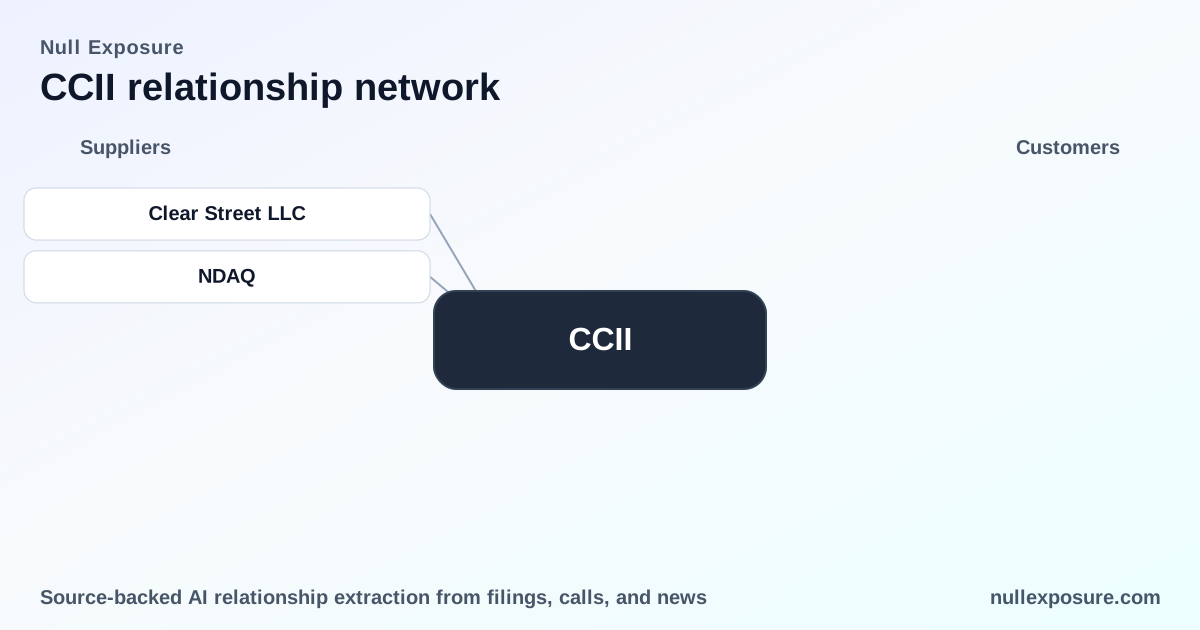
Supplier relationships reported in public coverage Below are every supplier relationship captured in available coverage and what each link means for execution and liquidity.
Clear Street LLC
Clear Street served as the sole book‑running manager for CCII’s offering, a central role that handled syndication and pricing of the IPO. Using a single book‑runner concentrates execution risk but can accelerate cohesion in pricing and allocations. (source: GlobeNewswire press release reported by The Manila Times, July 3, 2025 — https://www.manilatimes.net/2025/07/03/tmt-newswire/globenewswire/cohen-circle-acquisition-corp-ii-completes-253-million-initial-public-offering/2142899)
Nasdaq (exchange listing of units)
The company’s units began trading on the Nasdaq Global Market under the ticker CCIIU on July 1, 2025, providing initial secondary market access for public investors. Early liquidity through Nasdaq supported institutional placement and immediate tradability of securities issued at IPO. (source: GlobeNewswire press release reported by The Manila Times, July 3, 2025 — https://www.manilatimes.net/2025/07/03/tmt-newswire/globenewswire/cohen-circle-acquisition-corp-ii-completes-253-million-initial-public-offering/2142899)
Nasdaq Global Market (separate trading of Class A shares and warrants)
CCII announced the separate trading of its Class A ordinary shares and warrants on the Nasdaq Global Market, with those securities trading under CCII and CCIIW respectively beginning August 22, 2025 — a standard SPAC operational step to provide distinct instruments for equity and warrants. Separating units into discrete securities increases tradability and enables clearer price discovery for equity and derivative components. (source: FinancialContent / Markets article, August 18, 2025 — https://markets.financialcontent.com/stocks/article/gnwcq-2025-8-18-cohen-circle-acquisition-corp-ii-announces-the-separate-trading-of-its-class-a-ordinary-shares-and-warrants-commencing-august-22-2025)
Implications for investors and operators Underwriting and listing partners directly shape CCII’s ability to raise capital, maintain market liquidity, and deliver timely deal execution. Clear Street’s role as sole book‑runner places execution leverage in one firm’s hands; Nasdaq membership provides standard market access and listing rules that constrain timing and disclosure. Given CCII’s SPAC profile, these relationships are both strategically important and operationally routine — they are necessary enablers rather than differentiators of long‑term value.
Risk considerations and operational constraints
- Concentration risk: single-book‑runner arrangements increase execution concentration and create a single point of relationship failure if market conditions sour.
- Liquidity and float: with high institutional ownership and low insider stakes, post‑deal price moves will reflect institutional flows and secondary market sentiment more than insider signaling.
- Maturity and criticality: CCII is at a pre‑combination stage with no operating revenue; its critical suppliers are capital markets intermediaries (underwriters, exchanges) and therefore business continuity is tied to financial market access rather than operational supply chains.
For a vendor‑level intelligence product that tracks the underwriting and exchange relationships across multiple SPACs, explore our platform: https://nullexposure.com/.
What this means for deal diligence and counterparty selection When performing diligence on a SPAC like CCII, prioritize the following operational checks: the reputation and recent deal track record of the underwriter, the listing status and any exchange conditions attached to securities, and the sponsor’s commitment timeline toward completing a business combination. Supplier due diligence should be treated as a core part of transaction risk assessment — the underwriter and exchange are execution partners, not mere service providers.
Final perspective and next steps CCII’s supplier map in public reporting is compact and indicates a traditional SPAC setup: a single book‑running manager and Nasdaq-listed securities that were split to improve liquidity. Execution risk is concentrated but visible; the variables that will create value for investors are sponsor selection of targets and the ability of capital markets partners to support transaction timing and aftermarket liquidity.
For ongoing supplier monitoring and to compare CCII’s counterparties with peers, visit NullExposure and request a tailored report: https://nullexposure.com/.