Churchill Capital Corp IX (CCIX): supplier relationships and what they mean for investors
Churchill Capital Corp IX operates as a special purpose acquisition company (SPAC) that raises capital through an IPO, places proceeds in a trust account, and monetizes via transaction-related fees and sponsor/advisor arrangements upon closing a business combination. Revenue and realized upside depend entirely on completing a merger; meanwhile CCIX funds ongoing operations through sponsor reimbursements, advisory retainers, and contingent transaction fees tied to deal close. For investors evaluating supplier exposure, the relevant signal is not traditional operating vendor spend but a concentrated, deal-driven supplier ecosystem where a handful of advisors and service providers capture outsized contingent and recurring fees.
If you want a quick institutional view of CCIX supplier structures and contractual signals, start with our overview at https://nullexposure.com/.
How CCIX’s commercial plumbing converts capital into value
CCIX’s business model is straightforward: raise capital via a public listing, hold proceeds in trust, and execute a business combination that triggers deferred underwriting fees, advisor fees, and settlement of vendor invoices. Key monetization levers are contingent — deferred underwriter fees and advisor transaction fees — and fixed operating reimbursements to sponsors while the SPAC searches for a target. That creates two investor implications: (1) counterparty importance concentrates on a small set of financial and governance advisers, and (2) cash burn and contingent obligations are highly visible on the balance sheet and proxy materials.
Early-stage contract posture is mostly standard for SPACs: service agreements with contingency clauses, monthly reimbursements to sponsors, and performance-based premium payments to advisers. These terms align incentives for deal completion while increasing execution risk if counterparties are paid only on consummation.
Who CCIX uses for capital markets and proxy support (the relationships)
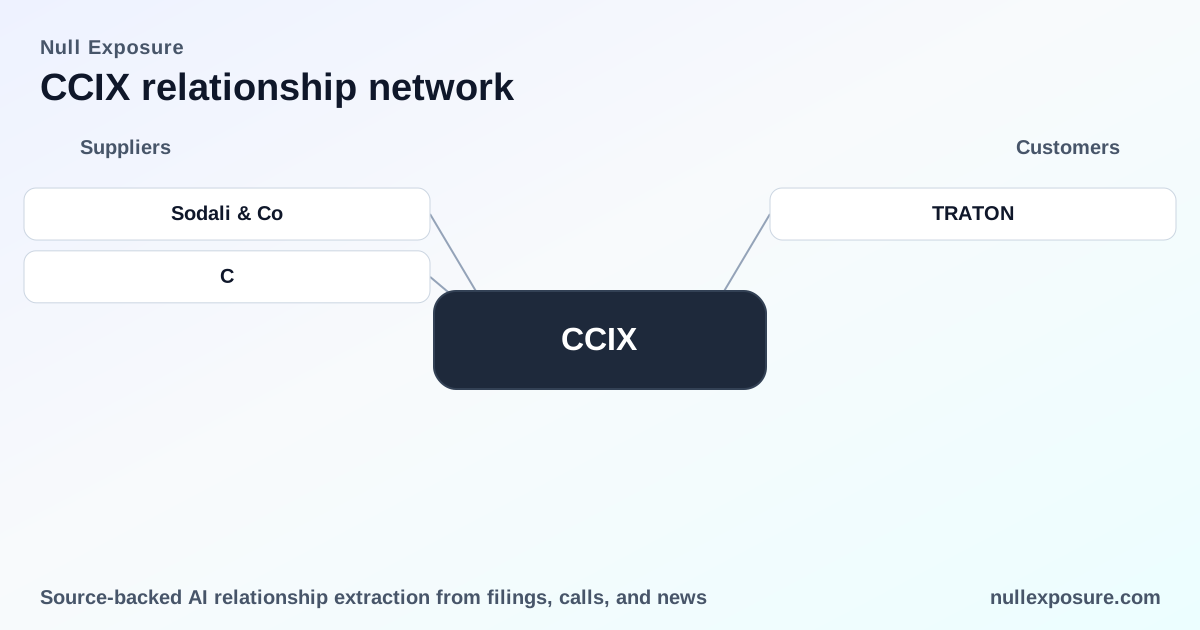
CCIX’s supplier map in public filings and news reports highlights two named professional service providers: Sodali & Co and Citigroup Global Markets Inc. Both play distinct roles in the lifecycle of a SPAC transaction.
Sodali & Co — proxy solicitation and shareholder communications
Sodali & Co acts as CCIX’s proxy solicitor, handling shareholder communications and voting logistics for extraordinary general meetings. According to an AIJourn notice on March 9, 2026, investors were instructed to contact Sodali for voting information and assistance (AIJourn, 2026-03-09; https://aijourn.com/churchill-capital-corp-ix-reschedules-date-of-extraordinary-general-meeting/). This is a governance-critical supplier because proxy solicitation affects vote outcomes that determine whether contingent fees and combination proceeds are released.
Citigroup Global Markets Inc. — capital markets advisory
Citigroup Global Markets Inc. has been engaged under an advisory agreement to provide capital markets advisory services for CCIX’s transaction. TradingView reported on March 9, 2026, that CCIX disclosed the advisory arrangement in its SEC filing for FY2026 (TradingView, FY2026; https://www.tradingview.com/news/tradingview:3f8acd4a8da47:0-churchill-capital-corp-ix-cayman-sec-10-k-report/). Citigroup’s role is commercially material because it influences financing strategy and market execution; advisory mandates of this sort are typically compensated via cash retainer or transaction fees that scale with deal size.
What the contractual constraints say about CCIX’s operating model
CCIX’s public disclosures show a supplier posture dominated by contingent, transaction-tied payments and modest ongoing operating reimbursements. These excerpts from company filings surface several company-level signals:
- Contracting posture: The firm relies on standard SPAC structures — deferred underwriting fees (3.5% of IPO proceeds equating to roughly $10.06 million if over-allotment is exercised), contingent advisor premiums payable at closing, and monthly reimbursements to sponsor affiliates for office and support services. These terms prioritize alignment with deal close over fixed-cost contracting.
- Spend concentration and criticality: Spend is concentrated in high-impact advisory relationships (underwriters, capital markets advisors, legal and due diligence providers) rather than a broad vendor base. A small number of suppliers capture most of the economic value tied to a successful combination, making counterparty risk concentrated and mission-critical.
- Maturity and cadence: Many fees are contingent and episodic — large payments occur at merger close — while smaller recurring costs (e.g., $30,000 per month to a sponsor affiliate for office support) fund day-to-day operations until a combination is achieved. The company also carries a secured borrowing facility (WCL Promissory Note) with available capacity, indicating short-term liquidity options.
- Spend bands: Documented items range from monthly reimbursements (hundreds of thousands annually) to single-digit million due-diligence and legal engagements and double-digit million deferred underwriting fees, reflecting a mix of operating and large contingent transaction costs.
Collectively these constraints point to an operating model where execution and counterparty reliability around the business combination are the primary investment risks, while routine operating costs are predictable and modest.
If you want a consolidated supplier risk brief for CCIX, request a tailored report at https://nullexposure.com/.
Investment implications — what to watch as an investor or operator
- Concentration risk is high. The SPAC model funnels economic exposure into a handful of advisers and underwriters; a dispute or performance failure with those counterparties has outsized impact on a transaction timeline and cash outcomes.
- Contingent liabilities drive valuation sensitivity. Deferred fees and premium payments that are only paid on closing mean that valuation and net proceeds to holders depend heavily on successful vote outcomes and regulatory clearances.
- Operational spend is manageable but visible. Monthly sponsor reimbursements are material at scale (e.g., $30,000/month), and several mid-range engagements (due diligence, legal work) have incurred multi-hundred-thousand to multi-million dollar bills that become payable on consummation.
Bottom line and next steps
CCIX is a classic SPAC supplier footprint: concentrated, transaction-dependent, and dominated by high-stakes professional services rather than broad vendor relationships. Investors should prioritize monitoring proxy solicitation activity, advisor mandates, and the status of contingent fee obligations as proximate indicators of deal health.
For a deeper supplier risk analysis and ongoing monitoring of SPAC service relationships, visit https://nullexposure.com/ and request the CCIX supplier dossier.
Key takeaway: track vote mechanics and adviser performance — they are the operational levers that convert CCIX’s trust-account capital into realized shareholder value.