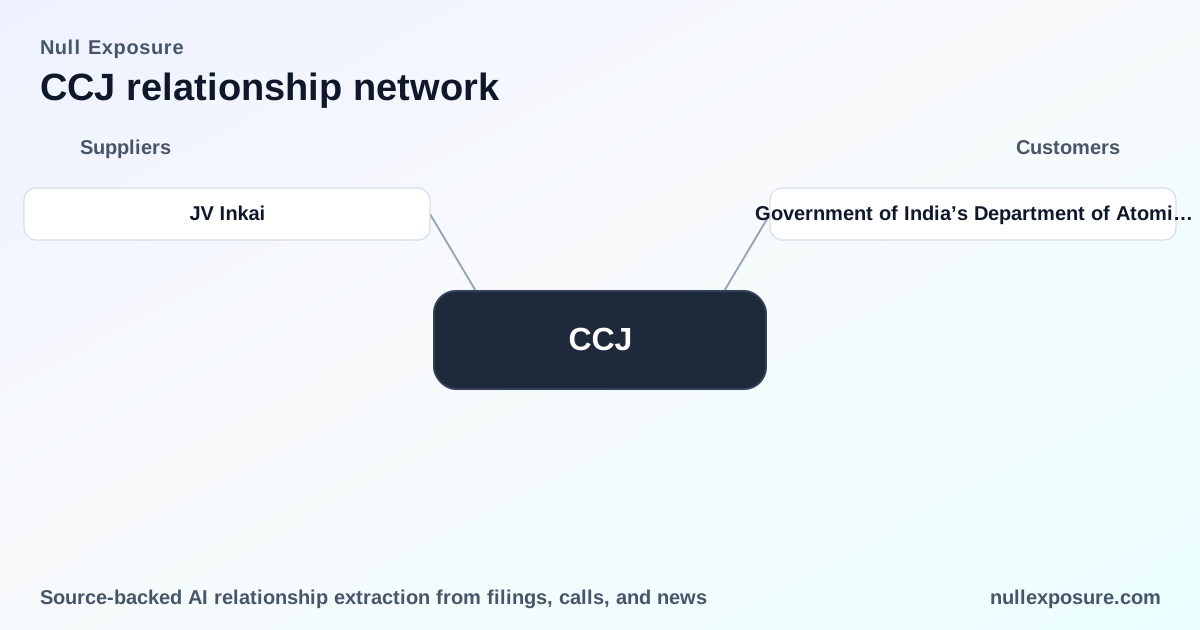
Cameco (CCJ) — supplier relationships and what they mean for investors
Cameco is a vertically integrated uranium producer that monetizes through mined production, long-term offtakes and spot market sales, supplemented by inventory management and short-term financing. The company combines stable, contracted cashflow with opportunistic spot exposure; that mix drives operating leverage and explains a premium valuation relative to peers given the security-of-supply narrative. With a market capitalization around $48.1 billion and trailing revenue of $3.48 billion, Cameco’s supplier posture—how it sources and secures supply—directly affects margins, production optionality and geopolitical exposure.
For a quick supplier-risk scan and ongoing monitoring, visit the NullExposure homepage: https://nullexposure.com/
Why this matters to investors
- Supply contracts and JV stakes are not peripheral for Cameco: they are core to its ability to deliver contracted uranium volumes to utilities and to capture upside in spot cycles.
- Contract mix (long-term vs spot) drives cash flow predictability and valuation multiples; Cameco’s high P/E (112.6 trailing) reflects investor willingness to pay for predictable future earnings underpinned by contracted supply and strategic supplier relationships.
- Geography and partner structure (e.g., Kazakhstan JV exposure) introduce operational and political risk that must be priced into any investment thesis.
How Cameco sources supply — the operating model in plain English Cameco uses a layered supply strategy that combines inventory, financing, spot purchases and committed long-term purchases. That multi-pronged approach produces the following company-level signals about operating model and business characteristics:
- Contracting posture: The company pursues a blend of long-term offtakes and spot market activity. Long-term purchases and owned production create predictability for utility customers; spot purchases and inventory provide flexibility to respond to price cycles.
- Concentration vs diversification: Cameco balances internal production with external contracted supply. The presence of material long-term purchases suggests deliberate diversification of sourcing, but individual large partners can concentrate risk.
- Criticality of suppliers: Committed suppliers that provide stable production are critical to meeting long-term offtake obligations; any disruption to those channels affects revenue visibility.
- Maturity of relationships: Long-term purchases and joint ventures indicate mature, contractual relationships rather than ad-hoc procurement—this supports covenantable cash flows useful for financing and valuation.
These signals come from management statements about supply levers and financials showing sizeable fixed-income-like features in revenue mix (FY2025–FY2026 company filings and market disclosures).
Supplier relationship in the public record
JV Inkai — Kazakhstan production purchased under long-term commitments
Cameco explicitly lists committed long-term purchases of production from JV Inkai in Kazakhstan as one of its supply levers alongside inventory, loans and spot purchases; this positions Inkai as a contracted source of uranium volumes that supports contractual deliveries to utilities. (InsiderMonkey transcript of Cameco’s FY2026 earnings call, reported March 9, 2026: https://www.insidermonkey.com/blog/cameco-corporation-nyseccj-q4-2025-earnings-call-transcript-1696004/)
Operational and financial implications for investors and operators
- Revenue predictability: Long-term purchases from partners like JV Inkai strengthen Cameco’s ability to underwrite long-dated offtakes, which supports a premium valuation and institutional holder base (institutions account for roughly 68% of float). Company results (FY2025–FY2026) show moderate profitability (profit margin ~16.9%) and positive operating leverage.
- Counterparty and geopolitical risk: Committed supply from Kazakhstan introduces country risk that is material for operational continuity and insurance/financing terms. Investors must treat Kazakhstan exposure as a first-order supplier risk when modeling downside scenarios.
- Flexibility to capture spot upside: The explicit inclusion of spot purchases and inventory in the supply strategy gives Cameco optionality to scale exposure to higher spot prices, which is a structural driver of earnings volatility and potential upside.
- Balance sheet and financing posture: The firm’s use of “loans” as a supply lever implies working-capital or supplier-financing arrangements that can smooth timing mismatch between production receipts and contractual sales.
Mid-article action: for a more granular supplier map and monitoring dashboard, go to https://nullexposure.com/
How supplier dynamics shape negotiation and execution
- Long-term commitment is a bargaining lever. Because Cameco buys committed volumes, it negotiates from a position of volume certainty—this yields more favorable pricing and structured terms with counterparty protections.
- Operational contingency planning is binding. For counterparties and investors, the focus is not only price but logistics, transport security and currency/sovereign exposure, especially when volumes originate in Kazakhstan.
- Disclosure and transparency matter. Given the valuation premium, management-level transparency on contracted volumes, remaining contract tenors and counterparty concentration should be monitoring priorities for investors.
Checklist for investors and operators
- Track proportion of production covered by committed purchases vs spot exposure and inventory levels.
- Monitor any public disclosures about JV Inkai volumes, contract tenor and pricing mechanics.
- Stress-test scenarios that assume partial disruption of Kazakhstan supply and estimate P&L and covenant impact.
- Watch balance-sheet indicators tied to supplier financing or inventory loans for signs of liquidity stress.
Final takeaway and investor guidance Cameco’s supplier model is purposefully hybrid: long-term contracted purchases (including material volumes from JV Inkai), supported by active inventory and spot-market management, give the company both predictability and upside exposure to commodity cycles. Investors should treat supplier relationships—especially the Kazakhstan JV—as a central input to valuation and risk modeling. For deal teams and operators, contracting posture and contingency planning around these supplier channels are the operational levers that determine execution risk.
Further reading and next steps
- For an ongoing view of supplier relationships, contractual tenors and counterparty concentration, visit NullExposure: https://nullexposure.com/
- If you need a tailored supplier-risk briefing for Cameco or peer comparisons, the NullExposure platform provides curated monitoring and alerts: https://nullexposure.com/
Sources referenced in this article include Cameco public financial metrics (FY2025–FY2026 disclosure) and a March 9, 2026 earnings-call transcript reported by InsiderMonkey discussing supply levers and committed purchases from JV Inkai (Kazakhstan).