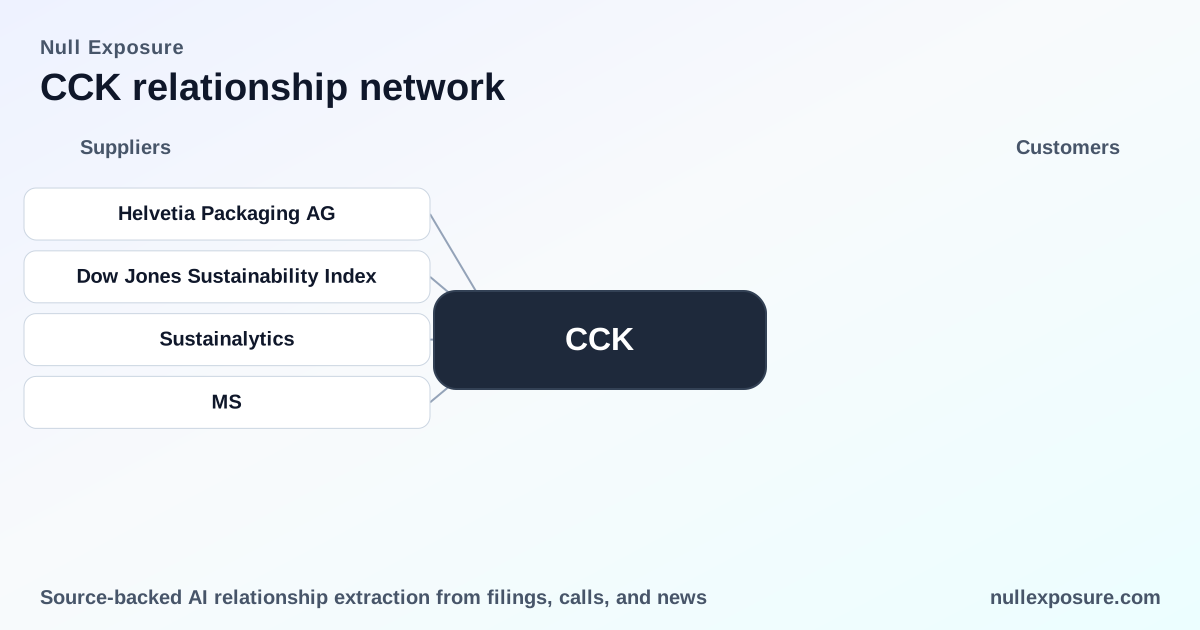
Crown Holdings (CCK) — supplier profile and partner map for investors
Crown Holdings manufactures beverage cans, ends and packaging equipment and monetizes through global scale in manufacturing and equipment sales, selling high-volume metal packaging to consumer goods and beverage companies while capturing margin from aluminum and steel processing and equipment services. With roughly $12.4 billion in revenue and a market capitalization north of $12 billion, Crown’s profitability depends on raw-material purchasing, plant footprint optimization and ESG positioning that influences customer contracts and investor sentiment. This profile synthesizes Crown’s supplier and external relationships that directly shape procurement risk, regulatory exposure and reputational leverage. For a concise view of supplier exposures and partner signals, visit https://nullexposure.com/.
How Crown’s supplier posture shapes the business
Crown is fundamentally a large-scale buyer of commodities (aluminum, steel and polymer inputs) and an operator of capital-intensive manufacturing plants across the Americas, Europe and Asia. Revenue is driven by unit volumes in beverage and specialty packaging and recurring aftermarket services for equipment, while input costs introduce cyclical margin pressure. The company uses a mix of contract structures to manage volatility: multi-year aluminum arrangements with price floating mechanisms and shorter steel contracts with fixed or periodic repricing, reflecting a hedged-but-exposed procurement posture. That procurement posture is an operational lever and a financial risk point that investors must track alongside rate cycles and supplier concentration.
Major takeaways up front
- Procurement is a core strategic and risk vector — Crown’s margins swing with aluminum and steel cycles, and purchase commitments lock in quantities and pricing structures.
- ESG reporting and ratings are meaningful to Crown’s commercial positioning, influencing large beverage customers and index-based investor flows.
- Acquisitions and global footprint matter for regional supply continuity — the company supplements capacity through selective deals, with direct implications for supplier relationships in Europe.
Explore the platform for relationship-level analytics at https://nullexposure.com/.
Supplier and partner map — what the filings and press coverage reveal
Helvetia Packaging AG
Crown closed a targeted acquisition in October 2023, buying Helvetia Packaging AG — a beverage can and end manufacturer in Saarlouis, Germany — for $126 million, expanding European can capacity and integrating a local production base into Crown’s network. According to Crown’s FY2024 Form 10-K, the Helvetia transaction completed in October 2023 (FY2024 filing).
Dow Jones Sustainability Index
Crown’s ESG performance is tracked by major ratings providers and included in investor-facing sustainability indexes; the company’s sustainability metrics are explicitly scored by the Dow Jones Sustainability Index, which influences asset managers and index-linked investors evaluating Crown’s long-term resilience. A CSRwire press release summarizing Crown’s TwentyBy30 sustainability program references index scoring in FY2025/press coverage (March 2026).
Sustainalytics
Sustainalytics is cited as a ratings provider that scores Crown’s ESG performance, a public-facing relationship that affects institutional assessments and sustainability-linked engagement. This linkage is mentioned in the same CSRwire coverage of Crown’s sustainability commitments in FY2025/press coverage (March 2026).
Morgan Stanley Smith Barney LLC
SEC filings mentioning Morgan Stanley Smith Barney LLC appear in public filing aggregations; the reference documents institutional custodian or brokerage relationships and shareholding/service records associated with Crown. An SEC filing posted via StockTitan in March 2026 cites Morgan Stanley Smith Barney LLC in FY2026 filing text (March 2026).
What these relationships signal for investors
-
Acquisition-led capacity management: The Helvetia acquisition is a deliberate, capital-deploying move to secure European capacity and shorten logistics chains for beverage customers; that increases Crown’s control over a portion of its supply chain and reduces reliance on external can suppliers in that region. (See FY2024 10‑K.)
-
ESG ratings as commercial leverage: Being scored by Sustainalytics and the Dow Jones Sustainability Index is not decorative — scores influence procurement decisions at major beverage companies and the cost of capital for Crown, given the prevalence of ESG-screened funds and sustainability-linked lending. (CSRwire, FY2025 coverage.)
-
Institutional brokerage and custody relationships: References to Morgan Stanley Smith Barney LLC reflect the standard ecosystem of custodians and broker-dealers handling Crown stock for institutional holders; these are operational market relationships that influence liquidity and investor outreach. (SEC filing visibility, FY2026.)
Company-level constraints that matter for supplier risk
Crown’s filings and related evidence outline procurement constraints that define its operating model:
-
Contracting posture: A mix of long-term and short-term raw-material contracts, with aluminum commonly under multi-year agreements that employ floating price mechanisms and steel under shorter, often one-year fixed-price or repricing arrangements. These contract terms are structural — they balance volume certainty against price exposure and shape working-capital and hedging needs. (Evidence from FY2024 Form 10‑K.)
-
Purchase commitments: Crown’s purchase commitments include fixed or minimum quantities and explicit timing and pricing provisions, which create firm obligations and can force purchases into adverse market cycles if commodity prices move sharply. (Form 10‑K excerpts.)
-
Relationship role: Crown is primarily a large-scale buyer of aluminum, steel and polymer inputs; this buyer posture places it in price-sensitive, cyclical markets where negotiating leverage varies by region and capacity utilization. (Company statements on raw material purchasing.)
-
Maturity and criticality: The company operates mature manufacturing assets and relies on steady raw-material supply; procurement arrangements and recent acquisitions (e.g., Helvetia) are tactical moves to secure continuity and regional criticality. These are company-level signals rather than relationship-specific assignments.
Operational and investment risks to watch
- Commodity volatility drives margin risk. Aluminum and steel cycles translate directly into earnings variability given the combination of floating and shorter fixed-price contracts.
- ESG performance affects access to customers and capital. Measured scores from Sustainalytics and DJSI influence both procurement positioning with brand owners and investor flows.
- Integration and regional concentration risk. Acquisitions that expand capacity (Helvetia) reduce external supplier dependence but introduce integration and execution risk.
For a deeper drill into counterparties, procurement terms and exposure scoring, see the Crown supplier dossier at https://nullexposure.com/.
Bottom line and recommended actions for investors and operators
Crown’s operating model is anchored in high-volume metal packaging, with procurement contracts and ESG positioning as the two levers that most directly influence durable margins. Investors should monitor aluminum and steel contract renewals, sustainability ratings trends and regional capacity moves as the primary drivers of upside or downside to consensus estimates. Operators evaluating supplier relationships should prioritize counterparties whose contract tenors and price mechanisms align with Crown’s exposure profile.
To review detailed relationship-level intelligence and ongoing monitoring tools for Crown Holdings, visit https://nullexposure.com/.