Carnival Corporation (CCL): supplier footprint and what it means for investors
Carnival Corporation operates and monetizes travel-leisure at scale by selling cruise capacity across a portfolio of brands and monetizing onboard spend, ticket pricing, and ancillary services while financing long-cycle capital through newbuild programs and fleet management. Revenue derives from passenger ticketing and high-margin onboard services, but the business model is capital-intensive and directly linked to a concentrated supplier ecosystem for shipbuilding, maintenance and onboard services. This note unpacks supplier relationships disclosed in recent filings and public reports, and translates those ties into actionable signals for investors and operators. For deeper supplier intelligence, visit https://nullexposure.com/.
What Carnival’s supplier posture looks like in one sentence
Carnival runs a high-fixed-cost, asset-heavy model that depends on long-term manufacturing and service contracts for newbuilds and operations; suppliers are often critical, concentrated, and contractually entrenched, exposing Carnival to both capex and operational counterparties.
Snapshot context investors need
Carnival is the world’s largest cruise operator with a combined fleet of over 100 vessels and FY2025 revenue of roughly $26.6 billion. The company carries substantial newbuild commitments (euro-denominated contracts totaling $8.4 billion as of November 30, 2025) that drive long-term supplier exposure, currency risk and concentrated spend with shipbuilders and specialized service firms. According to Carnival’s FY2025 10‑K, these newbuild commitments are a dominant feature of supplier risk and capital planning.
Supplier relationships to note
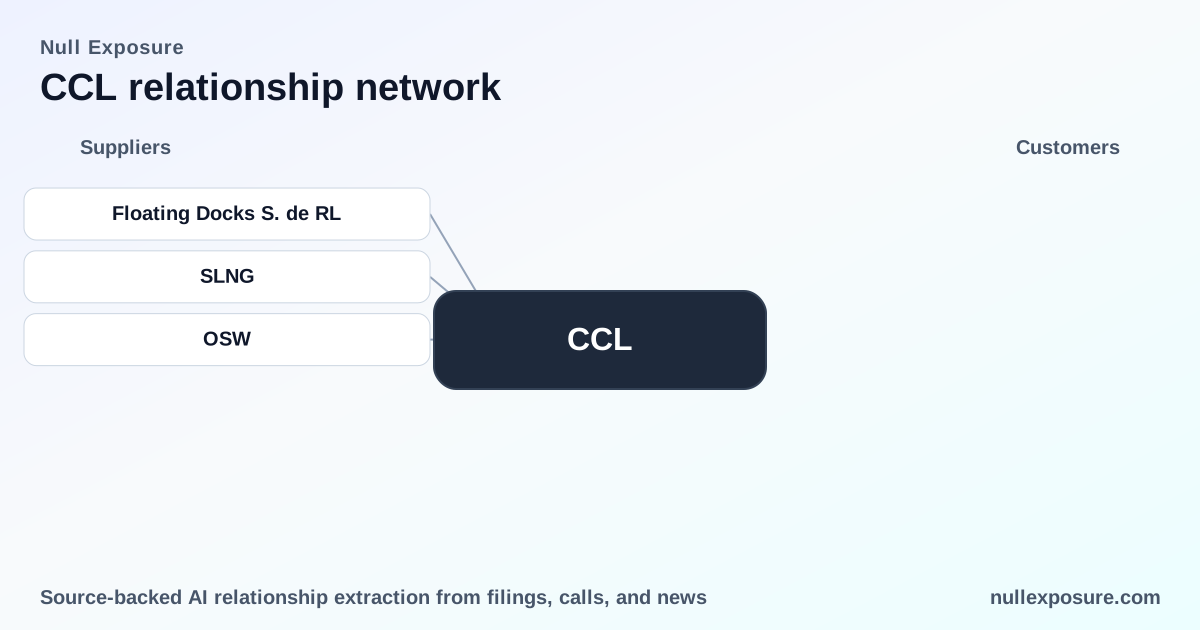
Floating Docks S. de RL — an advance on shipbuilding or outfitting
Carnival disclosed an advance of $100 million made to Floating Docks S. de RL in its FY2025 10‑K, indicating a material prepayment to a manufacturing/outfitting counterparty tied to its fleet program. According to Carnival’s FY2025 10‑K filed for the year ended November 30, 2025, this is recorded as an advance against supplier commitments.
Stabilis Solutions, Inc. — bunkering and fuel logistics partner
Carnival uses third-party providers for marine bunkering; Stabilis Solutions referenced a truck-to-ship marine bunkering contract with Carnival, signaling Carnival’s reliance on specialist fuel logistics suppliers for vessel operations. This was reported in a Stabilis earnings-call transcript coverage in March 2026, where the company noted the Carnival bunkering arrangement.
OneSpaWorld Holdings Limited — onboard guest services contractor
OneSpaWorld operates spa and wellness services across major cruise lines, and identifies Carnival Corporation among its core cruise clients, reflecting Carnival’s outsourcing of guest-facing specialty services. Market announcements and company commentary in February–March 2026 list Carnival alongside other leading cruise operators as a customer for OneSpaWorld’s services.
What the disclosed constraints tell investors (company-level signals)
Carnival’s supply-side constraints in disclosures form a coherent picture:
- Long-term contracting posture: The firm carries substantial multi-year newbuild commitments (euro-denominated contracts totaling $8.4 billion as of November 30, 2025), which locks Carnival into negotiated pricing and delivery timelines and creates extended counterparty exposure.
- Geographic concentration in EMEA for manufacturing risk: Currency and contractual exposures tied to euro-denominated newbuild payments point to supplier relationships and production risk clustered in Europe.
- Critical supplier dependency: Carnival explicitly recognizes that certain suppliers and providers are integral to operations; a failure to perform would have a negative business impact, making supplier continuity a strategic risk.
- Service-provider reliance for operations and guest experience: The company sources significant goods and services from a global supply base, meaning recurring operational dependency on third-party service providers for onboard experiences and port/headquarter services.
- Manufacturing segment emphasis and large spend bands: The newbuild program positions shipyards and equipment suppliers in the manufacturing segment as top-tier counterparty exposures, with spend band signals above $100 million for key commitments.
Collectively, these constraints signal concentrated, high-dollar, and strategically critical supplier relationships that affect both operational continuity and capital allocation.
For programmatic supplier monitoring and portfolio analysis, see more at https://nullexposure.com/.
Investment implications and operator takeaways
Investors and operators should treat Carnival’s supplier ecosystem as a material risk and differentiator for valuation and operations:
- Balance-sheet and cashflow sensitivity: Large advances and long-term contract payments (for example, the $100 million advance to Floating Docks and the $8.4 billion newbuild commitment) compress liquidity and increase the importance of working-capital management.
- Currency and procurement risk: Euro-denominated shipbuilding obligations create FX exposure that directly affects the effective cost of capex and margins on newbuild delivery schedules.
- Operational continuity risk: Reliance on specialist providers for bunkering (Stabilis) and guest services (OneSpaWorld) means disruptions can translate quickly to guest experience and revenue-per-passenger impacts.
- Counterparty concentration: Large single-source commitments to shipbuilders or major service providers are a valuation lever—reputational or execution failures at those suppliers would have outsized effects.
Practical investor actions:
- Prioritize monitoring of newbuild delivery schedules and shipyard health in EMEA.
- Stress-test currency assumptions around euro payments and hedging disclosures.
- Watch vendor advance payments and any escalation in prepayments as indicators of supplier détente or risk.
- Evaluate guest-service outsourcing economics (e.g., revenue-sharing arrangements with companies like OneSpaWorld) for margin durability.
Final observations and recommended next steps
Supplier relationships are a central determinant of Carnival’s capital and operational trajectory. Advances to shipyards, branded outsourcing partners for onboard services, and fuel logistics agreements all translate into quantifiable exposure that should inform valuation multiples and scenario analysis.
For continuous supplier-level intelligence and to map these relationships into investment workflows, visit https://nullexposure.com/. If you want a focused briefing on Carnival’s supply-chain contracts and capex counterparties, start here: https://nullexposure.com/.
Sources: Carnival Corporation FY2025 10‑K (filed for year ended November 30, 2025) for advance and newbuild commitment language; Stabilis Solutions earnings-call transcript coverage reported March 2026 for the bunkering contract mention; MarketBeat/OneSpaWorld press coverage in February–March 2026 for OneSpaWorld’s cruise-line client list.