Concord Medical Services (CCM): supplier relationship briefing for investors and operators
Concord Medical Services operates a network of radiotherapy and diagnostic imaging centers across mainland China and monetizes by delivering fee-for-service oncology and imaging treatments, supported by acquisitions of specialized treatment assets. Revenue is driven by clinical throughput at owned and joint-venture centers and by asset-level investments in high-capital modalities (for example, proton therapy). This note focuses on supplier and advisor relationships that affect capital projects, compliance and operational risk, and what those ties signal about contracting posture and vendor selection. For a broader supplier intelligence view, visit https://nullexposure.com/.
The financial and strategic context that shapes supplier relationships
Concord is a capital-intensive healthcare operator with material operating losses and balance-sheet stress that directly influence supplier contracting and counterparty risk. Public financials (latest quarter 2025-06-30) show revenue of roughly $365.8 million but negative gross profit and an EBITDA loss, with reported margins and returns trending below peer expectations: operating margin TTM is -72.1%, profit margin -44.6%, and diluted EPS -5.44. Book value is negative and institutional ownership is effectively negligible at 0.036%, while insiders hold about 18%, which concentrates governance influence.
These metrics create clear operating constraints: Concord will favor supplier terms that reduce near-term cash outflow and transfer downside on large capital items; it will be selective with long-term guarantees and prudent on maintenance-capex commitments. Contracting posture will emphasize capex-light structures, milestone-based payments and legal protections for major acquisitions. The company’s prior use of external legal counsel on material acquisitions signals an appetite to use top-tier advisors for complex deals.
One supplier/advisor relationship disclosed in our records
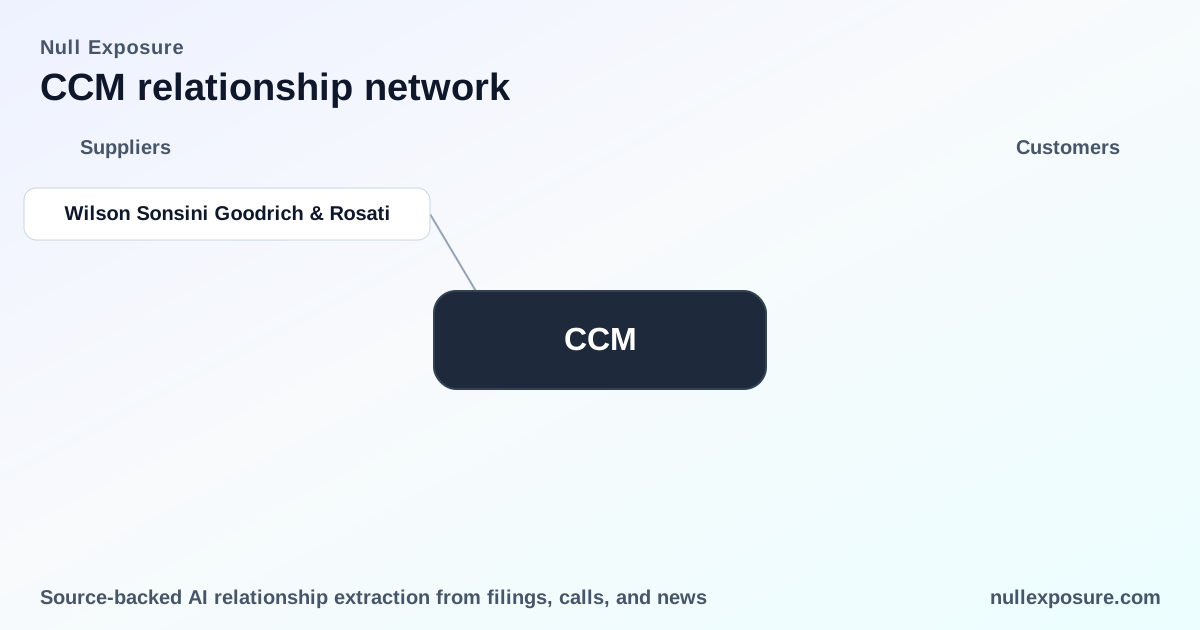
- Wilson Sonsini Goodrich & Rosati — In 2015, Wilson Sonsini acted as legal advisor to Concord on the acquisition of additional ownership interest in the MD Anderson Proton Therapy Center, an asset-level transaction tied to advanced oncology treatment capabilities; the engagement demonstrates Concord’s use of international law firms for complex cross-border asset deals. (News-Medical report, August 12, 2015)
What that single relationship tells investors and operators
Wilson Sonsini’s role on the MD Anderson proton therapy transaction is a meaningful signal. Proton therapy centers are exceptionally capital- and compliance-intensive; hiring an experienced international law firm indicates Concord treats such asset acquisitions as strategic, legally complex events requiring external risk mitigation. For suppliers and partners, that implies Concord will insist on robust contractual protections, detailed governance over JV structures, and formal legal documentation on ownership and operational responsibilities.
- Contracting posture: The company will likely accept structured, milestone-linked payments and extensive vendor warranties on capital equipment.
- Transaction maturity: Use of recognized legal counsel indicates prior experience with large transactions and an ability to marshal external expertise on demand.
- Criticality and concentration: Investment in proton therapy shows concentration in high-end oncology services — a supplier to those assets becomes critical to operations and therefore should expect tighter performance KPIs and escalation clauses.
How Concord’s financial profile alters supplier risk and pricing
Concord’s negative operating margins, negative book value and modest market capitalization compress the range of feasible supplier terms. Suppliers and vendors should price for:
- Higher counterparty credit risk — demand stronger credit support, parent guarantees, or escrowed milestone payments.
- Payment timing sensitivity — expect lengthened receivable days and periodic restructuring of payment schedules.
- Operational concentration risk — specialized vendors (proton therapy, advanced imaging) take on operational dependence; insist on redundancy and spare-part commitments.
These are company-level signals drawn from the firm’s public financials (latest quarter 2025-06-30) rather than from any single vendor constraint.
For larger strategic sourcing programs and competitive benchmarking, see how Concord’s supplier posture compares across healthcare providers at https://nullexposure.com/.
Practical takeaways for investors and procurement teams
- Legal and advisory spend matters. Concord engages top-tier counsel for major asset moves; this increases transaction execution quality but raises deal costs that squeeze near-term cash flow—factor advisory fees into acquisition economics.
- Supplier contracts will be defensive. Expect vendor agreements loaded with protections for Concord (e.g., performance-based payments), but also reciprocal protections demanded by suppliers given the company’s weak earnings profile.
- Operational suppliers become de facto strategic partners. For modality-specific vendors (proton therapy, radiotherapy equipment), the relationship will be high-touch, governed by service-level agreements, spare-part logistics and joint regulatory compliance.
- Governance and ownership concentration create idiosyncratic risks. Low institutional ownership and meaningful insider stakes mean strategic direction can shift with a small set of stakeholders; suppliers should build contractual flexibility for potential governance-driven changes.
Risk checklist before contracting with Concord
- Confirm credit support mechanisms (letters of credit, escrow arrangements).
- Insist on clear milestone definitions and consequences for delayed payment.
- Verify maintenance and parts supply commitments for critical equipment.
- Obtain third-party validation of regulatory compliance responsibilities, especially for radiotherapy and proton therapy assets.
If you're modeling supplier exposure or sizing loss-given-default scenarios, these items should feed directly into your risk adjustments and pricing discipline. For supplier risk scoring and bespoke exposure analysis, consider our intelligence platform at https://nullexposure.com/.
Final recommendation for investors and operators
Concord Medical is an operator concentrated in capital-intensive oncology services with demonstrable appetite for complex acquisitions and an evident reliance on external legal counsel for material deals. Suppliers should price for credit risk and insist on contractual protections; investors should treat Concord as a high-operational-risk, turnaround-style exposure until margins and balance-sheet metrics normalize.
For procurement teams considering rollout of service agreements or capital sales, demand robust contractual security and phased payment models tied to demonstrable operational milestones. For a deeper supplier network assessment or to benchmark Concord against peers in Asia’s oncology services market, visit https://nullexposure.com/ for detailed supplier intelligence and advisory support.