CCNEP supplier relationships: what investors should know about counterparties, liquidity sources and advisory roles
Thesis: CCNEP represents depositary shares tied to CNB Financial Corporation’s preferred capital structure; the company operates as a regional bank holding company that funds lending and balance-sheet growth through a mix of deposits, wholesale liquidity channels and capital markets issuances, and it monetizes primarily via net interest margin and fee income while using preferred shares and correspondent lines to manage capital and liquidity. For investors, the supplier map for CCNEP is less about vendors in the software sense and more about advisory, listing and funding counterparties that shape governance, capital access and contingency funding. Learn more at https://nullexposure.com/.
Quick read: what these counterparties do for CCNEP and why they matter
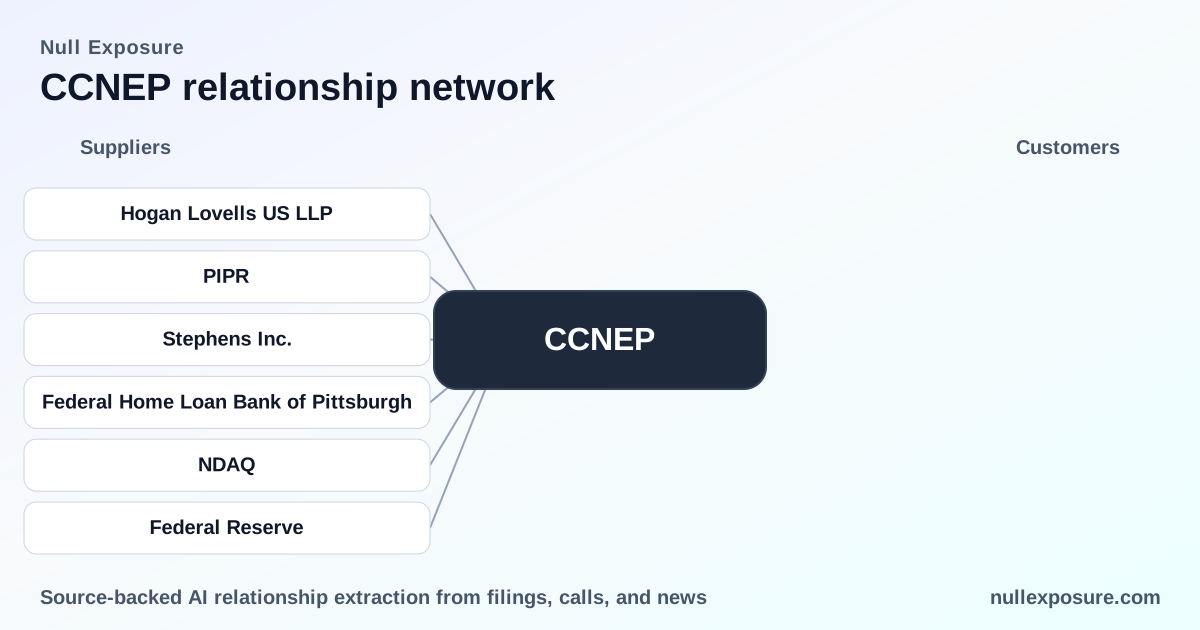
CCNEP’s active supplier relationships cluster in three strategic buckets: legal and financial advisory that shape transactions and governance, market infrastructure for listing and capital access, and wholesale liquidity providers that underpin funding resilience. Together these relationships influence investor protections, access to capital, and the operational continuity of the bank.
The supplier roster — one-line takeaways for each counterparty
Hogan Lovells US LLP (legal advisor)
Hogan Lovells served as legal counsel on CNB’s merger activity, providing transactional and regulatory legal services that support deal execution and documentation. This engagement was reported in the context of the CNB/ESSA merger (FY2025) by StockTitan news coverage on March 9, 2026.
Piper Sandler & Co (fairness opinion provider)
Piper Sandler rendered a fairness opinion to CNB’s board in connection with merger approvals, a role that directly affects board-level decision-making and shareholder disclosures. The engagement is noted in the same StockTitan report relating to FY2025 transaction activity (reported March 9, 2026).
Stephens Inc. (exclusive financial advisor)
Stephens Inc. acted as CNB’s exclusive financial advisor for the transaction, coordinating valuation, negotiation and strategic positioning for the deal process. StockTitan’s coverage of the merger (FY2025) records Stephens’ exclusive advisory role (March 9, 2026).
Federal Home Loan Bank of Pittsburgh (wholesale liquidity provider)
The Federal Home Loan Bank of Pittsburgh is listed as a source of available borrowing capacity that contributes to CCNEP’s collective contingent liquidity resources; this facility is cited as part of approximately $6.7 billion of contingent liquidity (FY2026). The liquidity disclosure appears in CNB’s FY2026 results press release as distributed via GlobeNewswire and reported by The Manila Times on January 28, 2026.
Federal Reserve (central bank liquidity access)
The Federal Reserve is identified as a backstop lending channel included in CCNEP’s contingent liquidity resources, reinforcing access to emergency or standing lending facilities referenced in the FY2026 results release. This is documented in the same GlobeNewswire/ManilaTimes press release dated January 28, 2026.
The NASDAQ Stock Market LLC (listing venue)
NASDAQ is the exchange where CCNE common stock (CCNE) and the depositary shares (CCNEP) are listed, with filings describing the listing of a Series A preferred instrument underlying CCNEP (FY2026). The listing is documented in SEC filing commentary captured on StockTitan’s copy of the filing (reported March 9, 2026).
What the relationship map reveals about CCNEP’s operating model
The supplier list is compact but strategically dense. CCNEP’s contracting posture is transactional and governance-focused: legal and financial advisors are engaged for M&A and capital decisions rather than for long-term outsourced operational services. Simultaneously, funding relationships are core to resilience, with the Federal Home Loan Bank of Pittsburgh and the Federal Reserve forming primary contingent liquidity channels that sit behind deposits and brokered commitments.
- Contracting posture: CCNEP behaves like a buyer of specialist advisory services when executing strategic transactions; legal and investment banking relationships are episodic but high-impact.
- Concentration: Supplier concentration is moderate — a small set of counterparties hold outsized influence over transaction execution and funding access, which creates single-point dependencies in M&A and liquidity paths.
- Criticality: The constraints filed by the company frame vendor/service failures as potentially material, implying that interruptions to these relationships or to third-party services in the broader services segment could have substantive operational or financial consequences.
- Maturity and segment exposure: The relationships align with a mature regional banking operating model that relies on established market infrastructure (exchange listing, FHLB membership, Fed access) and professional advisors rather than experimental vendors. The company classifies vendor services under a services segment that includes core infrastructure such as data processing and network access, indicating attention to operational continuity beyond transactional counterparty engagements.
If you want a deeper counterparty map and risk scoring for CCNEP, see full supplier intelligence at https://nullexposure.com/.
Risk and valuation implications for investors
- Governance and fairness: Engagement of Stephens and Piper Sandler for exclusive advice and a fairness opinion strengthens the informational and procedural quality of deal approvals, which reduces governance arbitrage risk around shareholder treatment. StockTitan’s FY2025 report documents these advisory roles.
- Liquidity resilience: The explicit inclusion of FHLB Pittsburgh and the Federal Reserve in the company’s contingent liquidity disclosure (GlobeNewswire/ManilaTimes, Jan 28, 2026) provides a tangible funding backstop; investors should treat these relationships as high-value insurance that materially reduces short-term funding shock risk.
- Counterparty concentration: With a small number of high-impact suppliers, operational or reputational disruption to one provider — especially in advisory or credit lines — would have outsized consequences. The firm’s own disclosures characterize vendor failure as a potential material event, flagging supplier criticality as a real investor consideration.
- Market access and investor protections: NASDAQ listing of CCNE and CCNEP reinforces liquidity and disclosure obligations (SEC filing commentary on StockTitan, FY2026), which benefits price discovery and minority investor rights for holders of depositary shares.
Practical next steps for investors
- Monitor continued advisory engagement disclosures around any future M&A or capital actions; changes in advisors often presage strategic shifts.
- Track FHLB and Fed borrowing capacity as part of quarterly liquidity reporting — reductions in these lines would alter funding risk profiles quickly.
- Review NASDAQ listing statements and dividend notices for the Series A preferred underlying CCNEP to evaluate yield sustainability.
For a structured counterparty risk scorecard and to benchmark CCNEP against peer regional banks, visit https://nullexposure.com/ and request supplier-level analytics.
Final read: concise takeaway
CCNEP’s supplier footprint shows a governance- and liquidity-centric supplier strategy: experienced legal and financial advisors execute transactions, NASDAQ provides market access, and the FHLB and Federal Reserve secure contingent funding channels. These relationships reduce certain execution and funding risks but create concentration and criticality points that investors should monitor through regular filings and liquidity disclosures. Explore more supplier insights and portfolio-level counterparty assessments at https://nullexposure.com/.