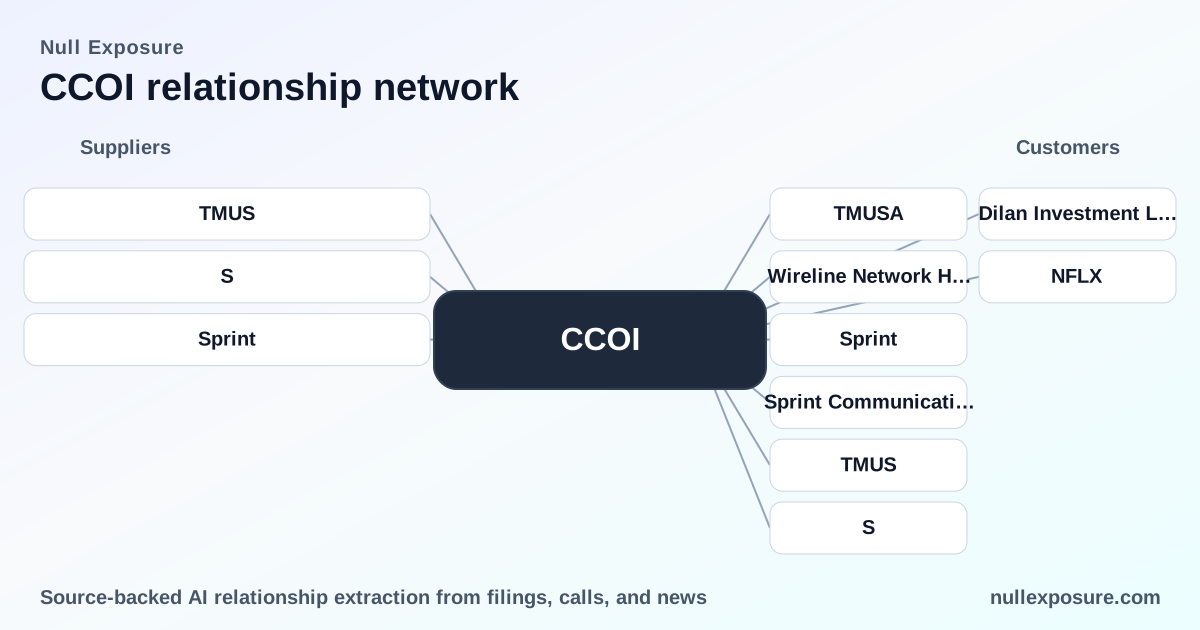
Cogent (CCOI) as a Supplier Partner: What investors and operators need to know
Cogent Communications (CCOI) operates a wholesale and enterprise-focused fiber network that monetizes primarily by selling bandwidth and long-haul transit services to carriers, service providers and large enterprises. The company scales through interconnection and carriage agreements rather than retail subscriber growth, capturing recurring revenue from transit, colocation and managed connectivity while leveraging acquired fiber assets to expand capacity and route diversity. For investors evaluating supplier-side relationships, Cogent’s counterparty mix and the history of major asset transfers are essential to assessing revenue stability and operational risk.
For more supplier intelligence and relationship mapping, visit https://nullexposure.com/.
The business model in plain English: recurring transit, transaction-based expansion
Cogent generates cash largely from predictable recurring contracts for IP transit and dedicated bandwidth while intermittently extending reach through acquisitions and TSA arrangements. The model emphasizes low-touch, volume-driven margins—Cogent sells connectivity as a commodity but relies on scale and dense peering to protect margins. Critical elements of the operating posture include a high degree of carrier-to-carrier interdependence, exposure to enterprise churn on acquired routes, and reliance on transition services during major asset transfers.
Supplier relationships you must read (complete list)
Below are every relationship noted in the reviewed signals, each summarized succinctly with source context.
T‑Mobile
Cogent acquired the Sprint Wireline Business from T‑Mobile in May 2023—effectively taking ownership of a roughly 20,000‑mile long‑haul fiber network in exchange for assuming long‑term liabilities and operating under a transition services agreement (TSA) during the handover, with T‑Mobile initially billing customers on Cogent’s behalf under the TSA. This arrangement is described in Cogent’s filings and was discussed in FY2026 coverage and earnings call transcripts. Sources: FY2024 10‑K (TSA description), earnings call transcript coverage in FY2026, and a FinancialContent deep‑dive (reported March 2026).
Sprint Communications
On May 1, 2023, Cogent completed the acquisition of Sprint Communications’ U.S. long‑haul fiber network, a transaction that materially expanded Cogent’s backbone and enterprise reach and reshaped its wholesale footprint. Source: Cogent SEC filing coverage and reporting on the May 2023 acquisition (TradingView summary of the SEC 10‑K, FY2026 context).
Sprint
Post‑acquisition performance signals indicate the fiber network acquired from Sprint has been experiencing significant customer attrition, with reports of thousands of customers lost quarterly and an enterprise client base contraction (reported as a 20% decline in 2025), triggering investor scrutiny and a board investigation into fiduciary matters. Sources: investigative and market commentary published in FY2026 (Intellectia reporting on customer losses and board scrutiny).
What these relationships mean for operators and investors
- Contracting posture and transition dynamics: Cogent uses Transition Services Agreements when taking over complex carrier assets, which reduces immediate operational disruption but creates short‑term dependency on seller systems (for example, T‑Mobile billing customers under a TSA). This indicates a pragmatic, contract‑driven integration approach that preserves revenue flow while operational control is transferred.
- Concentration and counterparty impact: Relationships with large carriers like T‑Mobile and Sprint underscore that Cogent’s network growth is significantly influenced by bilateral transactions with major incumbents, which can rapidly shift route economics and customer mix when assets move hands.
- Criticality and service exposure: The acquired long‑haul assets materially increase Cogent’s importance to carrier routing and enterprise connectivity; conversely, customer attrition on acquired routes signals an operational vulnerability where revenue from newly acquired assets can decline if churn and migration are not arrested.
- Maturity of the arrangements: The use of a TSA and the 2023 acquisition represent mid‑transition maturity—operational integration is advanced but still under observation, as evidenced by the FY2026 reporting cycle and subsequent market coverage.
These characteristics are company‑level signals inferred from public excerpts describing network scale, carrier agreements and transition services; they are not tied to any single relationship unless explicitly cited.
Risks and hotspots to monitor now
- Churn on acquired routes. Reported quarterly customer losses and a reported 20% enterprise decline in 2025 create downside risk to expected synergies from the Sprint acquisition; investors should track sequential customer counts and ARPU on the acquired fiber routes (Intellectia coverage, FY2026).
- Operational integration under TSA. Short‑term billing and support dependencies on sellers like T‑Mobile expose Cogent to execution risk if transition timelines slip; the FY2024 10‑K documents the TSA mechanics and obligations.
- Governance and oversight. Board inquiries connected with post‑acquisition performance indicate shareholder activism or regulatory interest that could influence capital allocation and strategic priorities (market reports in FY2026).
Practical takeaways for supplier negotiation and diligence
- Prioritize clauses that protect against post‑close revenue erosion (step‑down guarantees, retention incentives, and clear SLA‑linked credits).
- Require transparency on customer migration plans and a timeline for full transfer of billing and operational control—TSA language is a decisive indicator of how prolonged dependence will be.
- Model sensitivity in two dimensions: (1) customer attrition on acquired routes, (2) timing risk for migration off seller platforms.
For a deeper supplier-mapping and risk profile tailored to transaction diligence, see https://nullexposure.com/.
What investors should watch in the next 12 months
- Sequential customer counts and segment‑level revenue trends for routes attributed to the Sprint asset.
- Any formal outcomes from board investigations and related governance actions.
- Timing and completeness of billing and operational transfers away from T‑Mobile systems per the TSA disclosures in Cogent’s filings.
Final verdict and action items
Cogent’s expansion via the Sprint wireline purchase transformed its backbone capacity and market reach but introduced execution and churn risk that investors and operators must assess alongside the recurring nature of Cogent’s transit revenues. The company’s contracting posture—favoring TSAs and inherited liabilities—creates both an opportunity to capture immediate revenue and a short‑to‑medium‑term integration liability that will determine realized value.
For portfolio managers and operators conducting counterparty due diligence or negotiating supplier terms, prioritize contract protections tied to customer retention and assert timelines for migration off seller platforms. If you need a custom relationship risk brief or a tailored supplier scorecard, start here: https://nullexposure.com/.