Cross Country Healthcare (CCRN) — supplier relationships, deal advisory, and what investors should price in
Cross Country Healthcare operates as a staffing and workforce solutions provider for acute care and allied health settings and monetizes primarily through contracted nurse placements and MSP-style staffing arrangements where it bills customers for labor and records revenue at the time of billing, net of any subcontractor liabilities. The company routinely engages top-tier financial and legal advisors for strategic transactions, which is a signal of active capital markets activity and potential value realization events. For a deeper look at counterparties and contract implications, visit https://nullexposure.com/.
Business model in one paragraph for the investor desk
Cross Country books revenue by fulfilling customer orders under contract with acute care facilities, using its own clinicians and third‑party subcontractors; when subcontractors are used, Cross Country invoices the end customer and recognizes revenue net of related subcontractor liabilities. That structure drives immediate billing-driven revenue recognition, dependency on subcontractor availability, and gross-margin pressure when third parties are deployed. Contracting is customer-facing and operationally critical, so any disruptions in supply or execution directly affect near-term cash flow and earnings.
- Contracting posture: The company operates under explicit contracts with acute care facilities that demand rapid fulfillment and compliance with clinical staffing standards.
- Operational concentration: Revenue is sourced from contracted placements and MSP solutions rather than one-off transactions, increasing predictability but concentrating operational risk on staffing capacity.
- Criticality: Staffing is mission-critical to customers, which supports pricing power in shortage environments but also raises reputational risk if service levels slip.
- Maturity: Use of established law and banking advisors for transactions indicates a corporate posture consistent with mid‑market M&A and capital markets sophistication.
If you want ongoing monitoring of CCRN counterparties and transaction flow, see https://nullexposure.com/ for subscription options.
Advisor and banker relationships identified in recent coverage
Below I cover each relationship instance surfaced in public reporting. Each entry is a concise, plain-English summary with a source reference.
-
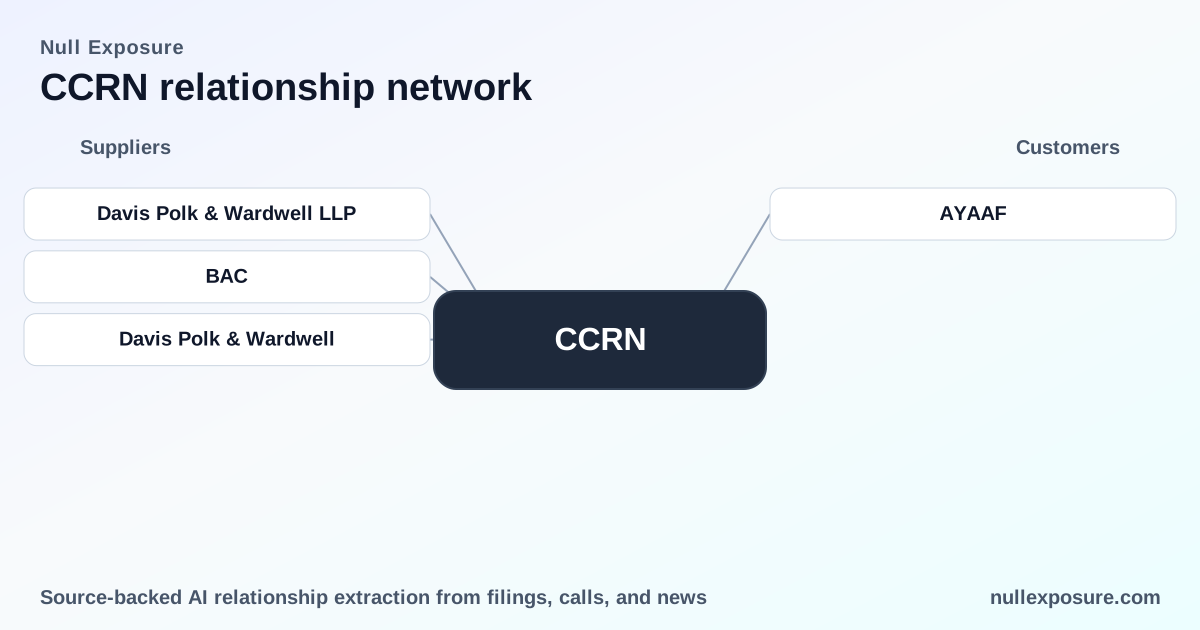
Davis Polk & Wardwell LLP — ConnectMoney reported that Davis Polk is serving as legal advisor to Cross Country Healthcare in the context of the Aya Healthcare take‑private transaction (reported Mar 9, 2026, cited as FY2025). Source: ConnectMoney article on the Aya acquisition (https://www.connectmoney.com/stories/aya-healthcare-to-buy-cross-country-healthcare-in-615m-take-private-deal/).
-
BofA Securities — A Yahoo Finance press release (reported Mar 9, 2026 and tagged FY2024 in the scraped record) states BofA Securities is acting as financial advisor to Cross Country Healthcare for the Aya Healthcare acquisition agreement. Source: Yahoo Finance release covering the Aya transaction (https://finance.yahoo.com/news/aya-healthcare-signs-agreement-acquire-153726844.html).
-
BofA Securities, Inc. — Pulse2 coverage (reported Mar 9, 2026, FY2024 in the data) repeats that BofA Securities, Inc. is serving as financial advisor while Davis Polk is legal advisor for Cross Country Healthcare in the Aya deal commentary. Source: Pulse2 article explaining the Aya acquisition rationale (https://pulse2.com/why-aya-is-acquiring-cross-country-healthcare-for-about-615-million-in-cash/).
-
Davis Polk & Wardwell LLP — Pulse2 also records that Davis Polk & Wardwell LLP is serving as legal advisor to Cross Country Healthcare in the transaction commentary (same Pulse2 piece, Mar 9, 2026). Source: Pulse2 article on the Aya acquisition (https://pulse2.com/why-aya-is-acquiring-cross-country-healthcare-for-about-615-million-in-cash/).
-
BofA Securities, Inc. — The ConnectMoney article (Mar 9, 2026, FY2025) likewise identifies BofA Securities, Inc. as the financial advisor to Cross Country Healthcare around the Aya deal reporting. Source: ConnectMoney coverage of the transaction (https://www.connectmoney.com/stories/aya-healthcare-to-buy-cross-country-healthcare-in-615m-take-private-deal/).
-
Davis Polk & Wardwell (variation) — The Yahoo Finance item (Mar 9, 2026, FY2024 metadata) frames Davis Polk & Wardwell as legal counsel alongside BofA as financial advisor in the announcement of the Aya agreement. Source: Yahoo Finance transaction announcement (https://finance.yahoo.com/news/aya-healthcare-signs-agreement-acquire-153726844.html).
Across the reporting set, two counterparty names recur: BofA Securities (financial advisor) and Davis Polk & Wardwell (legal advisor), with consistency across multiple news outlets and reporting dates in early March 2026. That redundancy strengthens confidence that Cross Country retained top-tier advisors for a material strategic transaction.
What these relationships imply for valuation and execution risk
Engagement of BofA and Davis Polk signals a formal, bank-led strategic process and sophisticated legal structuring. For investors this implies three practical points:
- Deal credibility and readiness: Top-tier advisors reduce execution risk in complex take‑private or acquisition scenarios and suggest management is pursuing value‑realizing alternatives rather than opportunistic trades.
- Transaction cost and timing: Using Tier‑1 advisors increases transaction fees but also improves access to financing and buyer networks; expect a disciplined timeline and thorough due diligence.
- Information flow: Public filings and press releases tied to advisor engagement provide clear milestones for investors to track deal progress and covenants.
Operational constraints that matter to counterparties and acquirers
Company-level contract language shows Cross Country uses a hybrid delivery model — its employees plus third‑party subcontractors — and records revenue net of subcontractor liabilities at billing. This structure creates operating leverage in staffing supply environments and margin sensitivity when subcontractor penetration rises. For counterparties and potential acquirers, the crucial operational constraints are:
- Counterparty dependence on third‑party subcontractors for order fulfillment, increasing vendor management complexity.
- Revenue recognition tied to billing rather than milestone accounting, which compresses short‑term earnings volatility into billing cycles.
- Contractual obligations to acute care facilities that are service-critical and subject to regulatory and performance scrutiny.
These are company-level signals derived from Cross Country’s contract disclosure and are not attributed to any advisor relationship.
How investors should act on this information
- Price in the operational risk: expect margin compression in periods with higher subcontractor usage and value Cross Country accordingly.
- Use deal milestones as liquidity signals: advisor-led transactions offer predictable event-driven catalysts; monitor press releases and regulatory filings tied to BofA and Davis Polk engagement.
- Factor in integration risk: if an acquirer is consolidating staffing assets, contract terms and subcontractor arrangements will drive near-term synergies and costs.
For ongoing monitoring of CCRN counterparties, transaction activity, and supplier risk scoring, visit https://nullexposure.com/.
Bottom line
Cross Country Healthcare monetizes through contractual staffing placements and recognizes revenue at billing net of subcontractor liabilities; recent public reporting confirms engagement of BofA Securities as financial advisor and Davis Polk & Wardwell as legal advisor in the Aya-related transaction cycle (March 2026). Investors should treat advisor engagement as a positive signal for deal execution while pricing operational leverage and subcontractor risk into any valuation assumptions. For subscription access to live counterparty mapping and alerts tied to CCRN deals, go to https://nullexposure.com/.