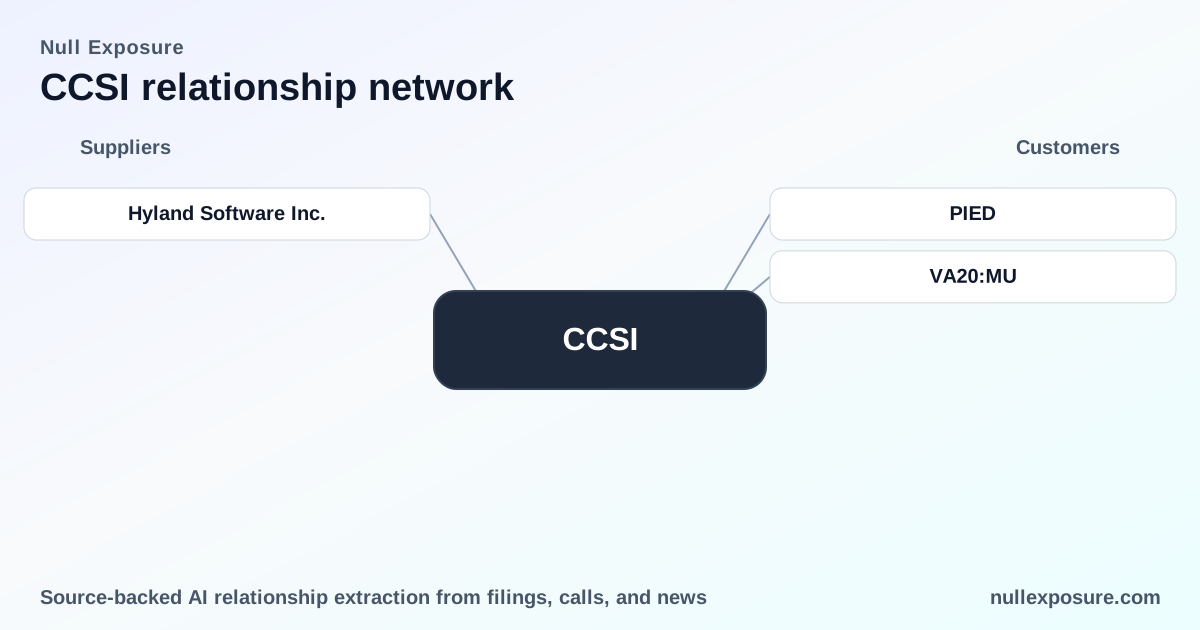
Consensus Cloud Solutions (CCSI): supplier posture, partner footprint, and investor implications
Consensus Cloud Solutions operates a software-as-a-service platform that delivers information to enterprise customers, monetizing primarily through recurring subscription revenue for cloud-hosted communications and secure information exchange. The business combines high gross margins with a focused go-to-market into regulated verticals — healthcare and financial services — and captures value through platform licensing, managed services, and integration partnerships. For investors evaluating supplier and technology risk, the supplier relationships and disclosed contracting posture are as material to operational continuity as top-line growth. For a deeper look at supplier exposures and commercial relationships, visit https://nullexposure.com/.
How CCSI makes money and why suppliers matter
Consensus runs a cloud-first model: subscription fees and platform services drive the bulk of revenue, supported by managed onboarding and professional services. The company’s most recent reported figures show $349.7M revenue TTM, a 41.1% operating margin, and $168.97M EBITDA, which signals a profitable, capital-efficient SaaS operator with a clear cashflow profile. Market capitalization sits near $563M and trailing P/E is 6.8, reflecting strong current profitability relative to valuation.
Suppliers matter to CCSI because the product is a cloud delivery stack: communications, networking and hosting relationships are operationally critical to uptime and regulatory compliance for customers in healthcare. Where those third-party arrangements are short-term or the firm serves as the buyer of critical connectivity and hosting, continuity and cost exposure become direct inputs to margin stability and service-level reliability.
The partner ecosystem you need to account for
Investors should track two things in the partner ecosystem: strategic integration partners that extend product reach and infrastructure/telecom suppliers that underpin service delivery. Both groups affect revenue growth and operational risk in different ways — integrations drive customer acquisition and stickiness, while infrastructure vendors determine availability and cost structure.
Hyland Software Inc. — integration for cloud faxing and patient data exchange
Consensus announced a strategic partnership with Hyland Software to streamline cloud faxing and support seamless integration of patient data between healthcare applications, positioning CCSI as a conduit for interoperability inside health systems. This partnership is a commercial extension into clinical workflows and helps CCSI sell into health systems that require certified integrations. According to a PR Newswire release dated March 9, 2026, the agreement focuses on integrating cloud-fax capabilities and connecting patient data across applications.
All supplier relationships disclosed in the record
- Hyland Software Inc.: Consensus partnered to integrate cloud faxing and enable patient data exchange between healthcare applications, strengthening CCSI’s position in clinical interoperability (PR Newswire, March 9, 2026).
This article covers every relationship reported in the supplied results.
Constraints and what they imply about operating model risk
Company disclosures reveal two relevant supplier constraints that are company-level signals rather than relationship-specific limitations:
- Short-term contract posture for certain telecommunications services. The company states that it purchases some telecommunications services under short-term agreements that providers can terminate or opt not to renew. This indicates a low-tenor contracting posture for parts of the connectivity stack, which increases rollover and repricing risk for network-related costs.
- Buyer role and reliance on third-party providers for Internet, telecommunications, hosting, and cloud compute. CCSI explicitly relies on private third-party providers for Internet, telecommunications, data center hosting, and cloud computing needs, establishing the company as a buyer of critical infrastructure services rather than an owner-operator.
From these excerpts investors should draw the following operational insights:
- Contracting posture: Short-term vendor arrangements reduce vendor lock-in but increase exposure to sudden supplier pricing moves or service discontinuations.
- Concentration/criticality: Reliance on third-party providers for core hosting and connectivity makes these suppliers highly critical to uptime and compliance, especially in regulated healthcare workflows.
- Maturity and switching dynamics: Short-term contracts imply transactional supplier relationships that are easier to replace but harder to negotiate for long-term discounts or embedded SLAs; that trade-off affects gross margin stability.
- Buyer leverage: The buyer role signals some negotiating leverage exists, but practical leverage depends on market alternatives for specialized cloud-fax and healthcare-compliant hosting services.
All constraints are taken from company disclosures and should be considered company-level risk indicators rather than actions tied to a named partner unless the disclosure names that partner directly.
What this means for investors: risk and opportunity framed
- Operational risk is tangible but manageable. High operating margins and recurring revenue create a buffer to absorb supplier cost increases, but short-term telecom contracts introduce episodic cost variability.
- Strategic partnerships accelerate adoption in regulated verticals. The Hyland relationship materially enhances CCSI’s distribution into health systems by embedding cloud-fax and patient-data integrations into existing workflows — a growth and retention lever for the business.
- Valuation reflects profitability; monitor supplier-led margin pressure. With a trailing P/E of 6.8 and EV/EBITDA near 6.3, the market is pricing current earnings credibility. Any sustained supplier cost inflation or a major outage tied to third-party vendors would compress multiples rapidly given the business’s reliance on high-quality service delivery.
- Key metrics to watch: uptime/SLA performance, supplier contract renewals and pricing, integration adoption rates with partners like Hyland, and any movement from short-term to longer-term supplier agreements.
What investors and operators should do next
- For investors: prioritize monitoring supplier contract terms disclosed in quarterly filings and any operational incident reports tied to third-party providers. Track adoption metrics for strategic integrations as they correlate with revenue retention.
- For operators: negotiate longer-term SLAs or multi-vendor redundancy for critical telecom and hosting services to convert short-term exposures into repeatable reliability.
For deeper supplier intelligence and to benchmark CCSI’s vendor exposures against peers, visit https://nullexposure.com/ for targeted supplier-insight tools.
Final takeaways and next steps
Consensus Cloud Solutions combines high-margin SaaS economics with dependence on third-party connectivity and hosting. Strategic partnerships like the Hyland agreement accelerate penetration into healthcare, while disclosed short-term telecom contracts create a quantifiable supplier risk profile that investors must monitor alongside adoption and uptime metrics. For ongoing monitoring and supplier risk scoring, see the research resources at https://nullexposure.com/.
Bold and disciplined attention to supplier contracts and integration adoption will separate companies that sustain margins from those that face episodic shocks in a cloud-delivered market.