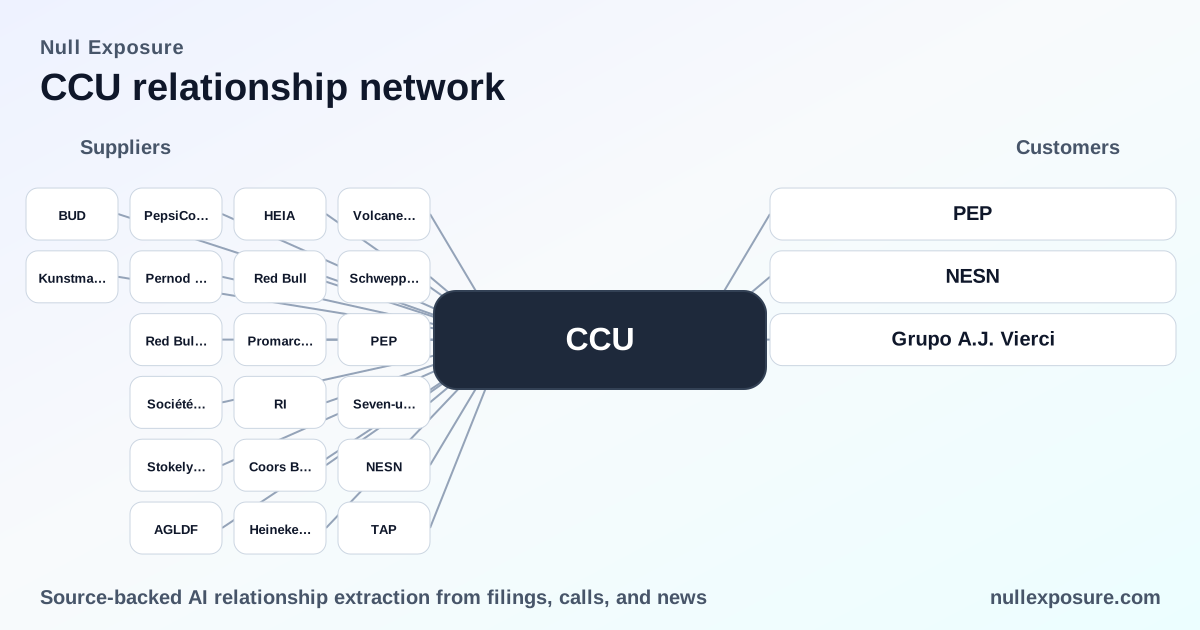
CCU: The partner-driven footprint behind Compañía Cervecerías Unidas
Companía Cervecerías Unidas (NYSE: CCU) operates as a regional beverage manufacturer and distributor that monetizes through owned brands and long-term licensing, distribution and joint-venture agreements with global beverage firms. The company converts scale in Chile and across South America into steady beverage revenue by combining proprietary beer and non-alcoholic SKUs with internationally licensed labels; licensing and distribution contracts are a core recurring revenue engine and a structural competitive advantage. For decision-makers evaluating supplier relationships, the critical question is not whether CCU sells third‑party brands, but how dependent its portfolio and route-to-market are on those partnerships. Learn more at https://nullexposure.com/.
How CCU's partner model drives margins and exposure
CCU’s financial profile—over $3.0 trillion CLP in trailing revenues (reported as RevenueTTM) and a modest profit margin of 4.03%—reflects a mixed business of heavy manufacturing costs offset by licensing income and distribution margins on global brands. Licensing and distribution contracts allow CCU to capture brand premium without incurring global marketing scale, but they also create counterparty and contract‐term exposure: loss or renegotiation of a large brand license would compress margins and reduce shelf assortment. CCU’s public filings and press coverage list an array of global partners, providing diversification across beverage categories and geographies while anchoring CCU in repeatable revenue streams. For a concise supplier risk profile and relationship inventory, visit https://nullexposure.com/.
Relationship-by-relationship guide (what investors and operators need to know)
The following summarizes every partner relationship reported in the supplied results. Each entry is a plain-English 1–2 sentence takeaway with a concise source note.
Volcanes del Sur
CCU acquired the Volcanes del Sur beer brand as part of the Luksic Group’s consolidation of local labels, expanding CCU’s domestic beer portfolio. According to a BioBioChile news report from August 2022, the acquisition increased CCU’s stable of regional beer brands. (BioBioChile, Aug 2022: https://www.biobiochile.cl/noticias/economia/negocios-y-empresas/2022/08/29/el-grupo-luksic-compra-a-traves-de-ccu-a-volcanes-del-sur-y-queda-con-17-cervezas-en-el-mercado.shtml)
Schweppes Holdings Limited
CCU lists Schweppes among its principal licensing and distribution partners, indicating a formal arrangement for carbonated soft drinks and mixers across parts of its footprint. This relationship is recorded in CCU’s cited overviews and filings (StockTitan / 6-K aggregation, FY2025–FY2026). (StockTitan overview / 6-K reference, FY2025–FY2026: https://www.stocktitan.net/overview/CCU/)
PepsiCo / PepsiCo Inc.
PepsiCo brands are part of CCU’s licensed portfolio; press reports note CCU expanded PepsiCo licensing into Paraguay, making Paraguay the second country in the region where CCU holds that license. According to a Yahoo Finanzas report, PepsiCo licensing was integrated into CCU’s Paraguay operations (FY2024 report). (Yahoo Finanzas, FY2024: https://es-us.finanzas.yahoo.com/noticias/ccu-pepsico-integran-paraguay-formar-233000259.html)
Seven-up International
CCU lists Seven‑Up International as a principal licensing/distribution partner, signaling responsibility for local distribution of the 7UP soft drink brands in some markets. This listing appears in CCU’s public overview coverage (StockTitan, FY2025). (StockTitan overview, FY2025: https://www.stocktitan.net/overview/CCU/)
Société des Produits Nestlé S.A. (Nestlé)
CCU’s filings include Nestlé among principal partners, reflecting distribution or licensing arrangements for juices, nectars or related non-alcoholic beverages in specific territories. The relationship is documented in overview filings and press summaries (StockTitan / FY2025–FY2026). (StockTitan / filings, FY2025–FY2026: https://www.stocktitan.net/overview/CCU/)
Coors Brewing Company / Coors Tecate / Blue Moon
CCU brews and sells several international malt brands under license, including Coors Tecate and Blue Moon, which are integrated into CCU’s Chile beer assortment. Market commentary and CCU segment descriptions list Coors and Blue Moon among licensed beers sold in Chile (TradingView and StockTitan summaries, FY2026). (TradingView / Market summaries, FY2026: https://www.tradingview.com/symbols/BCS-CU_CL/?sort=recent)
Heineken Brouwerijen B.V. / Heineken
Heineken is a named licensed brand that CCU brews or distributes in select markets; CCU’s beer segment explicitly includes Heineken among international labels produced under license. MarketBeat and CCU press materials record Heineken as a strategic licensing partner (MarketBeat and company press releases, FY2026). (MarketBeat / press coverage, FY2026: https://www.marketbeat.com/instant-alerts/compania-cervecerias-unidas-ccu-projected-to-post-earnings-on-tuesday-2026-02-21/)
Red Bull / Red Bull Panamá S.A.
CCU supports licensing and distribution partnerships that include Red Bull in its energy-drink category, indicating CCU handles regional distribution for the brand in at least some Latin American markets. This is referenced in CCU press releases and The Globe and Mail coverage (FY2026). (The Globe and Mail press release coverage, FY2026: https://www.theglobeandmail.com/investing/markets/stocks/CCU/pressreleases/37183802/ccu-announces-leadership-transition-as-chairman-francisco-perez-mackenna-resigns/)
Pernod Ricard Chile S.A.
Pernod Ricard Chile appears in CCU’s list of principal licensing/distribution or joint-venture partners, signalling activity in the spirits and ready-to-drink category through local arrangements. The relationship is listed in consolidated overview filings (StockTitan, FY2025). (StockTitan overview, FY2025: https://www.stocktitan.net/overview/CCU/)
Promarca S.A. (Watt’s)
Promarca (Watt’s) is included among CCU’s principal local partnerships, implying distribution or co‑branding activity in juices, nectars and packaged non-alcoholic beverages. The listing is shown in CCU’s public overviews (StockTitan, FY2025–FY2026). (StockTitan / filings, FY2025–FY2026: https://www.stocktitan.net/overview/CCU/)
Stokely Van Camp Inc.
Stokely Van Camp is named in CCU’s FY2026 listings of licensing/distribution partners, indicating CCU handles regional rights for legacy beverage or canned product brands in specific markets. This appears in CCU’s 6-K aggregate reporting. (StockTitan / 6-K aggregation, FY2026: https://www.stocktitan.net/sec-filings/CCU/6-k-united-breweries-co-inc-current-report-foreign-issuer-6ea3b6fab7d0.html)
Austral, Kunstmann, Sol (owned and local international labels)
CCU’s Chile segment sells an assortment of local and international beers—Austral, Kunstmann and Sol among them—reflecting a combined owned-and-licensed portfolio that supports shelf breadth and local premiumization strategies. TradingView segment descriptions list these brands as part of CCU’s Chile product mix (TradingView, FY2026). (TradingView segment summary, FY2026: https://www.tradingview.com/symbols/BCS-CU_CL/?sort=recent)
What the partner list implies about CCU’s operating model and risk profile
-
Contracting posture: CCU operates as a strategic licensee and distributor; filings consistently describe “licensing, distribution and/or joint venture agreements,” indicating long-term, bilateral commercial contracts rather than ad hoc supply deals. (See CCU 6-K / StockTitan filings, FY2026.)
-
Revenue diversification with partner dependence: The breadth of global partners (PepsiCo, Heineken, Nestlé, Red Bull, Coors) spreads category and brand risk, but licensed brands materially contribute to assortment and revenue, making contract renewals and terms a corporate priority.
-
Criticality and maturity: Relationships with legacy global beverage firms are mature and operationally critical—they supply high-turn SKUs and justify distribution economics—so operational disruptions or renegotiations would have immediate P&L impact.
-
Concentration: While CCU lists many partners, the presence of several global majors means counterparty concentration risk is moderate: losing any single major license would be material but not existential, given CCU’s owned brand portfolio and other partners.
These company-level signals are drawn from CCU’s public overview and recent filings that catalogue its principal licensing and distribution agreements (StockTitan / 6-K references, FY2025–FY2026).
Practical takeaways for investors and operators
-
For investors: CCU’s financials reflect a hybrid model—manufacturing scale plus licensed-brand margin—so valuation sensitivity hinges on contract stability and market share in Chile and neighboring countries. Monitor contract disclosures, renewal timelines and any partner-specific concentration called out in filings.
-
For operators and procurement leads: Prioritize contract management and supply-chain continuity for licensed SKUs, and quantify the margin contribution of licensed versus owned brands by market to prepare for renegotiation cycles.
For additional supplier intelligence and to track CCU’s partner exposures in a single view, visit https://nullexposure.com/.
Closing recommendation
CCU’s business is partner-centric and regionally entrenched, combining owned brands with a wide set of licensing and distribution agreements that deliver stable shelf presence and recurring revenue. Investors and operators should treat brand contracts as strategic assets—monitor disclosures and partner negotiations closely. To see this relationship inventory integrated with supplier risk analysis, explore the platform at https://nullexposure.com/.