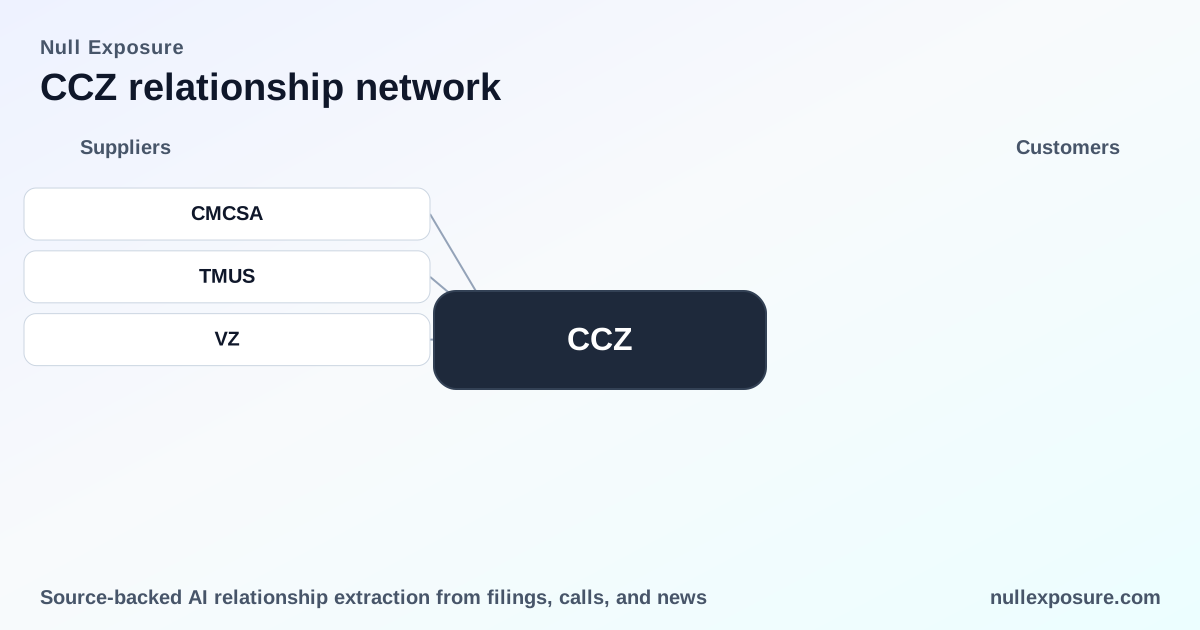
Comcast Holdings Corp (CCZ): Supplier map and strategic implications for investors
Comcast Holdings Corp operates and monetizes a multi-product communications bundle—broadband, video, advertising, and retail wireless—by combining owned network assets, extensive franchise rights and capital-light mobile retailing through MVNO partnerships. Revenue accrues from subscriber fees, content licensing arrangements and device/equipment procurement, while margin and capital intensity are driven by large, long-duration programming and lease obligations and concentrated supplier relationships. For investors evaluating supplier risk, the commercial links to Verizon and T‑Mobile, plus the company-level contract profile around programming, leases and equipment, are the highest-impact inputs to forward cashflow and operational resilience. Visit the NullExposure homepage to explore full relationship intelligence: https://nullexposure.com/
What the explicit supplier relationships show — line by line
The source results identify three discrete references to Verizon and one to T‑Mobile. Below I summarize each item exactly as cited.
Verizon — MVNO leverage reported in a market overview (FY2026)
Xfinity Mobile is described as operating “on Verizon’s network” with Comcast leveraging Verizon’s coverage to expand mobile offerings while integrating Comcast’s dense Wi‑Fi footprint to reduce network load. Source: ad-hoc-news market overview on Comcast (FY2026), published March 2026 (https://www.ad-hoc-news.de/boerse/news/ueberblick/inside-comcast-corp-how-a-legacy-cable-giant-is-rebuilding-itself-as-a/68539454).
T‑Mobile — added as a network partner for business customers (2025 Q4)
Comcast announced the addition of T‑Mobile as a network partner for business customers, citing this as a way to sustain a capital‑efficient mobile platform and support a durable convergence value proposition. Source: Comcast 2025 Q4 earnings call (ccz-2025q4-earnings-call), March 2026.
Verizon — modernization of MVNO partnership referenced in the earnings call (2025 Q4)
Management stated they “modernized our MVNO partnership with Verizon,” positioning that arrangement as supportive of continued profitable growth for Comcast and partner carriers. Source: Comcast 2025 Q4 earnings call (ccz-2025q4-earnings-call), March 2026.
Verizon — Xfinity Mobile described as Verizon-backed plus Wi‑Fi (FY2026)
A separate ad-hoc-news piece reiterates that Xfinity Mobile rides on Verizon’s network while leveraging Comcast’s Wi‑Fi footprint to differentiate service economics. Source: ad-hoc-news report on Comcast (FY2026), published March 2026 (https://www.ad-hoc-news.de/boerse/ueberblick/comcast-corp-can-a-cable-giant-reinvent-itself-for-the-streaming-first/68471747).
How these relationships translate to commercial realities
- Network outsourcing for wireless: Comcast runs mobile offerings as an MVNO, outsourcing radio access and spectrum-dependent functions to carriers (Verizon, and now T‑Mobile for parts of the business). This lowers Comcast’s capital intensity for wireless growth while making service availability and wholesale pricing dependent on third‑party carriers. The earnings call explicitly framed this as a capital‑efficient model supporting convergence monetization.
- Operational leverage from Wi‑Fi: Comcast’s dense Wi‑Fi footprint is a structural asset that reduces wholesale usage and improves unit economics for mobile customers when paired with partner networks. The ad-hoc reports highlight this duality—carrier coverage for macro reach and Wi‑Fi for off‑load.
- Partner concentration: Reliance on two national carriers for mobile access creates counterparty concentration in the wireless product line; carrier contract terms and renewal economics are a direct input to Comcast’s unit margins for mobile subscribers.
Explore the full supplier mapping and relationship detail at NullExposure: https://nullexposure.com/
Company‑level constraints that define supplier risk and contracting posture
The constraint signals from Comcast’s filings and notes present a clear operating profile:
- Long-term contracting posture: Comcast carries very long lease tenors (weighted-average remaining lease term ~18 years) and sizable fixed-price content purchase obligations, indicating structural long-duration liabilities against which revenue must match over time.
- High spend and large commitments: Programming and production obligations run in the multi‑billion dollar range, and total future minimum lease payments are material—these are not incremental, short-term contracts but core drivers of cash outflows.
- Counterparty mix includes government: Cable franchise rights arise from state and local government agreements, exposing parts of the footprint to regulatory and political operating risk that is contractually anchored.
- Supplier concentration and criticality: Comcast purchases from a limited set of vendors for customer premise equipment and uses a small number of vendors for billing systems; these suppliers are material and operationally critical to customer delivery.
- Relationship roles: The company is both a licensee for content and a buyer of critical services (billing, network gear), so supplier risk spans strategic content partners and operational vendors.
These constraints imply a mature, capital‑intensive vendor ecosystem with substantial fixed obligations and concentrated supplier counterparty exposure—important context when valuing margins or stress testing scenarios.
Investment implications and monitoring triggers
- Positive: capital-efficient wireless growth — The MVNO model with Verizon and T‑Mobile lets Comcast monetize converged bundles without major wireless capex, supporting free cash flow if wholesale pricing remains favorable. Monitor carrier contract renewals and wholesale rate disclosures.
- Negative: fixed-cost sensitivity — Large programming obligations and long lease tenors compress operating leverage in downturns; programming expenses are described as the company’s most significant operating cost. Watch programming spend disclosures and renegotiation outcomes.
- Governance and regulatory exposure — Franchise agreements with local governments and reliance on a small number of billing/equipment suppliers create concentrated operational risks that are material to service continuity.
- Event triggers to watch:
- Renewal terms with Verizon and T‑Mobile and any shifts away from MVNO economics.
- Quarterly disclosure of programming and production obligations.
- Supplier disruptions for CPE or billing vendors, and any regulatory challenges to franchise agreements.
Bottom line and next steps for investor due diligence
Comcast’s supplier landscape is strategically coherent but materially concentrated. The company converts network assets and franchise scale into recurring revenue streams while outsourcing radio access to major carriers to preserve capital. That model generates attractive capital efficiency for mobile but amplifies exposure to a few large counterparties and to long-term content and lease commitments that shape cashflow durability.
For a deeper, decision‑grade look at counterparties, contractual tenure and spend bands, review the full relationship index on NullExposure: https://nullexposure.com/
If you are benchmarking supplier concentration across peers or building scenario stress tests for programming and lease obligations, start with Comcast’s supplier map and constraint signals at NullExposure — detailed, investor-focused relationship intelligence is available here: https://nullexposure.com/
Bold takeaway: MVNO partnerships with Verizon and T‑Mobile materially reduce wireless capex but increase counterparty concentration; programming and lease obligations remain the dominant, long-duration constraint on margins and cashflow.