Chaince Digital (CD) — Audit vendor swap is a governance event investors should price in
Chaince Digital Holdings Inc. operates operator‑neutral hyperscale data center solutions across China, India and Southeast Asia and monetizes primarily through facility capacity sales and related colocation services to cloud, enterprise and telco customers. The company’s value is driven by real estate and power‑intensive infrastructure scale, long‑dated customer commitments, and execution on capacity rollout — factors that make third‑party service providers and auditors critical to perceived financial integrity and execution risk. For investors and operators evaluating supplier exposure, the recent change in Chaince’s external auditor is a governance signal that requires immediate attention.
Learn more about how we surface supplier signals at the platform level at https://nullexposure.com/.
What happened: a rapid auditor change, disclosed in an 8‑K
Chaince Digital filed disclosures indicating an immediate dismissal of its then‑auditor and a one‑day follow‑up appointment of a successor. That sequence compresses the audit transition into a narrow window and shifts an important external control relationship at fiscal year end.
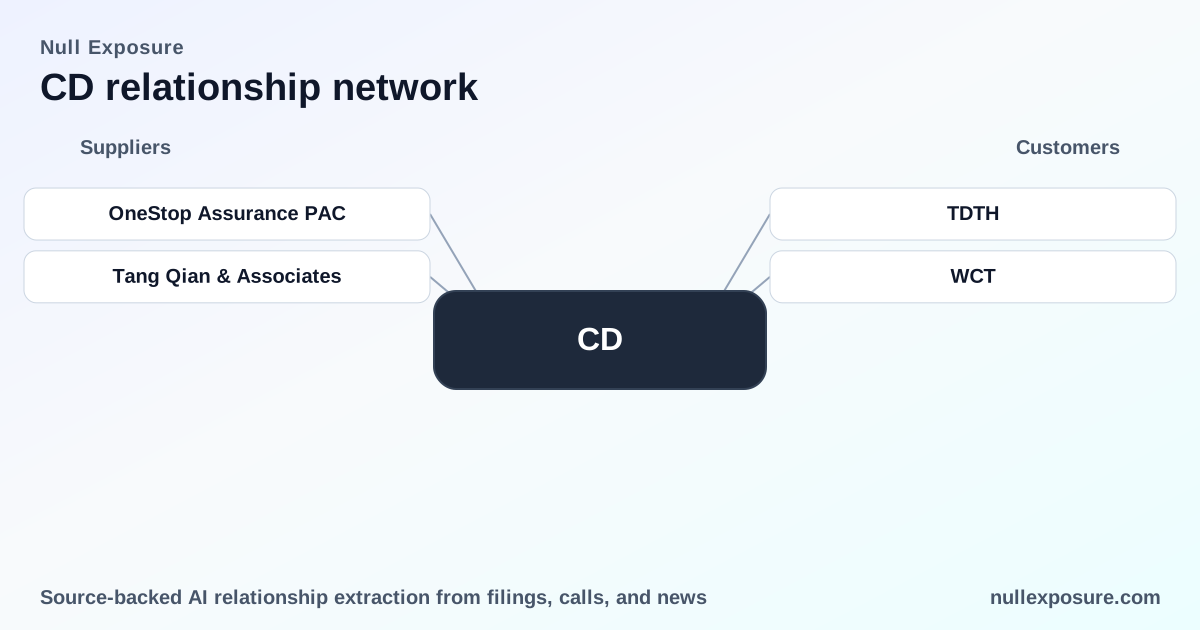
OneStop Assurance PAC — dismissed effective January 23, 2026
Chaince Digital dismissed OneStop Assurance PAC as its independent registered public accounting firm effective January 23, 2026. According to the company’s Form 8‑K filed for FY2026, the dismissal was immediate and disclosed publicly in March 2026 via reports of the filing. (Company 8‑K / StockTitan, March 2026.)
Tang Qian & Associates — appointed January 24, 2026 for FY2025
The Audit Committee approved the appointment of Tang Qian & Associates on January 24, 2026 as the company’s new independent registered public accounting firm for the year ended December 31, 2025. The appointment is recorded in the same 8‑K disclosure and was reported alongside the dismissal. (Company 8‑K / StockTitan, March 2026.)
Why the auditor swap matters to investors and operators
An auditor change by itself is not a verdict, but in Chaince’s case the timing and corporate backdrop require active risk re‑pricing:
- Governance signal: Switching auditors immediately at year‑end creates questions about the completeness of the audit record and potential disagreements over accounting, disclosures or internal controls. Market participants price such moves as higher governance risk until clarity is provided.
- Operational criticality: For a capital‑intensive data center operator, financial transparency underpins capital raises, debt covenants and vendor confidence; an auditor change can slow or complicate those processes if lenders or counterparties demand additional assurance.
- Market sensitivity: Chaince’s public metrics show negative EBITDA, negative operating and net margins, and highly elevated valuation multiples relative to revenue, which amplify the market’s reaction to any governance event. The company’s beta and share‑price dispersion will increase sensitivity to headline risk.
These are actionable signals for both equity investors and counterparties assessing counterparty financial health.
How this fits into Chaince’s supplier and contracting profile
Treat the auditor relationship as a critical but non‑revenue supplier whose role is to certify financial statements required for capital markets access and contractual compliance. Company‑level signals from public filings strengthen that perspective:
- Contracting posture: Chaince relies on independent auditors to validate financials required by NASDAQ reporting and lenders; changes in that relationship affect certification timing and covenant comfort.
- Concentration: Insider ownership is material — roughly 43% insiders vs ~28% institutions — which concentrates control and makes governance events more consequential for minority investors.
- Criticality: Auditors are non‑discretionary suppliers for a publicly listed company; any disruption to audit continuity is high criticality even if short lived.
- Maturity: Financials show small absolute revenues, negative EBITDA, and negative returns, signaling a company still in a growth or recovery phase rather than a mature cash generator. That immaturity increases the economic impact of governance or reporting shocks.
These operating model characteristics warrant heightened monitoring of vendor changes and follow‑up disclosures.
Relationship-by-relationship: the explicit vendor entries
-
OneStop Assurance PAC — Chaince dismissed OneStop as its independent registered public accounting firm effective January 23, 2026; the event was disclosed in the company’s 8‑K (filed in FY2026) and reported on March 9, 2026 via a filing aggregator. This is a clear termination of the audit engagement. (Company 8‑K / StockTitan, March 2026.)
-
Tang Qian & Associates — On January 24, 2026 the Audit Committee appointed Tang Qian & Associates as the new independent registered public accounting firm for the year ended December 31, 2025, as recorded in the same 8‑K disclosure. This is the immediate successor engagement intended to cover the prior fiscal year’s audit responsibilities. (Company 8‑K / StockTitan, March 2026.)
Practical implications for investors and operators
- Re‑price short‑term governance and refinancing risk. The auditor swap increases the probability that counterparties and lenders will request supplemental assurances or delay approvals until Tang Qian completes work for FY2025.
- Monitor follow‑up disclosures closely. Investors should watch for expanded auditor transition language, restatement risk, or material weaknesses identified in subsequent filings.
- Counterparties should require updated financials or auditor letters before amending contracts or providing incremental credit.
If you evaluate supplier and governance risk across portfolios, our platform consolidates these signal types and provides time‑stamped relationship tracking. Explore the methodology and live feed at https://nullexposure.com/.
Bottom line — actionable investor checklist
- Short horizon: Expect elevated volatility and potential liquidity pressure until the new auditor completes FY2025 work.
- Medium horizon: Confirm whether Tang Qian issues an unqualified report; a qualified opinion or material weakness would be a substantive negative for valuation and counterparty negotiations.
- Operational posture: Treat the auditor change as high‑impact for financing cadence and vendor negotiations given Chaince’s capital intensity and currently negative profitability.
For decision‑makers who need consolidated supplier signals and verified disclosure timelines, visit https://nullexposure.com/ to see how these events are tracked across portfolios.