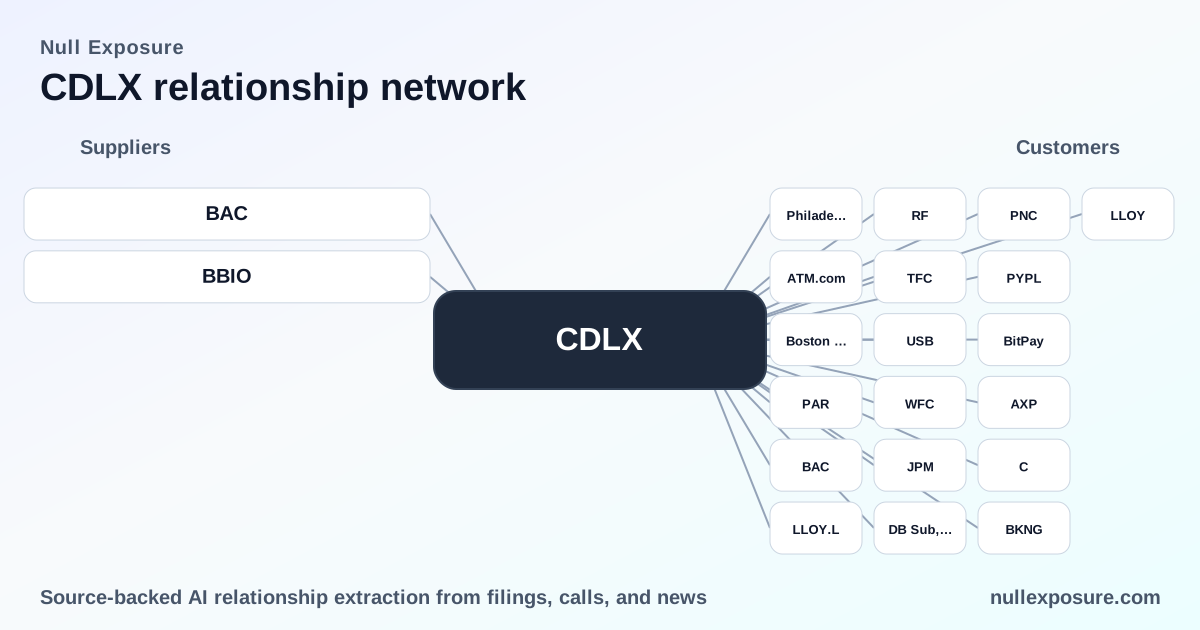
Cardlytics (CDLX): Bank partnerships are the product — the contracts are the moat
Cardlytics operates a purchase-based advertising platform embedded inside banks’ and fintechs’ digital channels and monetizes by selling targeted, measurable ad placements to national and local advertisers while sharing economics with its financial-institution partners. The company’s value proposition is first-party transaction visibility plus measurement; its economic model depends on bank distribution agreements, performance-based advertiser fees, and identity-resolution partnerships. Financially, Cardlytics generated $233.3M revenue TTM while remaining loss-making and highly leveraged to partner renewals and advertiser demand.
Explore supplier and counterparty signals for operational diligence: https://nullexposure.com/
What Cardlytics actually sells to advertisers and banks
Cardlytics packages aggregated, card-linked purchase signals into targeted marketing that runs inside bank apps, mobile channels, and communications. Advertisers pay for measurable lift and conversions; banks provide the data surface and get a share of revenue and increased customer engagement. This places Cardlytics between two sensitive constituencies—financial institutions (distribution) and brands (demand)—and makes contract terms, renewals, and identity-resolution capabilities strategic rather than tactical.
Supplier relationships you need on your radar
Below are the supplier/partner relationships surfaced in the recent monitoring set, each summarized in plain English with a source reference.
Bank of America — a strategic distribution partner that stepped away
Cardlytics lost a marquee distribution deal as Bank of America did not renew agreements that expired July 31, 2025, a development that directly reduces Cardlytics’ reach into a major U.S. retail banking customer base and signals banks’ desire to control and monetize first-party transaction data internally. (Markets FinancialContent coverage of the October 2, 2025 report: https://markets.financialcontent.com/stocks/article/marketminute-2025-10-2-cardlytics-shares-plummet-after-announcing-30-workforce-cut-amid-restructuring)
Bridg — identity resolution as an enabling supplier
Cardlytics leverages Bridg for identity resolution services that help translate anonymous, purchase-level signals into addressable audiences for advertisers, improving campaign reach beyond raw card data. (Press release noting identity-resolution relationship, January 16, 2026: https://markets.financialcontent.com/wral/article/bizwire-2026-1-16-cardlytics-announces-inducement-grant-under-nasdaq-listing-rule-5635c4)
What the contract- and supplier-constraints tell investors
Cardlytics’ disclosed constraints read like a compact operating model statement rather than isolated facts. Treat these as company-level signals about contracting posture, spend magnitude, and service dependency.
-
Long-term contracting stance with guaranteed spend: The company disclosed a renewal that guarantees $17.0M per year over a thirty-six month period, indicating Cardlytics does sign multi-year, committed agreements that smooth revenue visibility but also lock in counterparty expectations. This is a company-level signal of a preference for multi-year guarantees rather than purely transactional deals.
-
Material spend band: The same renewal maps to a $10M–$100M supplier spend band—evidence the firm operates at scale with meaningful single-counterparty economics when agreements exist, so loss of a major partner has outsized P&L impact.
-
Service-provider operating model: Cardlytics explicitly uses third-party providers for professional services, SaaS, managed services and cloud infrastructure, so operational resilience depends on vendor management and the maturity of those relationships.
These constraints imply a business that is contractually committed, operationally dependent on outsourced services, and economically sensitive to a small number of large counterparty agreements. None of the constraint excerpts name a specific partner; they should be read as company-level characteristics.
Risk and opportunity map for investors and operators
The business is simple to describe and complex to underwrite.
-
Key risk — client concentration and renewal cadence. The Bank of America non-renewal is the most tangible example: losing a major distribution partner reduces reach and advertiser ROI, and materially shifts revenue risk onto remaining bank relationships. (See Markets FinancialContent, Oct 2, 2025: https://markets.financialcontent.com/stocks/article/marketminute-2025-10-2-cardlytics-shares-plummet-after-announcing-30-workforce-cut-amid-restructuring)
-
Operational risk — outsourced tech and service providers. Cardlytics relies on third-party infrastructure and identity vendors; service continuity and data governance are operational dependencies that affect product performance and compliance.
-
Opportunity — identity resolution expands addressability. Partnerships like Bridg increase the ad product’s effectiveness by converting anonymous signals into known audiences, which supports higher advertiser spend-per-campaign and diversifies monetization beyond raw card-link performance. (Bridg mention, Jan 16, 2026: https://markets.financialcontent.com/wss/article/bizwire-2026-1-16-cardlytics-announces-inducement-grant-under-nasdaq-listing-rule-5635c4)
-
Corporate housekeeping — restructuring indicates cost remediation. Cardlytics has announced workforce reductions and other restructuring measures in recent filings and press reports as it pursues profitability and a leaner operating footprint. (See Markets FinancialContent coverage cited above.)
Take a closer look at Cardlytics partner signals and contractual footprints at https://nullexposure.com/ — validate renewals, contract length, and guaranteed spend when modeling downside scenarios.
How investors and operators should act
For investors: prioritize counterparty-readiness and scenario analysis. Model revenue with explicit shock scenarios for loss of 1–2 major bank partners, and stress-test advertiser CPMs and conversion rates absent identity-resolution uplift.
For operators and procurement teams: secure multi-year guarantees where possible, insist on clear performance clauses, and diversify identity-resolution and cloud infrastructure suppliers to reduce single-vendor risk. Contract terms and renewal cadence are the real moat; distribution is not durable without explicit contractual economics.
If you evaluate counterparties or need deeper supplier diligence, start with a targeted counterparty map and contract-parsing exercise on Cardlytics’ top bank partners and identity vendors — more resources and supplier intelligence are available at https://nullexposure.com/.
Bottom line
Cardlytics sells a unique combination of transactional measurement and bank-embedded reach, but its economic fate is tightly coupled to partner renewals and identity-resolution effectiveness. The loss of a marquee bank client materially re-rates risk; identity partnerships like Bridg provide tactical upside but do not replace distribution when a major bank leaves. Investors and operators must evaluate contract guarantees, spend concentration, and third-party service exposure as first-order inputs to valuation and operational plans.
Final action: review Cardlytics’ partner agreements, guaranteed-spend schedules, and supplier diversification before sizing exposure — tools and further supplier intelligence are available at https://nullexposure.com/.