CDMO supplier relationships: what investors and operators need to know
CDMO (ticker CDMO) operates as a contract development and manufacturing organization that monetizes through time‑and‑materials and milestone service contracts, facility slot utilization, and capital investments in GMP capacity that convert project pipelines into recurring manufacturing revenue. The company sells specialized development and commercial manufacturing services to biotech and pharma clients, captures margin through operational scalability and premium pricing for accelerated timelines, and leverages third‑party partnerships to extend upstream capabilities and compress delivery schedules. For a deeper view of relationships and supplier posture, see https://nullexposure.com/.
How the business actually makes money and what that implies for investors
CDMO’s core revenue model is project‑based services billed under fixed‑fee or T&M contracts and recurring manufacturing engagements that scale with client demand. The economics combine high gross margins on specialized services with significant working capital and CAPEX intensity, making capacity utilization and project throughput the principal drivers of near‑term cash flow. Contracting posture is project‑centric rather than subscription‑style: clients buy defined programs and often extend via follow‑on batches or process transfers. This structure creates high client criticality for assets in GMP production, concentration risk when large programs dominate capacity, and execution risk tied to construction, qualification, and regulatory timelines.
What the relationship set tells you about strategic posture and supply chain strategy
CDMO relies on external partners to fill technical and capital gaps in its offering. That approach signals a hybrid strategy: build core manufacturing and analytics in‑house while outsourcing specialized upstream science and turn‑key facility execution. This reduces time to market for clients and limits one‑time CAPEX spikes for CDMO when partnerships are non‑exclusive, but it increases dependency on supplier execution and alignment of program schedules.
For more context on supplier mapping and how these relationships affect valuation and operational risk, review our platform: https://nullexposure.com/.
Relationship details (every documented partner)
-
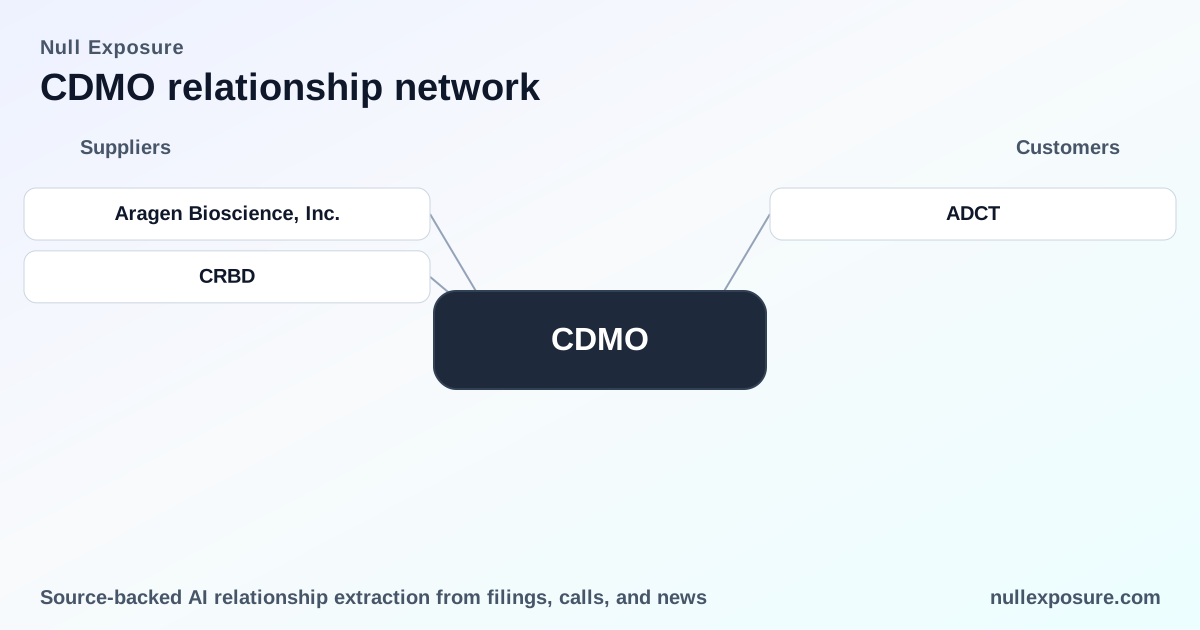
Aragen Bioscience, Inc. — In FY2020 CDMO entered a non‑exclusive agreement with Aragen to integrate Aragen’s cell line development with CDMO’s upstream, downstream, and analytical services so customers receive a combined pathway to CGMP bulk drug substance faster. This partnership is positioned to shorten overall timelines for deliverables and increase program throughput. According to a GlobeNewswire release in FY2020, the arrangement was explicitly framed to drive efficiencies and reduce development timelines. (GlobeNewswire, FY2020)
-
CRB (CRBD) — In FY2022 CDMO relied on CRB to design and construct a new viral vector facility in California using CRB’s ONEsolution™ project delivery approach; the facility reached a first‑phase opening in eight months. The engagement demonstrates CDMO’s use of specialist engineering & construction firms to accelerate capacity expansion and de‑risk project delivery timelines. A PR Newswire release in FY2022 highlighted CRB’s role in delivering the facility rapidly. (PR Newswire, FY2022)
Strategic implications for investors and operators
- Upside from capability extension: The Aragen deal expands CDMO’s upstream capabilities without requiring immediate in‑house R&D rebuild, increasing the addressable market for cell therapy and biologics programs. That accelerates potential revenue capture on high‑value programs and helps maintain pricing power for accelerated timelines.
- Capital execution and speed to market: The CRB relationship shows CDMO is willing to outsource EPC execution to compress timelines for capacity buildouts, which supports faster revenue ramp from new facilities but transfers execution risk to the contractor. Rapid facility delivery can materially accelerate cash generation, but it requires disciplined oversight and contingency planning during qualification and scale‑up.
- Commercial positioning: Non‑exclusive upstream agreements preserve CDMO’s ability to serve clients broadly and reduce single‑partner dependency on science capabilities, while contracting established EPC firms preserves balance sheet flexibility at the cost of partner reliance.
Operating model constraints and what’s not in the record
There are no explicit constraint entries in the provided relationship records. As a company‑level signal, no supplier constraints were documented in the source set, which does not imply absence of execution or regulatory risk — it simply reflects the available reporting. Investors should treat this as an information gap to address during diligence rather than proof of full supply‑chain resilience.
Key risks and due‑diligence prompts
- Client concentration: Project‑based revenue can be lumpy; verify top‑client exposure and the pipeline cadence for follow‑on batches.
- Single‑project execution risk: Outsourced facility build and critical upstream integrations introduce third‑party delivery risk; request contractor performance bonds, SLAs, and acceptance criteria.
- Regulatory qualification timelines: Fast facility openings (e.g., eight months) are commercially attractive but require clear validation plans; review PQ/OQ protocols and initial release criteria.
- Commercial terms: Non‑exclusive scientific partnerships improve flexibility but reduce capture of IP or proprietary process advantages; inspect economic sharing and exclusivity clauses.
How to act on this read
- For investors: prioritize conversations around capacity utilization rates, back‑log to committed revenue conversion, and the structure of partnership contracts (exclusivity, revenue share, and SLAs).
- For operators and procurement leads: demand transparent milestone schedules from EPC partners and integration playbooks for third‑party science collaborations to limit rework during tech transfer.
For a structured supplier-risk assessment and to compare CDMO’s partner set against peer CDMOs, visit https://nullexposure.com/ for practical tools and reporting.
Final takeaways
CDMO leverages partnerships to accelerate capability delivery while preserving financial flexibility, a model that creates both commercial upside and third‑party execution exposure. The Aragen collaboration strengthens upstream offering and program throughput; the CRB engagement validates an approach of outsourcing capital projects to specialist contractors to shorten time to revenue. Investors should prioritize evidence of contract alignment, capacity utilization, and contractor governance before extrapolating sustained growth trajectories.
Explore our broader coverage and supplier relationship analytics at https://nullexposure.com/ to convert these qualitative signals into actionable due diligence.