CareDx (CDNA): Supplier relationships, royalties and the roadmap for transplant diagnostics
CareDx is a specialty diagnostics company that sells transplant surveillance tests and related services, generating revenue primarily from clinical test volumes and recurring contracts while sustaining R&D through strategic collaborations and license arrangements. The business monetizes laboratory testing (AlloSure, AlloMap, HeartCare, AlloSure Lung), license-derived royalties, and partnerships that feed diagnostic product development; TTM revenue stands at $379.8M with gross profit of $256.6M, underlining a service-driven, margin-sensitive model. For a deeper supplier-risk profile and relationship monitoring, visit https://nullexposure.com/.
How CareDx operates and where the money comes from
CareDx operates a vertically integrated diagnostic platform focused on post-transplant patient management. The company processes clinical tests in central labs, bills payers and providers, and augments clinical capability through external collaborations and licensed intellectual property. Revenue is driven by recurring test volumes and diagnostic adoption, while margins are influenced by reagent and instrument costs plus royalty obligations disclosed in company filings. CareDx’s balance of top-line growth and negative EPS reflects ongoing investment in R&D and commercialization as the franchise scales.
Contracting posture, concentration and operational constraints
CareDx’s public disclosures describe a deliberate contracting posture: the company has negotiated long-term supply contracts in critical areas and entered multiple license agreements that carry royalty burdens. Company filings note a May 2018 license with Illumina that requires royalties in the mid-single to low-double digits, and an August 2023 university license with low-single-digit royalty terms. The filings also state reliance on a limited set of suppliers for key laboratory instruments and reagents and the use of third-party billing software that handles protected health information.
These facts produce several company-level signals for investors:
- Contracted supplier relationships are long-dated and operationally important, reducing short-term sourcing risk but introducing multi-year obligations.
- Royalty obligations are explicit and can pressure margins, given the mid- to low-double-digit structures disclosed.
- Supplier concentration is material to operations: inability to secure critical inputs would have a material adverse effect on manufacture and service delivery.
- Relationship maturity is high where long-term contracts exist; the company has invested in continuity plans and backups per filings.
Relationship snapshot: 10x Genomics — ImmuneScape collaboration
CareDx announced a collaboration with 10x Genomics to launch ImmuneScape, a multiomic research initiative designed to map immune activity in transplant rejection and therapeutic response. According to a TradingView news item (Mar 9, 2026), this program pairs CareDx clinical insight with 10x’s platforms to advance understanding of rejection biology. Bitget also reported on Mar 9, 2026 that ImmuneScape will leverage 10x’s Xenium spatial and Chromium Flex single-cell platforms to generate high-resolution immune maps that can inform future diagnostic development.
Why the 10x relationship matters to investors
The 10x Genomics collaboration is positioned as a high-value R&D partnership rather than an immediate revenue driver. High-resolution multiomic mapping can materially accelerate biomarker discovery and next-generation diagnostic design, which translates to longer-term product pipeline enhancement and potential competitive differentiation. The collaboration underscores CareDx’s strategy of partnering with platform technology providers to de-risk internal development and expand scientific reach.
Operational and financial implications you must consider
- R&D leverage, not instant cash: ImmuneScape enhances product roadmaps but will not materially add to near-term clinical test revenue; its value is realized through future diagnostic launches and clinical adoption.
- Margin pressure from royalties: Existing license agreements (Illumina, University) create a recurring cost layer that compresses gross margins on covered products; these are explicit obligations disclosed in company filings.
- Supply concentration risk remains: CareDx depends on a limited set of instrument and reagent suppliers for core tests, a company-level exposure that carries materiality if disrupted.
- Maturity and continuity: Long-term contracts and documented contingency planning reduce some operational volatility, signaling a mature supplier management posture.
These dynamics combine into a clear investor lens: CareDx is investing in scientific partnerships to protect future growth while operating under explicit royalty and supply-chain constraints that compress near-term operating leverage.
For ongoing monitoring of CareDx supplier exposure and partnership developments, check resources at https://nullexposure.com/.
Practical signals for portfolio and operations teams
Investors and operators should prioritize the following:
- Track clinical validation milestones from ImmuneScape and similar collaborations to assess timeline to commercializable assets.
- Model margin scenarios that incorporate disclosed royalty rates (university low-single digits; Illumina mid-single to low-double digits) to see sensitivity to price and volume changes.
- Monitor supplier concentration and any public notices about reagent or instrument availability; these are operationally critical to test throughput.
- Evaluate billing and data-service provider resiliency given the use of third-party systems for protected health information.
Closing view and recommended next steps
CareDx has built a defensible transplant diagnostics franchise with recurring revenue characteristics and deliberate scientific partnerships that should drive medium-term product differentiation. However, royalty obligations and supplier concentration are material constraints that will shape margins and execution risk. For analysts and operators, the priority is to convert high-quality R&D outputs from collaborations like ImmuneScape into validated, reimbursable tests while managing supplier risk and royalty drag.
For a continuous, business-focused view of supplier and partnership exposure for CareDx and comparable suppliers, visit https://nullexposure.com/. To begin tailored monitoring of CDNA supplier signals, go to https://nullexposure.com/.
Relationships covered in this note
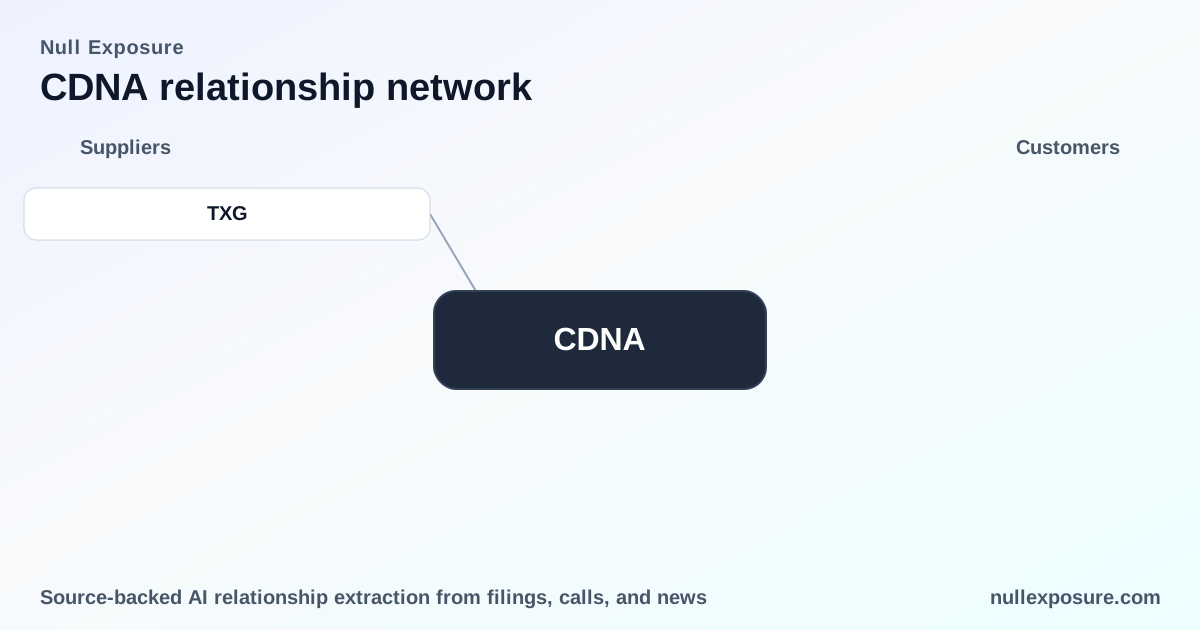
- 10x Genomics (TXG) — CareDx entered a collaboration to launch ImmuneScape, a multiomics research initiative intended to map immune mechanisms behind transplant rejection and therapeutic response; reported in news coverage on Mar 9, 2026 by TradingView and Bitget. (TradingView, Mar 9, 2026; Bitget, Mar 9, 2026)