Cardinal Infrastructure Group (CDNL): Supplier relationships, capital partners and operating signals investors need
Cardinal Infrastructure Group operates as a civil contractor focused on residential, commercial, industrial and municipal infrastructure projects, monetizing through project-based contracting, equipment and crew deployment, and ancillary site services. The company funds growth and working capital through project receipts and capital markets access—most recently evidenced by underwriter relationships tied to its initial public offering—and it manages property needs via third‑party lease arrangements. For investors evaluating supplier and counterparty risk, the mix of capital-market relationships and a discrete property lease are the most material partner signals today. Learn more at https://nullexposure.com/.
How Cardinal makes money and why these relationships matter
Cardinal invoices and collects on construction contracts, converting backlog into cash through phased project billing; margins are driven by project mix and execution efficiency. Capital partners such as underwriters affect liquidity and strategic optionality, while property leases indicate fixed‑cost exposure for operating subsidiaries. Cardinal’s reported metrics (FY‑TTM revenue near $395m, gross profit of ~$82m, and high insider/institutional ownership) show a business that is revenue‑scale with thin public‑market earnings visibility, so supplier and financial relationships have outsized impact on funding flexibility and operational continuity.
Company-level operating signals investors should read into
- Contracting posture: Cardinal runs a project‑centric civil contracting model with recurring project procurement cycles; this produces lumpy revenue and concentrated counterparties at the contract level.
- Concentration and criticality: The absence of many named long‑term supplier constraints in the available feed is a company‑level signal that financial counterparties (underwriters) and property lessors are the most visible external dependencies today.
- Maturity and capital posture: Multiple underwriters tied to the IPO indicate an active capital markets posture and institutional distribution support for equity, increasing potential for follow‑on financing capacity.
- Operational fixed costs: A commercial lease noted in FY2026 signals localized fixed‑cost commitments for a field subsidiary, relevant to short‑term cash flow under stress.
Explore Cardinal partner data and comparative supplier intelligence at https://nullexposure.com/.
Counterparties and filings: what recent records show
Below I cover every relationship extracted from the public results and the direct source for each item.
-
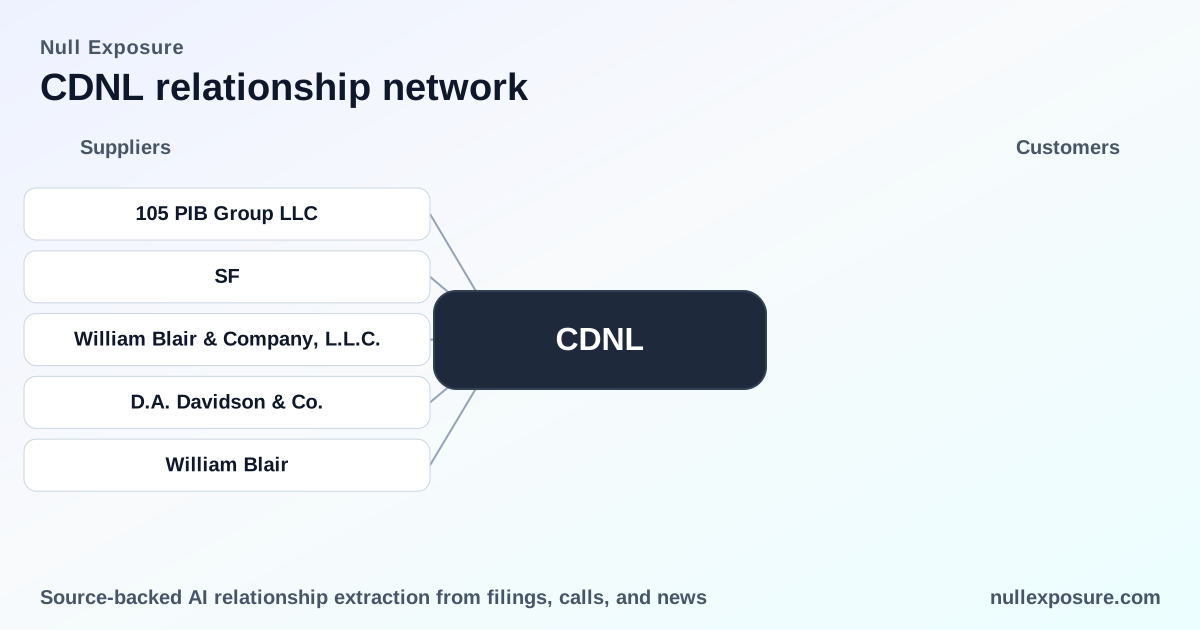
105 PIB Group LLC (lease with A.L. Grading Contractors, LLC) — A lease agreement dated February 18, 2026 relates to 105 Peachtree Industrial Boulevard in Suwanee, Georgia and ties a local property lessor to Cardinal’s field subsidiary, A.L. Grading. This is a direct operating lease commitment that creates localized site cost exposure for the business. (Source: 8‑K reported on StockTitan; FY2026 — https://www.stocktitan.net/sec-filings/CDNL/8-k-cardinal-infrastructure-group-inc-reports-material-event-ec5b6c7fd09d.html)
-
Stifel, Nicolaus & Company, Incorporated (book‑running manager, IPO) — Stifel is identified as a joint book‑running manager on Cardinal’s initial public offering, establishing a primary investment banking relationship for distribution and capital markets execution. (Source: Finviz news report on IPO pricing; FY2025 — https://finviz.com/news/250164/cardinal-infrastructure-group-inc-announces-pricing-of-initial-public-offering)
-
William Blair & Company, L.L.C. (book‑running manager, IPO) — William Blair served as the other joint book‑runner alongside Stifel on the offering, providing additional institutional placement support and syndicate distribution capacity. (Source: Finviz news report; FY2025 — https://finviz.com/news/250164/cardinal-infrastructure-group-inc-announces-pricing-of-initial-public-offering)
-
D.A. Davidson & Co. (lead manager, IPO) — D.A. Davidson is named as the lead manager for the offering, indicating primary coordination responsibilities for the deal and investor outreach. (Source: PR Newswire release announcing IPO pricing; FY2025 — https://www.prnewswire.com/news-releases/cardinal-infrastructure-group-inc-announces-pricing-of-initial-public-offering-302637279.html)
-
Stifel (PR Newswire mention, IPO) — Stifel’s role as a joint book‑running manager is also corroborated in the company press release announcing the IPO, reinforcing its strategic underwriter status. (Source: PR Newswire; FY2025 — https://www.prnewswire.com/news-releases/cardinal-infrastructure-group-inc-announces-pricing-of-initial-public-offering-302637279.html)
-
D.A. Davidson & Co. (Finviz listing of lead manager role) — The Finviz feed repeats D.A. Davidson’s lead manager role, confirming syndicate composition across multiple reporting channels. (Source: Finviz news republishing the IPO announcement; FY2025 — https://finviz.com/news/250164/cardinal-infrastructure-group-inc-announces-pricing-of-initial-public-offering)
-
William Blair (PR Newswire mention, IPO) — William Blair’s participation in the underwriting syndicate appears in Cardinal’s press materials, underscoring the multi‑bank distribution strategy. (Source: PR Newswire company release; FY2025 — https://www.prnewswire.com/news-releases/cardinal-infrastructure-group-inc-announces-pricing-of-initial-public-offering-302637279.html)
-
Stifel, Nicolaus & Company, Incorporated (StockTitan reiteration of IPO role) — StockTitan’s news record reiterates Stifel’s joint book‑runner appointment, offering a third independent publication of the same underwriting fact. This consistent reporting strengthens confidence in the disclosed syndicate. (Source: StockTitan IPO news republish; FY2025 — https://www.stocktitan.net/news/CDNL/cardinal-infrastructure-group-inc-announces-pricing-of-initial-dcpb6nlqqnn6.html)
-
William Blair & Company, L.L.C. (StockTitan reiteration of IPO role) — StockTitan also republishes William Blair’s participation, mirroring other outlets and confirming syndicated underwriting coverage. (Source: StockTitan; FY2025 — https://www.stocktitan.net/news/CDNL/cardinal-infrastructure-group-inc-announces-pricing-of-initial-dcpb6nlqqnn6.html)
-
D.A. Davidson & Co. (StockTitan reiteration) — StockTitan’s coverage includes D.A. Davidson as lead manager, consistent with PR and Finviz feeds and documenting multi‑channel reporting of the same capital markets relationship. (Source: StockTitan; FY2025 — https://www.stocktitan.net/news/CDNL/cardinal-infrastructure-group-inc-announces-pricing-of-initial-dcpb6nlqqnn6.html)
What these relationships mean for investors
- Capital-market relationships (Stifel, William Blair, D.A. Davidson) are consequential: they provide underwriting distribution and signal institutional engagement, which reduces liquidity risk for the equity and increases optionality for future capital raises. Underwriter diversity is a strength for a newly public infrastructure contractor.
- The lease with 105 PIB Group LLC creates a tangible fixed‑cost exposure for a field contractor unit and is operationally relevant if local project volumes fluctuate; leases of this type concentrate site‑level risk.
- No supplier‑side contractual constraints were extracted in the feed, which is a company‑level signal that the most visible external dependencies are financial and real‑estate related rather than long‑term vendor monopolies.
For deeper counterparty risk scoring and to see how Cardinal’s partner map compares across peers, visit https://nullexposure.com/.
Bottom line and investor action points
Cardinal is a revenue‑scale civil contractor with significant institutional backing from multiple underwriters and a small number of operational leases that create localized fixed commitments. For investors, the key monitoring items are near‑term project conversion, contract margin stability, and ongoing capital-market activity led by its underwriting partners. Priority actions: monitor syndicate activity for signs of follow‑on issuance, track lease renewals or terminations at the Peachtree Industrial Boulevard location, and watch quarterly billings to validate margin trends.
If you want a tailored briefing on Cardinal’s counterparty ecosystem or comparable supplier risk profiles, start here: https://nullexposure.com/.