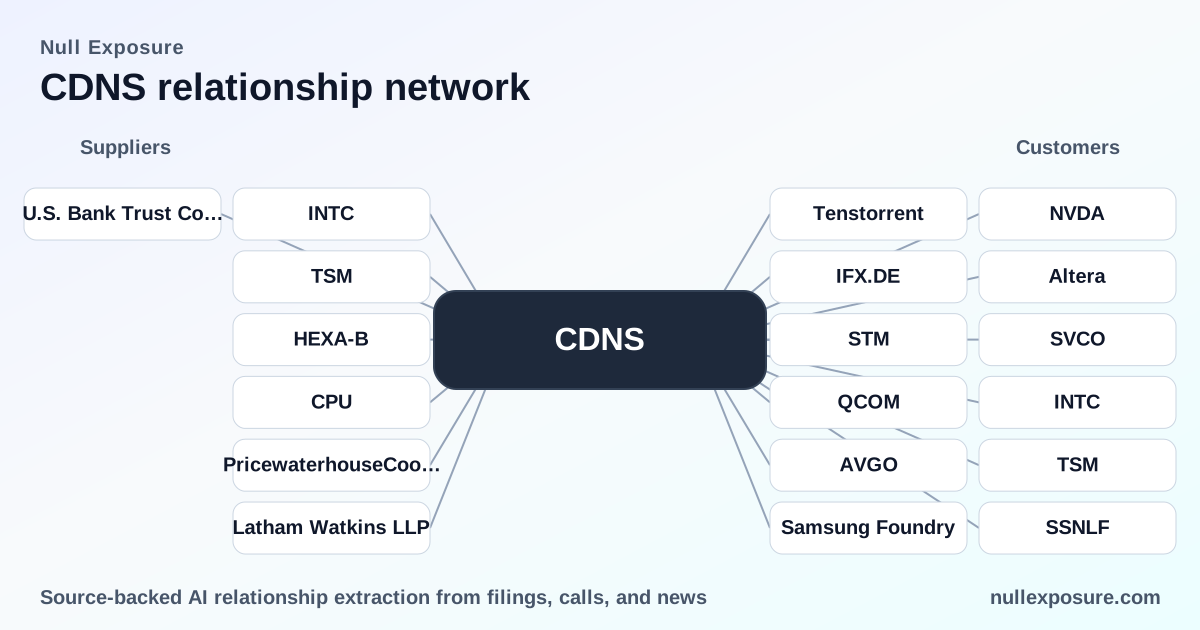
Cadence Design Systems (CDNS): Supplier Relationships and Operational Constraints that Shape Value
Cadence Design Systems builds the software, hardware and silicon structures engineers use to design integrated circuits, SoCs and PCBs, and it monetizes through a mix of software licenses, subscriptions, professional services and targeted hardware/IP sales. Revenue is recurring and high-margin, with growth driven by next‑generation node support and AI design flows, making supplier and service relationships important levers for time-to-market and customer enablement. For an investor-grade map of counterparty exposure and supplier concentration, visit https://nullexposure.com/.
Quick investor snapshot
Cadence is a large-cap software company with $5.30B revenue (TTM) and a market capitalization near $80.8B; margins are strong (operating margin ~32.8%, profit margin ~20.9%). The business model is fundamentally licensing- and services-driven, meaning third‑party suppliers largely support R&D, operations, legal/financial functions and channel enablement rather than generating direct product revenue.
Supplier and service relationships you should know (concise, source-backed)
Intel — strategic foundry engagement
Cadence publicly announced it joined the Intel Foundry Accelerator Design Services Alliance, strengthening collaboration on design flows and foundry enablement, according to comments on Cadence’s 2025 Q4 earnings call in March 2026. This is a strategic supply-channel relationship tied to foundry co‑optimization and customer enablement (2025 Q4 earnings call).
TSMC — collaboration on next‑gen AI process nodes
Cadence expanded collaboration with TSMC to power next‑generation AI flows on TSMC’s N2 and A16 technologies, per Cadence’s 2025 Q4 earnings call; that partnership underwrites Cadence’s relevance at the bleeding edge of process nodes and AI-centric design tool adoption (2025 Q4 earnings call).
Hexagon Smart Solutions AB — acquisition of design & engineering business
Cadence issued 3,224,473 shares of common stock as partial consideration for acquiring the design and engineering business of Hexagon Smart Solutions AB, disclosed in the company’s S‑3ASR prospectus related to its FY2026 filings. This signals inorganic expansion of engineering capabilities rather than a pure supplier contract (S‑3ASR / FY2026 filing).
Computershare Inc. — transfer agent and registrar
The company identifies Computershare Inc. as the transfer agent and registrar for its common stock, a standard corporate services relationship disclosed in the S‑3ASR prospectus for FY2026; this is administrative but essential for shareholder record keeping and transactions (S‑3ASR / FY2026 filing).
PricewaterhouseCoopers LLP — external auditor
Cadence’s FY2025 financial statements and internal control assessment were incorporated in reliance on PricewaterhouseCoopers LLP as the independent registered public accounting firm, which underpins financial reporting credibility and audit independence (S‑3ASR / FY2026 filing).
Latham & Watkins LLP — legal counsel on securities validity
The validity of the common stock offered in the prospectus is to be passed upon by Latham & Watkins LLP, indicating the firm’s role as principal securities counsel for the offering and related corporate legal work (S‑3ASR / FY2026 filing).
U.S. Bank Trust Company, National Association — indenture trustee
Cadence references a Base Indenture dated September 10, 2024, with U.S. Bank Trust Company serving as trustee, which establishes the bank’s role in bond/trust mechanics and debt administration for the company’s capital structure (S‑3ASR / FY2026 filing).
What the reported constraints say about Cadence’s operating model
Cadence reported $78.3 million of purchase obligations as of December 31, 2024, which the company characterizes as commitments for purchases of goods or services. From that disclosure two company-level signals follow:
- Contracting posture — buyer: The firm contracts with third parties and records purchase obligations, consistent with a corporate buyer that centralizes certain procurement decisions rather than relying exclusively on variable service relationships.
- Spend scale — $10M–$100M band: The size of recorded purchase obligations places Cadence’s discrete contractual commitments in the mid-range, implying meaningful but manageable supplier spend that is material enough to influence supplier negotiations without implying outsized concentration risk at the company level.
These constraints indicate a predictable procurement profile: commitments are large enough to require formal contracting and governance, but not so large that a single supplier likely dominates operating continuity. For investors, that implies supplier relationships are operationally important but not typically existential.
How these relationships affect valuation and risk
- Product road map and growth: Foundry partnerships with Intel and TSMC are value-enabling — they accelerate Cadence’s ability to monetize new process nodes and AI design flows. Those relationships are strategic and have positive leverage on addressable market expansion.
- Operational continuity: Corporate-service providers (Computershare, PwC, Latham, U.S. Bank) are standard governance and capital‑markets enablers; disruptions would be consequential for compliance and capital transactions but do not directly impair core product revenue.
- M&A and capability build: The Hexagon transaction paid with equity expands engineering capability and reduces time-to-market risk for certain product features; this is an integration risk with potential upside to product breadth and service depth.
Key investment considerations:
- Upside: Continued traction at leading foundries and successful integration of acquired engineering teams can sustain premium margins and revenue durability.
- Downside: Execution risk centers on integrating acquisitions and maintaining parity across multiple foundry processes; governance/service provider failures would be reputational or compliance risks rather than immediate revenue shocks.
If you are evaluating counterparty concentration or need a supplier-risk scorecard, start with a consolidated exposure map at https://nullexposure.com/ for investor-grade analysis.
Actionable diligence checklist for investors
- Confirm the operational scope of the Intel and TSMC collaborations in the latest quarterly filings and business development presentations.
- Review the Hexagon acquisition terms and integration milestones disclosed in FY2026 filings.
- Verify continuity arrangements with PwC, Computershare, Latham and U.S. Bank for audit, registrar, legal and trustee services to understand governance resilience.
For a systematic supplier exposure review and to benchmark Cadence against peers, visit https://nullexposure.com/.
Bottom line
Cadence’s supplier and service relationships are a mix of strategic engineering and foundry partnerships (Intel, TSMC), corporate services that underpin capital markets operations (Computershare, PwC, Latham, U.S. Bank), and targeted acquisitions (Hexagon) that expand technical capability. The company’s reported $78.3M of purchase obligations shows a buyer posture with mid‑size contractual commitments, which supports operational predictability without signaling acute supplier concentration. For investors focused on counterparty risk and operational continuity, Cadence’s partner map is supportive of its premium valuation, provided execution across node enablement and integration remains strong.
Explore the full supplier footprint and build a counterparty risk view at https://nullexposure.com/.