Cedar Realty Trust (CDR-P-B): Where the preferred yield meets operational retail real estate
Cedar Realty Trust’s 7.25% Series B cumulative redeemable preferred (CDR-P-B) delivers a fixed-income-style claim on a REIT that monetizes grocery-anchored retail through leasing cash flow and selective redevelopment and disposition activity. Investors buy CDR-P-B for stable, contractually cumulative dividends and issuer flexibility via the redeemable feature; operators and counterparties monetize Cedar’s portfolio through asset sales, leasing advisory, and legal and financial services relationships. Explore more supplier profiles and relationship intelligence at https://nullexposure.com/.
How this preferred instrument links to Cedar’s operating model
Cedar Realty is a grocery-anchored shopping center REIT that realizes value through rental income, tenant retention, and periodic asset sales and redevelopment. The Series B preferred stock is a senior dividend instrument with a fixed 7.25% coupon and cumulative payment obligation, which places a predictable cash distribution burden on the company ahead of common equity distributions. The redeemable characteristic gives Cedar the option to retire this capital under predefined terms, providing the balance sheet flexibility to optimize capital structure when market conditions are favorable.
From an operating-model standpoint, several characteristics stand out as investor-relevant signals:
- Contracting posture: Cedar operates with explicit contractual obligations to preferred holders (cumulative dividend payments and redeemability), which increases the priority of cash deployment to income investors.
- Concentration: The business focuses on grocery-anchored retail properties, creating tenant and sector concentration that links performance directly to grocery traffic and neighborhood retail fundamentals rather than diversified commercial asset classes.
- Criticality: Preferred dividend servicing is a critical short-term finance obligation; failure to meet cumulative dividends would materially alter investor recovery expectations and market perception.
- Maturity and optionality: Redeemable structure introduces issuer optionality on timing of capital repayment, a factor that affects duration risk for preferred holders even in the absence of a standard maturity date.
These company-level signals inform counterparty risk, covenant prioritization, and the types of supplier relationships Cedar maintains.
Supplier relationships and what they mean for investors
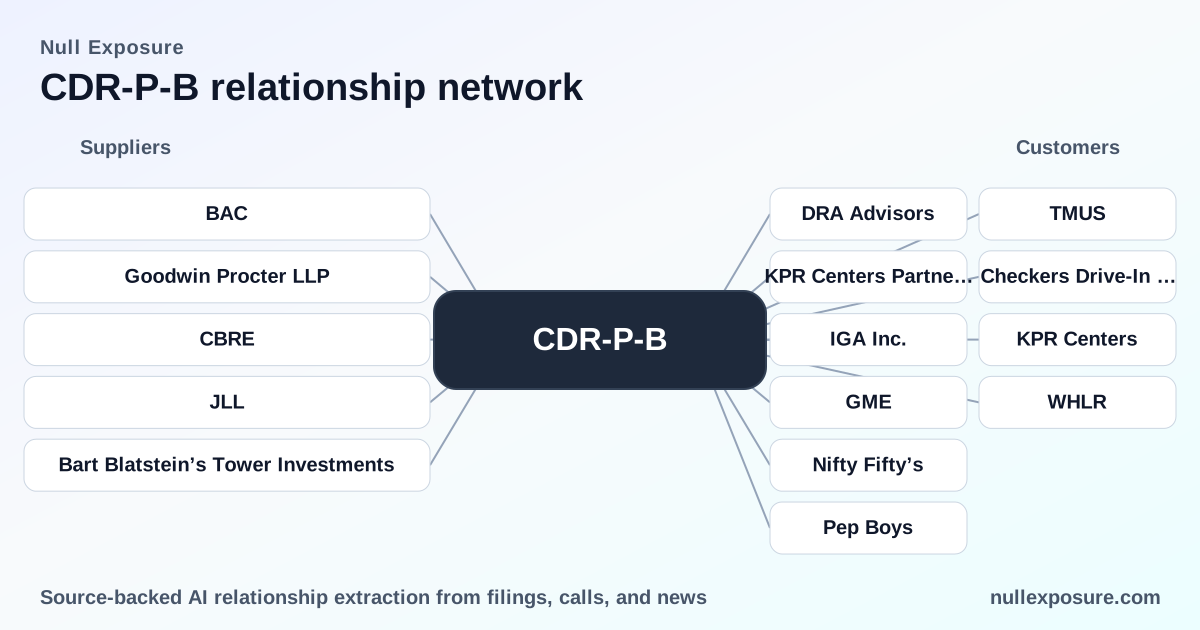
Below are every supplier relationship documented in available reporting, with concise takeaways and sourcing.
BofA Securities
BofA Securities acted as Cedar’s financial advisor in the context of board-level changes, signaling use of major investment-bank advisory capabilities for corporate governance and capital-marketing actions. Source: CityBiz reporting on Cedar’s director appointments (CityBiz, article at https://www.citybiz.co/article/49735/cedar-realty-trust-appoints-three-new-independent-directors/, cited in FY2021).
Goodwin Procter LLP
Goodwin Procter LLP served as legal counsel in the same engagement around Cedar’s board changes, indicating Cedar’s reliance on established national law firms for transaction and governance legal work. Source: CityBiz reporting (https://www.citybiz.co/article/49735/cedar-realty-trust-appoints-three-new-independent-directors/, cited FY2021).
CBRE
CBRE handled the sale of Cedar’s redevelopment projects, showing Cedar’s use of large global brokerage capabilities for executing higher-complexity dispositions tied to redevelopment value capture. Source: TheRealDeal coverage of Cedar’s portfolio sale (The Real Deal, https://therealdeal.com/new-york/2022/03/04/shopping-center-reit-cedar-realty-trust-sells-entire-portfolio-for-1-2b/, FY2022).
JLL
JLL advised Cedar on the sale of its grocery-anchored shopping center portfolio, which demonstrates Cedar’s segmentation of advisory roles across specialist brokers for portfolio versus redevelopment dispositions. Source: The Real Deal (https://therealdeal.com/new-york/2022/03/04/shopping-center-reit-cedar-realty-trust-sells-entire-portfolio-for-1-2b/, FY2022).
Bart Blatstein’s Tower Investments
Cedar acquired Riverview Plaza’s commercial properties from Bart Blatstein’s Tower Investments in a prior transaction, reflecting historical asset-level acquisitions sourced from local developers and investors. Source: Hidden City Philadelphia archival reporting on Riverview Plaza (HiddenCityPhila, https://hiddencityphila.org/2013/08/no-checkers/, FY2013 referencing a 2003 purchase).
What the supplier map implies about execution capability and counterparty risk
The supplier mix demonstrates a blend of global advisory and local transactional relationships. Using large brokerages (JLL, CBRE) for major dispositions and redevelopment sales signals Cedar’s execution strategy to extract institutional pricing for portfolio moves, while retaining legal and financial advisory relationships with recognized national firms for governance and transactional oversight. That profile supports an operator capable of orchestrating multi-faceted dispositions—an important read-through for preferred holders because successful asset sales and redevelopments improve the company’s ability to service preferred dividends and exercise redeemability advantageously.
Key operational takeaway: Cedar’s supplier relationships are weighted toward established market participants, which supports operational credibility and execution capacity but does not eliminate sector concentration risk tied to grocery-anchored retail fundamentals.
Explore detailed supplier intelligence and how these relationships influence counterparty exposure at https://nullexposure.com/.
Risk profile and practical implications for investors and operators
For investors evaluating CDR-P-B exposure, the primary considerations are cash-flow priority, sector concentration, and the issuer’s ability to execute on dispositions and redevelopments:
- Cash-flow priority: Preferred dividends are cumulative; the company must address these before distributing to common shareholders, elevating the importance of near-term rental collection and sale proceeds.
- Execution reliance: Cedar’s use of top-tier brokers and advisers reduces execution risk on large transactions, yet outcomes remain tied to retail asset market cycles and local leasing dynamics.
- Optionality risk: Redeemable feature creates issuer timing uncertainty—redeemability is an asset for the issuer and a duration risk for preferred holders if market conditions prompt early redemption.
Operators and lenders should also note that supplier selection shows a preference for scalable partners on complex transactions; counterparties that provide flexible capital and disposition platforms will find Cedar a natural counterparty.
Investment takeaway and next steps
Cedar’s 7.25% Series B preferred is a yield-focused instrument backed by a grocery-anchored retail operator that uses institutional advisors and brokers to execute strategic asset moves. For yield investors, the security offers prioritized income with issuer-call optionality; for market operators, Cedar’s supplier roster demonstrates access to execution capacity on portfolio sales and redevelopments.
- If your mandate prioritizes income with contractual seniority, CDR-P-B warrants consideration for a yield sleeve, subject to your view on grocery-anchored retail cash flows.
- If your mandate emphasizes downside protection or low-duration exposure, evaluate the redeemable feature and Cedar’s near-term disposition plan before allocating.
For a deeper look at Cedar’s counterparties and comparable supplier maps for other issuers, visit https://nullexposure.com/ and request the supplier profile that aligns with your diligence needs.