Cedar Realty Trust (CDR-P-C): who funds the preferred and what that means for investors
Cedar Realty Trust operates and monetizes as a grocery-anchored retail REIT: it acquires, manages and repositions neighborhood shopping centers and collects stable rental cash flows from essential-retail tenants, and funds that platform through a mix of equity (including its 6.50% cumulative redeemable preferred) and secured bank financing. The company relies on syndicated credit facilities and targeted capital transactions to preserve liquidity and to manage preferred-share obligations, making its preferred series an income instrument supported by active capital-management choices rather than a standalone yield play. For deeper partner mapping and transaction context visit https://nullexposure.com/.
How Cedar funds operations and protects preferred income
Cedar’s operating model is the classic, capital-intensive REIT playbook: stable rent roll from grocery-anchored assets, combined with opportunistic asset sales and credit-market financing to manage balance-sheet obligations. The 6.50% Series C preferred is cumulative and redeemable, so Cedar’s ability to service and ultimately redeem these securities depends on access to syndicated bank facilities and capital recycling. Recent public reporting shows Cedar both amended an existing credit facility and used new KeyBank facilities alongside asset-sale proceeds to repurchase preferred shares — a direct example of financing driving shareholder-return mechanics. Learn more on supply-chain and partner exposure at https://nullexposure.com/.
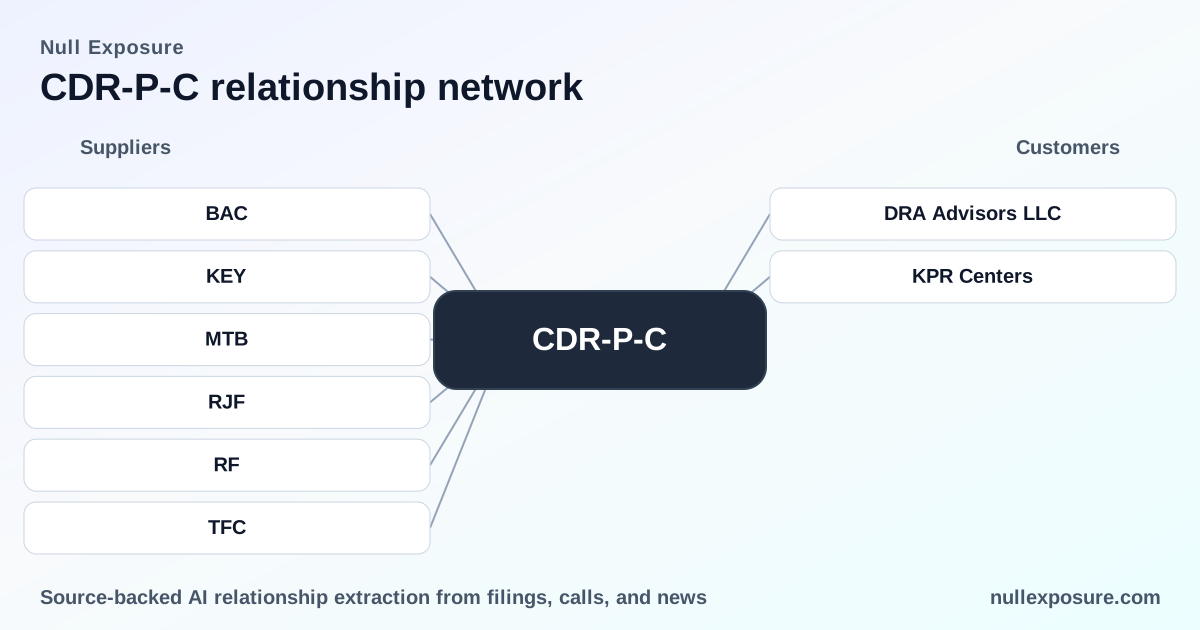
The bank group in plain English — every relationship found in the record
-
Bank of America, N.A. — Bank of America served as the syndication agent on Cedar’s amended $185 million credit facility, positioning it as the primary bank responsible for arranging commitments from other lenders. (CityBiz article, March 9, 2026: https://www.citybiz.co/article/138261/cedar-realty-trust-names-jennifer-bitterman-chief-financial-officer/)
-
KeyBank National Association / KeyBank — KeyBank acted as the administrative agent on the amended $185 million facility and later provided new credit facilities used, together with asset-sale proceeds, to repurchase and retire Series C and Series B preferred shares during 2024–2025. That financing reduced liquidation preference and future preferred dividend obligations. (CityBiz report, March 9, 2026; filing summary reported via StockTitan referencing FY2025 activity: https://www.citybiz.co/article/138261/cedar-realty-trust-names-jennifer-bitterman-chief-financial-officer/; https://www.stocktitan.net/sec-filings/CDR/)
-
Manufacturers and Traders Trust Company (M&T) — M&T participated as a co-documentation agent in the amended credit facility, signaling its role in supporting legal and administrative execution of Cedar’s secured borrowing structure. (CityBiz article, March 9, 2026: https://www.citybiz.co/article/138261/cedar-realty-trust-names-jennifer-bitterman-chief-financial-officer/)
-
Regions Bank — Regions Bank is listed as a co-documentation agent on the amended loan package, reflecting a multi-bank execution that spreads administrative and documentation responsibilities across the syndicate. (CityBiz article, March 9, 2026: https://www.citybiz.co/article/138261/cedar-realty-trust-names-jennifer-bitterman-chief-financial-officer/)
-
Regions Capital Markets — Regions Capital Markets joined the tranche as a co-lead arranger on the amended term loan, indicating a capital-markets-facing role in structuring and distributing debt capacity for Cedar. (CityBiz article, March 9, 2026: https://www.citybiz.co/article/138261/cedar-realty-trust-names-jennifer-bitterman-chief-financial-officer/)
-
Raymond James Bank, N.A. — Raymond James is listed among the participating banks in the credit group, providing incremental lending capacity and syndicate breadth to the facility. (CityBiz article, March 9, 2026: https://www.citybiz.co/article/138261/cedar-realty-trust-names-jennifer-bitterman-chief-financial-officer/)
-
Truist Bank — Truist joined the bank group as a participating lender, further diversifying Cedar’s lending relationships across regional and national banks. (CityBiz article, March 9, 2026: https://www.citybiz.co/article/138261/cedar-realty-trust-names-jennifer-bitterman-chief-financial-officer/)
Each of these relationships is documented in the same CityBiz coverage of Cedar’s corporate developments and in a filing summary that tracks preferred-share repurchases tied to KeyBank facilities and asset sales (StockTitan summary of FY2025 filings). Together they form the financing architecture that supports preferred liquidity actions.
What the partner mix implies about Cedar’s operating posture
-
Contracting posture: Cedar runs a syndicated, multi-institution financing model rather than relying on a single lender. That structure signals an intentional de-risking of lender concentration and allows the company to allocate administrative and distribution roles across banks (administrative agent, syndication agent, co-lead arrangers, co-documentation agents).
-
Concentration and criticality: While no single bank dominates the disclosed arrangements, KeyBank’s dual role—as administrative agent and as provider of new credit used in preferred repurchases—elevates its importance relative to other syndicate members. That makes KeyBank a critical counterparty for Cedar’s preferred-liability management.
-
Maturity and financial sophistication: The use of an amended $185 million facility and targeted repurchases of preferred shares with bank funding and asset-sale proceeds demonstrates an active capital-management program rather than passive funding. This is consistent with a mid-to-mature REIT that leverages credit markets to manage cost of capital and reduce future dividend obligations.
-
Operational implications for investors: For holders of CDR-P-C, the combination of cumulative dividend terms and a track record of using bank financing to retire preferred liabilities is a net positive for downside protection — but it also ties preferred security outcomes to the company’s ongoing access to syndicated credit markets.
If you’re mapping counterparties or stress-testing preferred coverage scenarios, our partner profiles and counterparty concentration analysis can accelerate diligence — learn more at https://nullexposure.com/.
Key investment takeaways and risks
-
Takeaway: Cedar’s preferred is supported by a proactive financing strategy: syndicated facilities, asset sales, and targeted repurchases have reduced liquidation exposure and future dividend drain. This is a materially positive credit signal for income-focused investors.
-
Risk: The preferred’s resilience depends on continued bank access and the REIT’s ability to generate asset-sale proceeds and stable retail income; KeyBank’s outsized operational role is a single-point dependency relative to other syndicate participants.
-
Actionable monitor points: Watch for announcements of facility amendments, changes in lead arranger composition, and further preferred retirements — each alters both redemption risk and dividend coverage.
For a comprehensive view of Cedar’s counterparty network and how it changes over time, visit https://nullexposure.com/.
Cedar’s capital strategy is not static; it is an ongoing interplay between the rent roll, asset dispositions, and a distributed bank syndicate. For investors and operators evaluating CDR-P-C, the bank group dynamics described above are central to understanding how preferred holders are prioritized and protected.