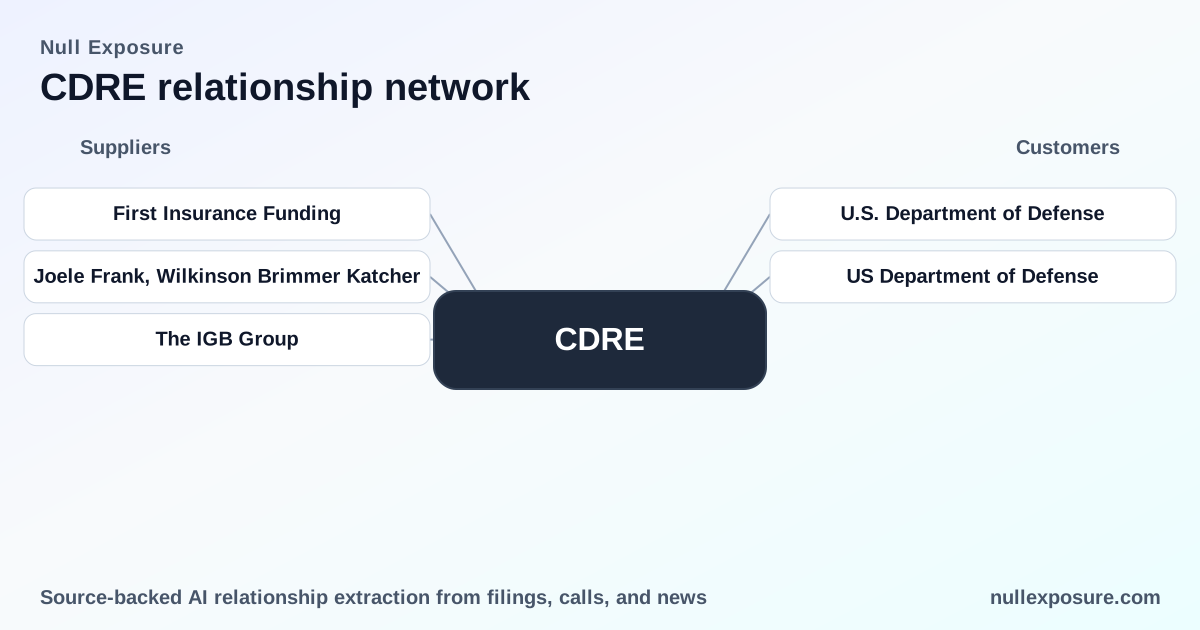
Cadre Holdings (CDRE) — supplier relationships that matter to investors and operators
Cadre Holdings manufactures and distributes safety and survival equipment for industrial, aerospace and defense customers and monetizes primarily through product sales and distribution channels, supported by corporate finance and investor-relations activities that keep access to capital and market visibility intact. The company reports roughly $610 million in trailing revenue, a ~13.4% operating margin, and a market capitalization near $1.34 billion, which frames how small supplier and service relationships can still affect execution and reputation. For procurement and investor teams evaluating counterparties, the vendor map is compact and focused on operational necessities (insurance and credit) and outsourced communications — all observable in public filings and press releases. Visit the Nillexposure home page for the full supplier intelligence platform: https://nullexposure.com/
Quick read: the relationships on file and what they do
Below are every supplier/relationship recorded in the public record for Cadre in the supplied results, each summarized in plain English with the supporting source.
-
First Insurance Funding — Cadre used a short-term premium financing facility of $3,948 with First Insurance Funding, with a maturity date of June 27, 2024, reflecting an operational financing arrangement for insurance costs; this is documented in Cadre’s 2024 Form 10‑K. (Source: Cadre 2024 Form 10‑K, FY2024)
-
Joele Frank, Wilkinson Brimmer Katcher — The firm is listed as media contact on Cadre press releases announcing dividend actions and other corporate news in 2025–2026, indicating Cadre outsources communications to established PR counsel. (Source: StockTitan-distributed press releases quoting Joele Frank as media contact, March 2026)
-
The IGB Group — Named as investor-relations contact on the same Cadre press releases covering dividends and corporate updates, signaling reliance on an external IR firm for shareholder communications. (Source: StockTitan-distributed press releases listing The IGB Group, March 2026)
What the supplier list says about Cadre’s operating posture
The supplier footprint is deliberate and compact. Cadre uses targeted, low-dollar financial instruments for operational continuity and outsources external communications to specialist firms, rather than maintaining large in-house teams for PR/IR. This structure produces several observable company-level characteristics:
-
Contracting posture: Public filings show Cadre executes short-term financing and standard credit agreements incorporated in its S‑1/10‑K exhibits, reflecting a conventional corporate finance posture that leverages external lenders and premium financers for working capital and insurance obligations. The 10‑K explicitly references a short-term insurance loan and prior registration statement exhibits include a credit agreement with PNC Bank and lenders. (Source: Cadre 2024 Form 10‑K and Form S‑1 exhibits)
-
Concentration and criticality: The supplier relationships on record are non-concentrated and operationally tactical — a small insurance financing line and external communications providers — so no single supplier on the list is structurally critical to Cadre’s revenue generation, though insurance financing is operationally important for risk transfer and continuity. (Company filings: FY2024 10‑K; press releases March 2026)
-
Maturity and governance signals: The use of established PR/IR firms and formal credit agreements indicates mature corporate governance and market-facing discipline: Cadre prioritizes investor communications and structured lender relationships over ad hoc arrangements. (Source: StockTitan press releases; Form S‑1 exhibits)
Risk implications investors and operators should weight
Cadre’s visible supplier footprint is light, but that creates distinct risk vectors investors must monitor.
-
Operational risk is low-dollar but real. The recorded insurance premium financing ($3,948) is immaterial to financial statements but signals the company uses short-term external financing to manage insurance obligations, a normal practice that requires oversight of renewal terms and counterparties. (Source: Cadre FY2024 10‑K)
-
Reputational and information-risk depends on PR/IR firms. Outsourced communications to Joele Frank and The IGB Group centralize message control; errors or delayed disclosures through these channels have outsized visibility. Cadre’s choice of nationally recognized firms reduces execution risk but raises dependence on external counsel for timely investor-facing disclosures. (Source: StockTitan press releases, March 2026)
-
Counterparty diversity is limited in the public record. While not evidence of operational weakness, the small set of disclosed supplier relationships suggests procurement diversification and contractual terms should be reviewed by operators to avoid concentration in unrecorded but material services (logistics, key component suppliers) that are not visible in these filings. (Company-level signal drawn from filings and disclosed relationships)
-
Corporate governance cues. The S‑1/exhibit references to an employment agreement with a named executive indicate executive-level contracts are formalized and disclosed, a governance feature investors should map when assessing insider incentives and retention risk. (Source: Form S‑1 exhibit references)
Practical next steps for procurement and investor teams
For investors and operational leaders evaluating supplier risk and negotiating posture, prioritize these actions:
-
Validate insurance-financing continuity: confirm whether the premium financing arrangement was a one-off operational tool or part of a recurring program and review renewal terms and counterparty credit. (Helpful resource: https://nullexposure.com/)
-
Audit PR/IR dependencies: ensure service-level agreements with Joele Frank and The IGB Group include timeliness guarantees and escalation protocols for material disclosures to protect share-price sensitivity.
-
Expand supplier mapping beyond public filings: the limited supplier list in filings points to hidden supply-line risk; procurement teams should pressure-test the vendor base for critical components and logistics partners that do not appear in current public records. (Learn more at https://nullexposure.com/)
Final read: what investors should take away
Cadre’s public supplier footprint is small and focused: operational finance (short-term premium financing) and external communications (PR/IR). These relationships are consistent with a company that runs a lean supplier model while leaning on established service providers for market access and compliance. The financials — ~$610M revenue, double-digit operating margin, and institutional ownership north of 76% — show Cadre has the scale to absorb modest supplier disruptions, but investors must watch corporate communications and lender arrangements for episodic risk. For an organized, third-party view of supplier relationships and contract signals, review the platform at https://nullexposure.com/ — it is a practical next step for teams that need to translate small counterparty links into actionable risk controls.