CDROW (Codere Online Luxembourg S.A. Warrants): Supplier Relationship Profile and Risk Takeaways
Codere Online Luxembourg operates online games and sports betting across Latin America and monetizes through customer wagers, platform fees and digital gaming revenue; as a warrant listed under CDROW, investors are effectively taking a leveraged exposure to the operator’s cash flow generation rather than an equity stake. The company reports Revenue TTM of $203.9M and Gross Profit of $185.9M, while showing a thin operating margin and a deeply negative reported EPS, signalling an asset with healthy top-line economics but capital-structure and earnings volatility. For a concise view of supplier exposure and relationship signals, see https://nullexposure.com/.
Quick take: why supplier relationships matter for CDROW investors
Supplier relationships are operational levers for online gaming — platform providers, payment processors, content licensors and regional partners drive service continuity and regulatory compliance. Any single supplier failure or contractual deterioration can impose outsized revenue disruption, particularly given cross-border dependencies in Latin America and the warrant instrument’s sensitivity to issuer performance. For more supplier profiles and practical intelligence, visit https://nullexposure.com/.
What the public record shows about supplier exposure
Public records captured in the available news feed are sparse but explicit on one theme: third‑party provider risk is a disclosed line item in the company’s risk inventory. A news item published by Sahm Capital on November 17, 2025, quoted an excerpt that lists “the risk that third‑party providers, including the Codere Group, are not able to fully and timely meet their obligations.” That language is a straightforward admission of supplier dependency (Sahm Capital, Nov 17, 2025: https://www.sahmcapital.com/news/content/codere-online-appoints-marcus-arildsson-as-chief-financial-officer-2025-11-17).
Operating model signals you should treat as company-level constraints
There are no extracted contractual constraint documents in the available record, so the following are company-level signals derived from disclosed economics and the supplier-risk mention:
- Contracting posture: The firm demonstrates an operational model that relies on external partners for critical functions; public disclosures explicitly allocate risk to third‑party providers. This signals standard outsourced arrangements rather than fully vertically integrated platform ownership.
- Concentration: The public record provides limited supplier visibility; the explicit mention of third-party risk without a list of alternatives is a signal of potential supplier concentration and limited redundancy.
- Criticality: Given online gaming’s reliance on payments, platform uptime and licensed content, suppliers are operationally critical to revenue continuity — downtime or contractual breakdowns would produce immediate revenue impact.
- Maturity: Gross margin structure (gross profit nearly matching reported revenue) implies a mature, digital-native cost base for core product delivery, but earnings and capital structure are not mature — negative EPS and low EBITDA relative to revenue point to leverage and financial fragility.
These are company-level constraints; no extracted contract excerpts in the record explicitly attach these constraints to a named supplier other than the relationship noted below.
Middle-ground operational reading for investors
Codere Online’s financial snapshot combines high revenue with high gross profitability and thin operating earnings. This produces two clear operational facts: the platform can generate margin on wagers, but earnings volatility and counterparty risk are the primary pathways for downside to warrant holders. Monitor supplier uptime SLAs, payment processor stability, and license renewals as high-return areas for due diligence. If you need deeper supplier intelligence, consult the supplier catalogue at https://nullexposure.com/.
Every identified relationship in the record
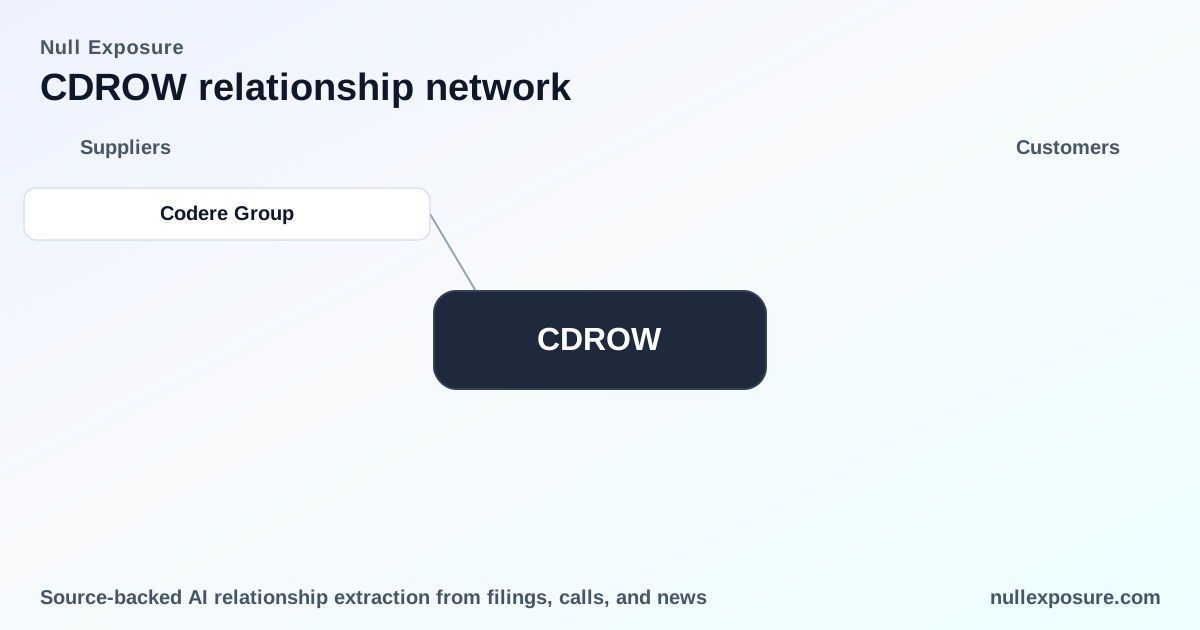
- Codere Group — The only relationship extracted in the available results is a reference to the Codere Group as a named third‑party provider in a risk disclosure that warns the group could fail to meet obligations, which emphasizes supplier dependence in the company’s public risk language (Sahm Capital, Nov 17, 2025: https://www.sahmcapital.com/news/content/codere-online-appoints-marcus-arildsson-as-chief-financial-officer-2025-11-17).
Investment implications and priority risk checks
- Operational dependency risk: The explicit disclosure on third‑party providers is a red flag for investors who value operational resilience; validate redundancy and fallback arrangements with counterparties.
- Earnings volatility: Negative EPS and modest EBITDA relative to revenue underscore balance-sheet sensitivity; any supplier-induced revenue disruption will materially affect valuation for warrant holders.
- Regulatory and geographic exposure: Latin American markets impose licensing and payment compliance demands that heighten supplier criticality; ensure counterparties meet local regulatory standards.
- Transparency gap: Public information on supplier bases is limited; this creates an information asymmetry that increases execution risk for investors conducting scenario analysis.
For practitioners and analysts: prioritize vendor continuity clauses, termination triggers, and financial exposure to single suppliers when modeling downside scenarios.
Actionable next steps for investors and operators
- Request counterparty lists and contract tenors during diligence, with emphasis on payments and platform providers.
- Stress-test cash flow models for supplier-induced revenue shocks rather than only market-volume scenarios.
- For operators negotiating with the company, insist on clear SLA language and financial remedies for nonperformance.
For a consolidated platform to compare supplier signals across issuers and to access curated relationship intelligence, go to https://nullexposure.com/.
Bottom line
Codere Online’s public profile shows strong top-line economics but concentrated operational risk driven by third‑party dependencies and financial leverage. Warrant investors require focused diligence on supplier continuity and contractual protections because supplier failures directly translate into valuation impairment for a leverage instrument. Operators and counterparties should treat supplier SLAs, regulatory compliance and redundancy as the primary mitigants. For ongoing monitoring and additional supplier relationship intelligence, visit https://nullexposure.com/.