Conduit Pharmaceuticals (CDT): Strategic supplier map and what it means for investors
Conduit Pharmaceuticals monetizes by licensing and developing clinical-stage assets—combining acquired clinical compounds and proprietary solid‑form cocrystal programs, then advancing those assets through early clinical development to generate value through out‑licensing, sublicensing revenue shares, and equity‑based consideration. The company leverages licensing deals with large pharmas, outsources development and manufacturing to CRO/CMO partners, and supplements its internal capabilities with AI and advisory relationships to accelerate asset evaluation and commercialization.
For a concise, interactive supplier risk map and relationship monitor, visit https://nullexposure.com/ for enterprise-grade discovery and tracking.
How Conduit builds a capital-efficient development model
Conduit’s operating model is explicitly externalized: the firm licenses clinical assets from large pharmaceutical firms, relies on third‑party contract research and manufacturing organizations for preclinical and clinical supply, and uses boutique advisory and AI partners to package assets for out‑licensing. The monetization vector is clear—equity and stock‑issuance consideration at acquisition, development through outsourced spend, and downstream sublicense revenue sharing on licensed assets. This model reduces fixed infrastructure costs but concentrates execution risk in supplier and counterparty performance.
A mid‑deck action: if you evaluate supplier concentration and revenue dependency across early‑stage biotechs, start tracking Conduit’s counterparties at https://nullexposure.com/ to benchmark counterparties and contract maturities.
Relationship roll call — every partner referenced in company materials and press
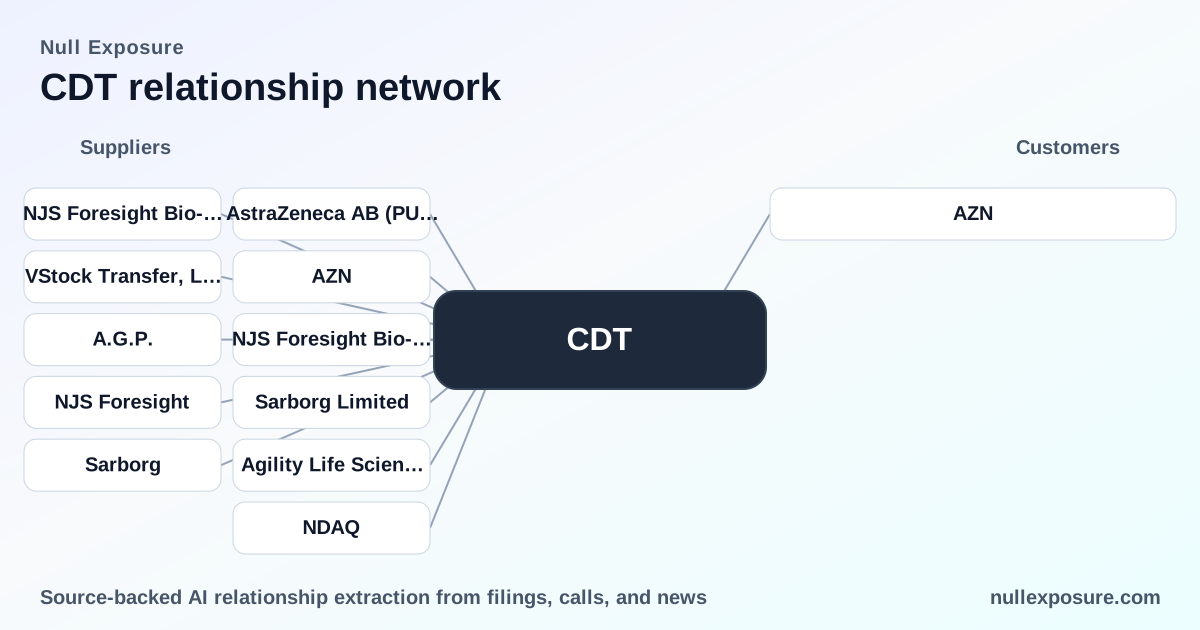
Below are the counterparties mentioned across Conduit’s filings and press coverage, with a plain‑English description and source for each.
-
AstraZeneca / AstraZeneca AB (PUBL) — Conduit licensed several clinical assets (AZD1656, AZD5658, AZD5904) from AstraZeneca and will be responsible for their development and commercialization; the deal included issuance of Conduit common stock to AstraZeneca and a share of future sublicense revenues, plus transfer of preclinical/clinical data and drug supplies. Sources: Conduit FY2024 10‑K (License Agreement dated August 7, 2024) and a Pharmaceutical‑Technology report on the asset acquisition (FY2024/FY2025 reporting).
-
NJS Foresight Bio‑Advisory, LLC / NJS Foresight — Conduit engaged NJS Foresight to identify and execute out‑licensing opportunities for selected solid‑form patents, effectively outsourcing business development and deal execution for that asset class. Source: GlobeNewswire distribution reported by The Manila Times and related press (FY2026).
-
Sarborg Limited / SARBORG Limited / Sarborg — Conduit has an active collaboration with Sarborg to apply proprietary signature analysis and AI capabilities to asset evaluation, and has taken a strategic stake to deepen that relationship and integrate AI into discovery and trial monitoring workflows. Source: Conduit press releases covered by StockTitan and The Manila Times (FY2025–FY2026).
-
Agility Life Sciences — Conduit has a strategic services agreement with Agility Life Sciences (a formulation development CDMO) specifically to develop new solid oral‑dosage form products derived from its solid‑form patent portfolio. Source: company profile coverage on SimplyWallSt (FY2025).
-
Nasdaq (NDAQ) — Nasdaq is referenced in relation to a corporate action: Conduit completed a reverse stock split and retained its listing on The Nasdaq Stock Market under the ticker “CDT,” with a new CUSIP assigned. Source: StockTitan coverage of the reverse split announcement (FY2025).
-
VStock Transfer, LLC — VStock Transfer serves as Conduit’s transfer agent and was named as the exchange agent for the reverse stock split. Source: StockTitan reporting on the reverse split and transfer agent role (FY2025).
-
A.G.P. — Conduit engaged A.G.P. in financing activities, including convertible promissory notes and a Sales Agreement to raise additional capital. Source: Conduit FY2025 disclosures summarized by TradingView (SEC 10‑K summary, FY2025).
Note: several names in press coverage are variants of the same counterparties above (AstraZeneca cited repeatedly across filings and press; Sarborg appears in multiple press items). Each listing above consolidates the available references into a single, actionable description.
What the documented constraints imply about Conduit’s operating posture
Conduit’s disclosed contracts and operational excerpts reveal a consistent business model profile:
-
Contracting posture: the balance of evidence is licensing‑centric. Conduit acts as a licensee of clinical assets from large pharmas (AstraZeneca) while also structuring out‑licensing and sublicense revenue arrangements, and executing capital raises with placement agents such as A.G.P. (company‑level signal and AstraZeneca license explicitly named).
-
Supplier roles and criticality: Conduit relies heavily on third‑party service providers (CROs/CMOs) for preclinical testing, clinical trials, and manufacturing; the company acknowledges sole‑source and single‑supplier exposures for certain clinical supplies, which elevates operational risk if a supplier fails to deliver (company‑level signal). The constraints explicitly identify Charles River Laboratories under a five‑year Master Services Agreement for preclinical testing (constraint excerpt names Charles River), and Sarborg under a 12‑month service agreement for AI/cybernetic services (constraint excerpt names Sarborg).
-
Contract maturity and concentration: Contract terms are mixed—there is at least one multi‑year MSA (Charles River) and several shorter‑term or renewable agreements (Sarborg). This creates near‑term execution dependencies but also planned renewal points to renegotiate terms. The license from AstraZeneca sets development and commercialization responsibilities squarely with Conduit, increasing strategic upside but also execution burden.
-
Business model characteristics: The firm is asset‑light with concentrated supplier exposure and a capital‑efficient growth plan driven by licensing income and out‑licensing proceeds; that structure accelerates upside if development milestones are reached, and concentrates downside if key CRO/CMO or data suppliers underperform.
Investment implications — upside drivers and concentrated risks
-
Upside drivers: the AstraZeneca license brings immediate clinical‑stage assets, transferable data, and in‑kind drug supply—these accelerate pipeline value realization without heavy capex. The Sarborg AI and NJS Foresight BD engagements create scalable pathways to identify high‑value out‑licensing partners and shorten time to monetization.
-
Concentrated execution risk: reliance on third‑party manufacturers and sole‑source APIs (company disclosures) plus a small institutional investor base and limited market cap underscore operational and liquidity fragility. A single supplier failure or clinical setback on a licensed asset would materially affect projected cash flows.
-
Capital structure sensitivity: engagement with A.G.P. and recent corporate actions (reverse split) signal active balance‑sheet management; Conduit’s ability to fund ongoing outsourced development is a gating factor for value realization.
Next steps for an investor due diligence program
- Request the full AstraZeneca License Agreement and confirm the scope of sublicensing economics, milestones, and manufacturing transition rights (critical to valuation).
- Validate CRO/CMO supply continuity and contract fallback provisions, particularly for sole‑source clinical supplies.
- Monitor SARBORG AI integration metrics and NJS Foresight’s progress on securing out‑licensing term sheets.
For an actionable supplier risk assessment and granular contract mapping, see the platform at https://nullexposure.com/ — it delivers the relationship intelligence investors require.
Bottom line and call to action
Conduit operates a licensed‑asset, asset‑light model that magnifies upside from successful out‑licensing while concentrating execution risk in a small set of third‑party providers and a major licensor (AstraZeneca). Investors should weight the value of the acquired clinical assets and data against the company’s reliance on external CROs/CMOs and its nascent commercialization engine.
To evaluate counterparties, track contract tenors, and benchmark supplier concentration for Conduit and comparable biotechs, begin with a targeted supplier dossier at https://nullexposure.com/.