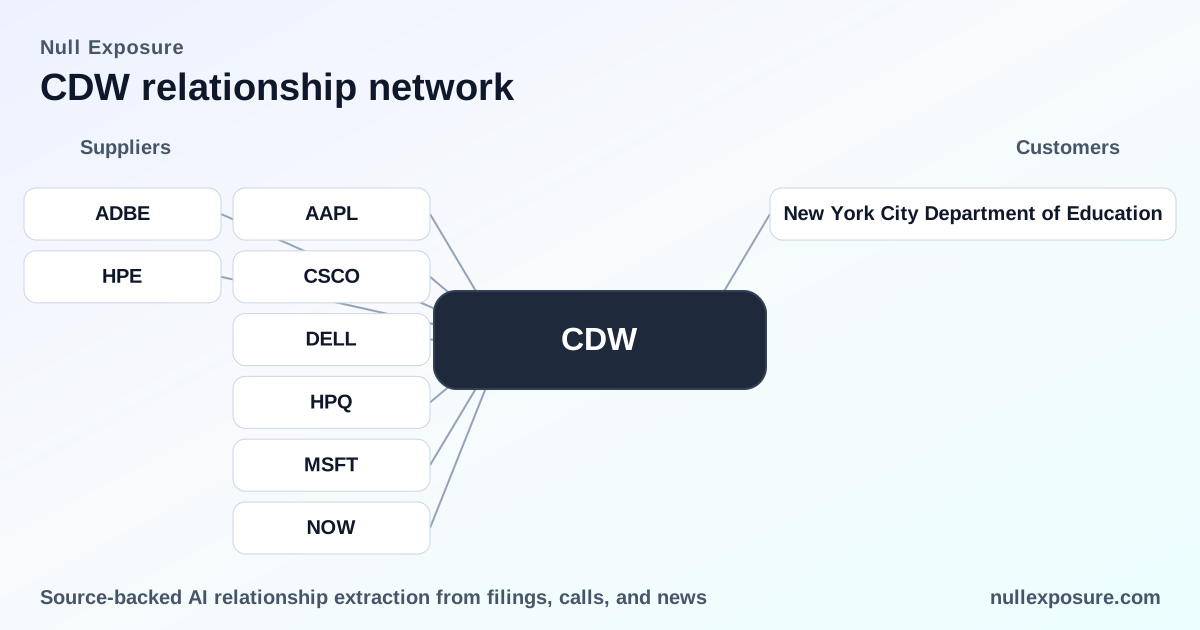
CDW Corp: Vendor-driven reseller with outsized services leverage
CDW operates as a large-scale technology reseller and systems integrator that monetizes by reselling hardware, software and cloud subscriptions while layering professional and managed services with higher gross margins. The company sources products from a broad vendor base, charges markups on resale, and captures recurring revenue through services, installation and managed-cloud engagements — a model that scales with vendor breadth and solution complexity. For a quick snapshot of supplier exposures and partner dynamics, visit https://nullexposure.com/.
Why the partner roster matters to investors
CDW’s economics depend on two linked facts: mass distribution of OEM products provides volume and scale, while services and integration drive margin expansion and stickiness. Public filings and market commentary show CDW workstreams span device OEMs, software publishers, cloud providers and specialty platform vendors. That mix reduces single-vendor sales concentration but raises dependency on partner supply, pricing and co-selling motions. The firm’s role alternates between buyer (inventory acquisition) and distributor (purchasing from wholesale channels), signaling a dual procurement posture that underpins both inventory flexibility and channel reach.
- Contracting posture: CDW operates as both a buyer and distributor, which creates negotiating leverage with vendors and distributors but also exposes the company to supplier terms and inventory cycles (company-level signal derived from filings).
- Concentration and criticality: Relationships with hyperscalers and major OEMs are critical because they supply the stack CDW packages and installs; those partners simultaneously represent demand drivers and potential supply constraints.
- Maturity: The partner base is extensive and long-standing, providing predictable catalogue breadth; incremental growth depends on deeper services adoption and co-sell execution.
What every relationship in the record looks like
Below are concise, investor-focused summaries for each partner mentioned in the source material, with the original public reference.
Microsoft
CDW resells and integrates Microsoft software, cloud and endpoint solutions as a foundational vendor across enterprise accounts. According to a TradingView summary of CDW’s SEC 10‑K (FY2026), Microsoft is listed among the major vendor partners driving catalog breadth.
Adobe
Adobe products are part of CDW’s large software portfolio used in workplace and creative stacks sold to business and education customers. TradingView’s coverage of CDW’s FY2026 10‑K lists Adobe among the company’s more than 1,000 vendor partners.
Apple
CDW distributes Apple hardware and related software for corporate and education customers and supports device lifecycle services through its solutions organization. The FY2026 10‑K excerpt cited on TradingView identifies Apple as a core brand in CDW’s catalog.
Cisco
CDW’s networking and security practices rely on Cisco hardware and software, which the company bundles into integrated solutions for customers. CDW’s FY2026 disclosures reported via TradingView and multiple industry stories (March 2026) list Cisco as a primary vendor partner.
Dell Technologies
Dell hardware and systems are a material part of CDW’s hardware resale business and solutions builds for enterprise customers. TradingView’s recap of CDW’s FY2026 10‑K includes Dell Technologies among the large-brand suppliers.
AWS (Amazon Web Services)
CDW partners with AWS on cloud migration and managed cloud services, positioning CDW as an AWS integrator for customers moving workloads to the cloud. A May 2026 market note on ad-hoc-news.de references CDW’s partnership with AWS and the company’s cloud-focused model.
Intel
CDW combines Intel hardware with software and services when building on-prem or edge compute solutions, particularly where performance and provisioning matter. An ad-hoc-news.de piece (May 2026) cites Intel as part of CDW’s generative AI and infrastructure positioning.
Nvidia
CDW sources GPU and accelerated compute hardware from Nvidia to assemble AI-ready systems and to sell AI infrastructure into customers modernizing for generative workloads. The May 2026 ad-hoc-news.de commentary highlights Nvidia as part of CDW’s AI stack strategy.
Google (Google Workspace & Cloud)
CDW has a multi-year partnership with Google across Workspace deployments and Google Cloud resale/integration. A tradersunion report (May 2026) notes that CDW has partnered with Google for over five years on Workspace and Cloud services.
ServiceNow
ServiceNow is a platform CDW both resells and deploys, and CDW leverages ServiceNow to tie workflow automation into broader solutions, increasing implementation scope and recurring revenue. CRN coverage (March 2026) quotes CDW executives describing ServiceNow as touching “every part” of CDW’s business.
DHX
DHX references CDW in an earnings-call context as a named peer or customer set, indicating CDW’s presence on corporate vendor lists for certain programs. The DHX Q3 2025 earnings call transcript (March 2026) explicitly mentions CDW among program participants.
DOMO
Market commentary links longer sales cycles with CDW partner channels to deal slippage for smaller SaaS vendors like Domo, which influenced sell‑side price targets in early May 2026. Investing.com and ng.investing.com reported TD Cowen’s price‑target revision for Domo tied to sales-cycle impacts involving CDW partners.
Inseego (INSG)
Inseego cited CDW alongside other large value‑added resellers when discussing distribution and stocking strategies for specific network devices, signifying CDW’s role in midmarket and telecom device channels. An InsideRMonkey earnings-call summary (March 2026) notes CDW as a stocking VAR for Inseego’s product.
WidePoint (WYY)
WidePoint stated that CDW will use its FedRAMP-authorized ITMS platform to manage devices for events, signaling CDW’s access to government‑grade device management solutions. An InsiderMonkey Q3 2025 earnings-call excerpt (March 2026) references CDW’s reliance on WidePoint’s platform for a federal-scale deployment.
HPE
HPE’s practice engagement at CDW surfaced in industry reporting when CDW personnel responded to HPE workforce movements, reflecting close channel and personnel ties between HPE and CDW’s solution teams. CRN reporting (March 2026) references CDW’s HPE practice activity.
HP (HPQ)
HP is listed among the hardware vendors CDW resells and integrates into client endpoints and printing/PC solutions for enterprise and education customers. Ad-hoc-news.de coverage (March 2026) includes HP in a vendor list that defines CDW’s reseller scope.
Constraints and what they mean in practice
Company-level evidence shows two procurement-role signals: CDW functions as both a buyer (entering agreements with financial institutions to facilitate inventory purchases) and as a distributor (purchasing from wholesale distributors to resell). These signals imply that CDW manages inventory financing and channel arbitrage actively — an operating model that supports scale but creates exposure to supplier terms, inventory cycles and wholesale price movements. Treat these as structural characteristics of the business rather than as exposures tied to any single partner.
Investment implications: risks and catalysts
- Catalysts: Upside centers on faster migration to cloud and AI, where CDW can capture higher-margin services by integrating hardware (Nvidia/Intel), cloud (AWS/Google/Microsoft) and orchestration software (ServiceNow). Adjacency to enterprise software and managed services drives recurring revenue and multiple expansion potential.
- Risks: Vendor-related deal slippage and longer sales cycles can compress near‑term growth for smaller partners (as observed with Domo), while supply constraints or unfavorable vendor terms could pressure margins. The buyer/distributor posture requires capital and creates inventory risk in volatile demand cycles.
For a structured view of supplier exposures and partner dynamics that matter to underwriting and operations, explore the platform at https://nullexposure.com/ — the site aggregates partner signals and public references to support supplier-risk decisioning.
Bottom line
CDW is a high‑scale reseller and integrator whose value proposition rests on catalog breadth and services depth. The partner roster — spanning hyperscalers, device OEMs and software platforms — is the engine of revenue and the governor of margin profile. Investors should weigh services-led margin expansion against supply and channel execution risks driven by vendor relationships and inventory posture.