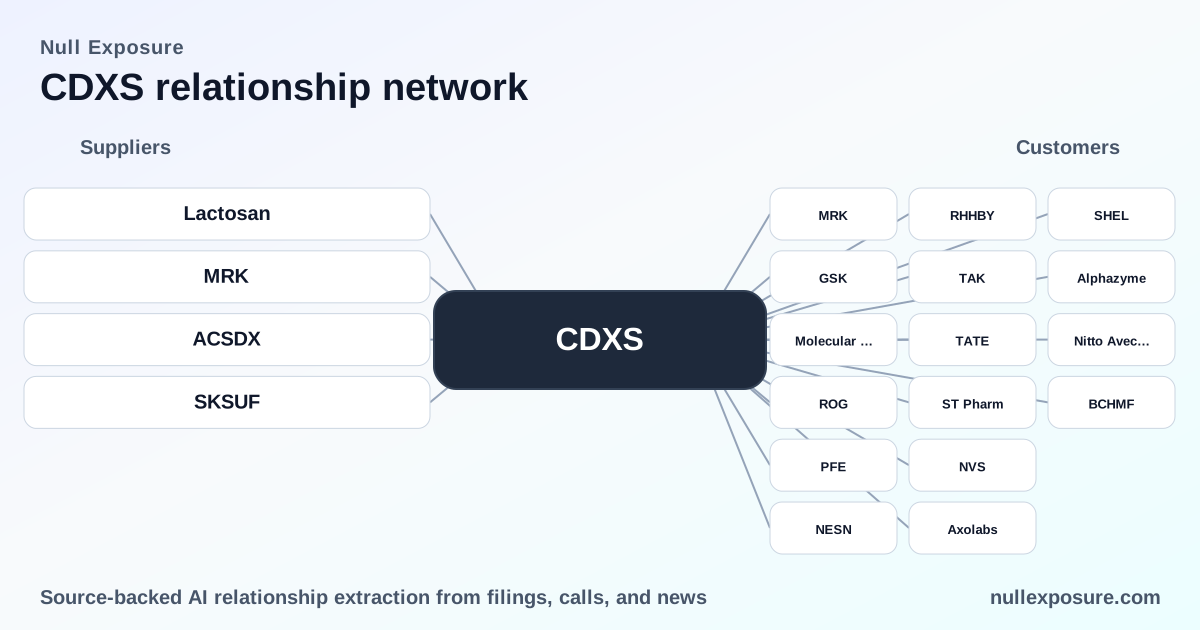
Codexis (CDXS): Supplier relationships that define commercial scaling and operational risk
Codexis discovers, develops and sells biocatalysts and monetizes through enzyme product sales, biocatalysis services for pharmaceutical manufacturing, and strategic supply agreements with large drugmakers. The company's in-house discovery and small-scale production is complemented by outsourced large-scale manufacturing, creating a two-tier operating model where product innovation is internal and commercial throughput is delivered by third-party contract manufacturers. Investors should evaluate both the revenue upside from durable pharma partnerships and the counterparty concentration risk embedded in a small set of manufacturing partners. For a concise supplier-risk profile and more supplier maps, visit https://nullexposure.com/.
Why the supplier network matters for Codexis’s commercial thesis
Codexis’s business model separates intellectual property and enzyme design from the heavy lifting of commercial-scale production. That separation accelerates time-to-market and limits capital intensity, but it also concentrates execution risk. Codexis reports that it outsources large-scale manufacturing to a limited number of contract manufacturers, and those arrangements are material to commercial supply.
From an investor perspective, four operating characteristics drive valuation and risk:
- Contracting posture: Codexis retains discovery and early-stage production while contracting out commercial scale manufacturing to third-party CMOs.
- Concentration: The company relies on a small number of external manufacturers for substantially all large-scale production, creating supplier concentration risk.
- Criticality: Outsourced CMOs are described as critical to the delivery of commercial enzyme products, making supplier disruptions potentially material to revenue.
- Geographic footprint: Outsourced manufacturing is anchored in EMEA (Austria and Italy), adding regional concentration to supplier risk.
These are company-level signals derived from Codexis’s FY2024 disclosures and should be central to any counterparty or operational due diligence. For a practical supplier risk scorecard and ongoing monitoring, see https://nullexposure.com/.
Relationship-by-relationship: who does what, and why it matters
Lactosan — commercial CMO based in Kapfenberg, Austria
Codexis lists Lactosan among three third‑party contract manufacturers used for large-scale enzyme manufacturing alongside its Redwood City facility. Lactosan provides commercial-scale capacity in Austria, representing part of the EMEA execution footprint Codexis relies on. This relationship is disclosed in Codexis’s FY2024 Form 10‑K.
Source: According to Codexis’s FY2024 Form 10‑K, manufacturing is conducted at three third‑party CMOs including Lactosan in Kapfenberg, Austria.
ACSD — third-party manufacturer in Anagni, Italy
ACSD is named explicitly as one of the external CMOs that handle Codexis’s large-scale manufacturing needs, situating significant production capability in Italy. ACSD is part of the limited roster of external manufacturers that carry Codexis’s commercial supply load, and therefore contributes to supplier concentration risk noted by the company. This is disclosed in the FY2024 Form 10‑K.
Source: Codexis’s FY2024 Form 10‑K lists ACSD in Anagni, Italy, as a third‑party contract manufacturer used for large‑scale enzyme production.
Sekisui — manufacturing partner in Maidstone, United Kingdom
Sekisui’s Maidstone facility is listed alongside Lactosan and ACSD as a named contract manufacturer for Codexis enzyme production. Sekisui completes the triad of external manufacturing partners in Europe that support Codexis’s commercial scale output, reinforcing the company’s EMEA manufacturing concentration. This detail is in Codexis’s FY2024 Form 10‑K.
Source: The FY2024 Form 10‑K identifies Sekisui in Maidstone, United Kingdom, as one of three third‑party CMOs used for manufacturing.
Merck — strategic customer and supply assurance partner
Codexis sells enzymes to Merck for manufacture of sitagliptin (the active ingredient in JANUVIA) and later signed a formal supply assurance agreement. Merck is a strategic pharmaceutical customer whose manufacturing program both validates Codexis technology and drives recurring commercial enzyme sales; the supply assurance agreement tightens that commercial linkage. The sale relationship is disclosed in the FY2024 Form 10‑K, and the supply assurance agreement was announced in Codexis’s 2025 Q3 earnings call.
Sources: Codexis’s FY2024 Form 10‑K notes enzyme sales to Merck for sitagliptin production; in the 2025 Q3 earnings call Codexis reported signing a supply assurance agreement with Merck.
Key takeaways for investors
- Operational leverage to external CMOs is explicit and material. Codexis’s model reduces capital intensity but substitutes vendor execution for internal capacity; that trade‑off is central to the investment case.
- Supplier concentration is a core risk. A limited number of named CMOs handle substantially all large-scale manufacturing, amplifying the possible impact of a single-site disruption.
- Geographic concentration in EMEA complements operational concentration. Outsourced facilities in Austria, Italy and the U.K. concentrate regional supply chain risk.
- Customer diversification includes large, creditworthy partners. Relationships like Merck’s provide revenue visibility and reduce cash-flow volatility when paired with formal supply agreements.
For investors focused on supplier exposure and counterparty risk dynamics, a monitored supplier map is essential—explore Codexis supplier profiles and monitoring tools at https://nullexposure.com/.
What to watch next (practical diligence checklist)
- Monitor amendments or extensions to the Merck supply assurance agreement and any movement of capacity between in‑house and third‑party facilities.
- Track operational disclosures about the three named CMOs for capacity expansions, regulatory inspections, or force‑majeure events in EMEA.
- Review revenue concentration by customer in upcoming filings to quantify the financial dependence on large pharma partners.
Bottom line: balanced upside with concentrated supplier execution risk
Codexis offers clear upside from enzyme sales and pharma partnerships, backed by in‑house innovation and validated by large customers like Merck. At the same time, its reliance on a small set of European CMOs is a material operational constraint that investors should price into scenarios for revenue disruption, time‑to‑scale, and margin volatility. For ongoing supplier surveillance and deeper supplier-to-counterparty analytics, visit https://nullexposure.com/—the fastest route to monitor supplier shifts that affect valuation and operational continuity.