Celcuity (CELC): supplier posture, commercial levers, and the two external relationships that matter
Celcuity is a clinical-stage biotechnology company that discovers cancer subtypes and develops targeted therapeutic options, monetizing through licensed drug rights, milestone and royalty economics embedded in licensing deals, and equity capital markets activity to fund clinical programs and scale. The company operates as a license-driven developer that outsources manufacturing, clinical execution, and distribution, and it leverages capital-market partnerships to convert development progress into near-term financing capacity. For a strategic supplier-risk snapshot and relationship intelligence, visit https://nullexposure.com/.
How Celcuity runs its supply chain and converts assets into cash
Celcuity’s operating model is built on three pillars: licensed intellectual property (gedatolisib rights acquired under a license agreement), third-party manufacturing and distribution, and external service providers for clinical development and communications. Revenue today is not product sales — it is the optionality embedded in licensed programs and the ability to access capital markets until commercialization occurs. The company funds R&D and operations through equity and debt capital, and it relies on outside suppliers to execute the technical and logistical tasks that would otherwise require internal infrastructure.
Company-level constraints that shape supplier relationships
The company’s public disclosures and financial reporting reveal several structural constraints that define supplier dynamics:
- Contracting posture — leverage exists. Company financial disclosures report long-term debt of approximately $97.7 million and total liabilities in the ~$105.1 million range, which shapes negotiation leverage and the priority of cash flows. These figures come from Celcuity’s financial disclosures in its filings.
- Licensing is core to the business model. Celcuity acquired exclusive, worldwide sublicensable rights to gedatolisib under a license agreement executed in April 2021; the license imposes diligence, milestone, royalty and insurance obligations that constrain timing and spending profiles (company disclosures).
- Supplier concentration is meaningful. Disclosures flag dependence on a limited number of third‑party manufacturers (CMOs) for active ingredient production and finished product packaging, a concentration that increases operational risk if a single supplier fails to perform.
- Criticality of outsourced services is high. Celcuity depends on third parties to run preclinical studies, clinical trials and regulatory activities (CROs, independent investigators, academic institutions), making these vendors critical path suppliers.
- Scale and spend are material. Publicly reported totals indicate vendor/contractual commitments at a $100M+ scale, consistent with a clinical-stage biotech running multiple programs and external manufacturing arrangements.
These signals collectively indicate a highly outsourced operating model with concentrated manufacturing risk, licensing-driven obligations that impose fixed milestones, and a capital structure that forces active use of equity markets to bridge development funding.
Two relationships investors and procurement teams should watch
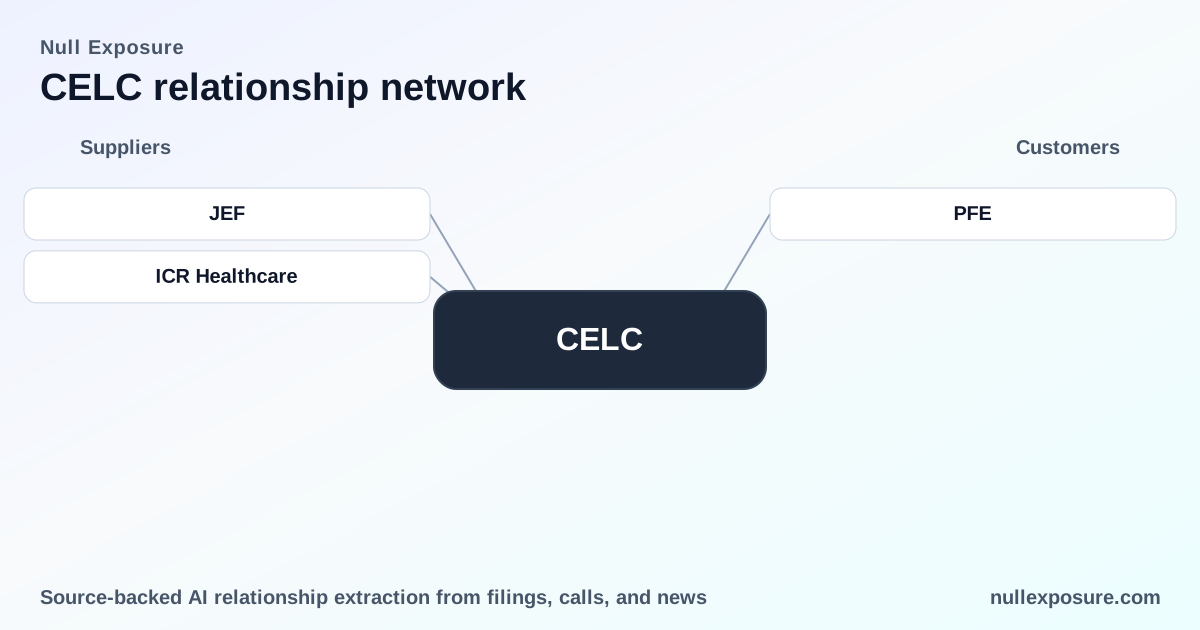
Both relationships discovered in recent coverage are transactional but carry different strategic signals: one is a capital markets distribution partner; the other is a communications/IR partner named in corporate releases.
Jefferies — equity placement and ATM execution partner
An effective S‑3ASR filed on 2026‑01‑09 gives Celcuity the authority to offer up to $400 million of common stock via an at‑the‑market (ATM) program with Jefferies, enabling on‑demand equity issuance to finance clinical development and operations. According to a StockTitan news release on March 9, 2026, that S‑3ASR supports the ATM arrangement with Jefferies for FY2026. (Source: StockTitan press coverage, March 9, 2026.)
ICR Healthcare — investor relations and press contacts listed on corporate release
Celcuity lists ICR Healthcare contacts as its media and investor relations partner in the same corporate announcement, signaling an ongoing externalized IR/communications relationship used for regulatory and public disclosures. The StockTitan press release dated March 9, 2026 includes ICR Healthcare contact details for investor and media inquiries. (Source: StockTitan press coverage, March 9, 2026.)
What those relationships imply for supplier risk and procurement strategy
Jefferies, as the ATM agent, is a financing counterparty with direct influence on liquidity and therefore indirectly on supplier payments and contract cadence — when Celcuity taps its ATM the company improves cash visibility and its ability to service CMOs and CROs. ICR Healthcare’s role is communications and IR execution, which influences market sentiment and the timing of capital raises but does not execute clinical or manufacturing tasks.
Operational takeaways for buyers, vendors and procurement teams:
- Manufacturers and CROs sit on the critical path. Given Celcuity’s concentration on a small set of CMOs, suppliers should price for continuity and regulatory compliance; Celcuity will value vendors that can demonstrate validated capacity and FDA‑grade quality systems.
- Payment and contracting terms will reflect financing cycles. Equity draws via the Jefferies ATM will create windows of heightened payment certainty; vendors should align billing milestones and delivery schedules to anticipated capital events.
- Communications control affects partner risk. External IR support via ICR Healthcare means Celcuity will actively manage market expectations; suppliers should expect coordinated disclosure timelines for program updates and material events.
For supplier managers evaluating Celcuity as a counterparty, focus negotiations on robust change‑of‑manufacturer clauses, clear dispute resolution tied to regulatory delays, and milestone‑driven invoicing that synchronizes with Celcuity’s financing cadence.
Explore a deeper supplier-risk profile and tailored procurement playbooks at https://nullexposure.com/.
Practical recommendations for investors and operators
- Investors: Treat the Jefferies ATM facility as a liquidity backstop that reduces short‑term cash risk but does not remove long‑term execution risk tied to manufacturing and regulatory success.
- Suppliers: Seek multi‑tier redundancy clauses and contractual protections against single‑point manufacturing failure, and price for the extra compliance burden.
- Procurement teams: Insist on audit rights, supply continuity plans, and regulatory evidence (e.g., FDA audit histories) from CMOs and CROs before accepting exclusivity or sole‑source arrangements.
Bottom line and next steps
Celcuity is a license‑centric, highly outsourced biotech whose supplier relationships are strategic and high‑risk by nature. Capital-market ties — specifically the Jefferies ATM arrangement — provide funding flexibility that benefits suppliers and investors in the near term, while concentrated manufacturing and CRO dependence create operational vulnerability that warrants contract protections.
If you need a bespoke supplier-risk briefing or want to monitor evolving capital-market arrangements and supplier disclosures for Celcuity, start here: https://nullexposure.com/. For ongoing alerts and deeper relationship intelligence tailored to procurement and investor workflows, visit https://nullexposure.com/ and request a specialist briefing.