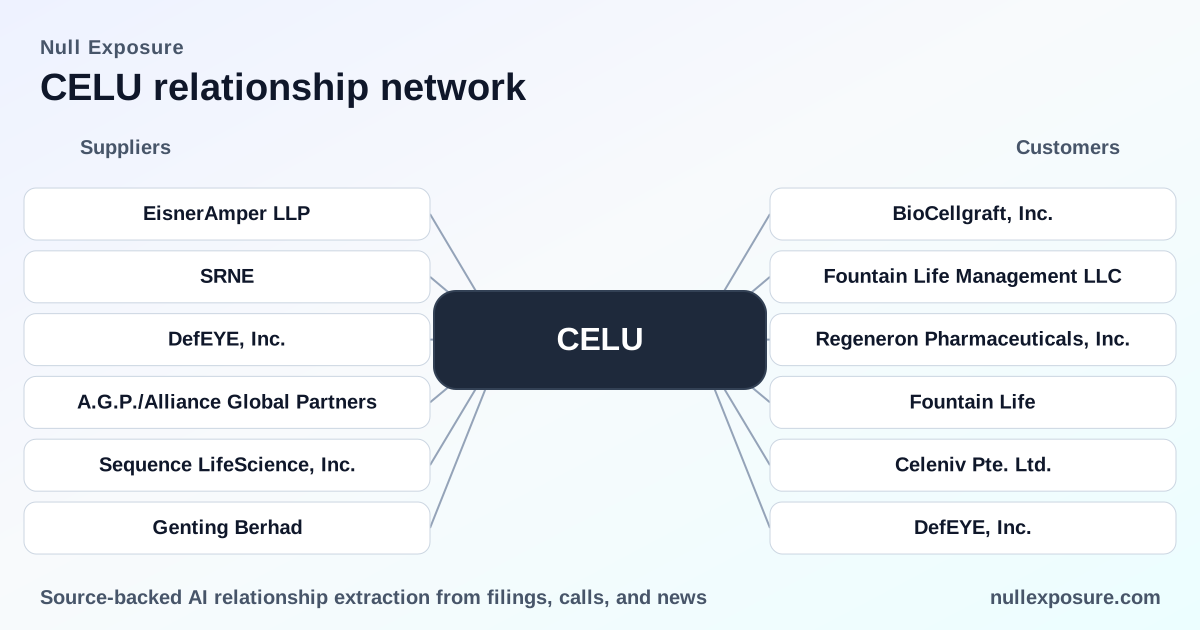
Celularity’s supplier map: who powers the placenta‑derived therapy story and why investors should care
Celularity develops and commercializes placenta‑derived cellular therapies and complements that pipeline with contract manufacturing and strategic partnerships. The company monetizes through therapeutic product development, manufacturing services for third parties, licensing/partnership arrangements, and selective equity financings, while relying on external donors and third‑party service providers for key inputs and clinical execution. For investors, the supplier footprint is a direct read on operational resilience: manufacturing partners, CROs and critical raw‑material vendors determine time‑to‑market and cash burn. Learn more at https://nullexposure.com/.
Big picture: how Celularity’s supplier posture shapes value creation
Celularity is an early‑stage biotechnology company with negative operating margins, recurring R&D spend and a small market cap, so supplier relationships have outsized impact on execution and liquidity. The company combines internal manufacturing with third‑party capacity and strategic partners to scale—a hybrid model that generates revenue via product sales and contract manufacturing while compressing capital intensity when partners carry facility burdens.
Key company‑level signals from filings and press coverage:
- Contracting posture: generally short‑to‑medium term — Celularity has used non‑exclusive CMOs and executed short minimum‑term supply obligations, which implies flexibility but raises renewal risk.
- Counterparty mix: includes individual donors and small specialized suppliers — dependence on full‑term placental donors and niche raw‑material vendors concentrates operational exposure.
- Relationship roles: heavy reliance on service providers and contract manufacturers — the firm outsources critical steps of development, manufacturing and clinical execution, which transfers certain execution risks but also reduces fixed costs.
- Maturity and concentration: venture‑stage dynamics — low revenue, persistent losses and limited institutional ownership increase the premium investors demand for execution certainty.
These characteristics mean supplier stability is a core risk‑return lever for Celularity equity.
Detailed supplier relationships — the counterparties on record
Below I list every supplier relationship observed in the available reporting and what it implies for operators and investors.
EisnerAmper LLP
Celularity engaged EisnerAmper LLP as its independent audit firm while implementing internal control improvements, a step that facilitated regaining Nasdaq compliance; this is a governance‑oriented relationship rather than operational manufacturing support. According to a Quiver Quant news item referencing FY2024, the audit engagement was highlighted as part of process upgrades and filings compliance.
Sorrento Therapeutics, Inc. (SRNE) — strategic investor and manufacturing collaborator
Sorrento invested in Celularity and provides manufacturing capacity support: the companies combined Sorrento’s CAR‑T and cGMP manufacturing capabilities with Celularity’s placental platform, and in a later initiative Sorrento’s San Diego cGMP facilities were used to supplement Celularity’s Florham Park site. A PR Newswire release in FY2018 described the investment and strategic intent, and a GlobeNewswire release in FY2020 documented the emergency NK‑cell therapy development and facility collaboration.
DefEYE, Inc.
Celularity entered an exclusive manufacturing partnership with DefEYE, taking on contract manufacturing responsibilities for DefEYE’s ophthalmic biologics and securing the right to name one member of DefEYE’s five‑member board—an alignment that blends manufacturing revenue with strategic governance exposure. Vision Monday covered the FY2025 partnership terms, and a financing notice in FY2025 likewise noted the exclusive manufacturing and board rights.
A.G.P./Alliance Global Partners
For capital markets and placement activity, A.G.P./Alliance Global Partners acted as sole placement agent for a registered direct offering, indicating Celularity’s reliance on external capital‑markets intermediaries to raise cash. A StockTitan news item covering FY2023 reported AGP’s role in the offering.
Sequence LifeScience, Inc.
Celularity acquired Rebound, a placental‑derived allograft product, from Sequence LifeScience, and concurrently entered an exclusive supply agreement to manufacture the product for a minimum period of six months—a short‑term supply commitment that ties product availability to Celularity’s capacity. CityBiz reported the acquisition and the subsequent supply arrangement in FY2024; the company’s disclosures also reference the six‑month minimum supply term.
Genting Berhad
Celularity supplies placenta‑derived stem cells for international commercialization channels: an Asia‑Pacific partnership with Genting Berhad will use Celularity‑manufactured cells in a Bali facility under the Fontaine Vitale brand to offer regenerative and aesthetic cell therapies to local and international patients. A Quiver Quant summary of Genting’s press materials described the FY2024 collaboration and the planned facility launch.
Operational implications and risk profile for operators and investors
The supplier map produces a clear set of operational tradeoffs:
- Manufacturing criticality: Celularity’s role as both a developer and contract manufacturer means production disruptions propagate to both revenue and partner obligations. The DefEYE and Sequence relationships highlight concentrated manufacturing exposure.
- Short‑term contracting increases execution risk: the explicit six‑month minimum supply term with Sequence and the company’s historical use of non‑exclusive CMOs point to flexibility at the cost of renewal uncertainty.
- Donor and small‑vendor dependency: reliance on donors for placentas and on small firms for specialty raw materials concentrates supply chain fragility; this is a structural company‑level constraint driven by the product biology rather than a single counterparty.
- Governance and capital‑markets links: audit firm engagement (EisnerAmper) and placement agent relationships (A.G.P.) are positive governance and financing signals that reduce regulatory and capital‑raising frictions, but do not eliminate operational execution risk.
For investors, these considerations imply a two‑track monitoring approach: track manufacturing capacity and partner renewals (operational milestones), and monitor capital access and governance improvements (liquidity and compliance). If you want a supplier‑risk dashboard and ongoing monitoring, start here: https://nullexposure.com/.
What to watch next and investment takeaways
- Priority KPI: capacity utilization and contractual tenor with manufacturing partners. Short minimum terms and non‑exclusive CMOs are useful for cash preservation but increase rollover risk; durable, longer‑term supply contracts would materially de‑risk the model.
- Supply inputs: donor recruitment and specialty vendor performance. These are backend constraints that directly affect production run‑rate and clinical timelines.
- Capital and governance flow: audit relationships and placement agents indicate management attention to compliance and financing; continued transparency reduces downside surprises.
For operators evaluating supplier relationships, prioritize longer‑dated manufacturing commitments, dual‑sourcing of critical raw materials and formalized donor pipelines to lower execution variance. For investors, the premium on Celularity equity hinges on demonstrable reductions in supplier and manufacturing concentration.
If you want to model counterparty risk into valuation or track updated supplier disclosures, see our research hub at https://nullexposure.com/.