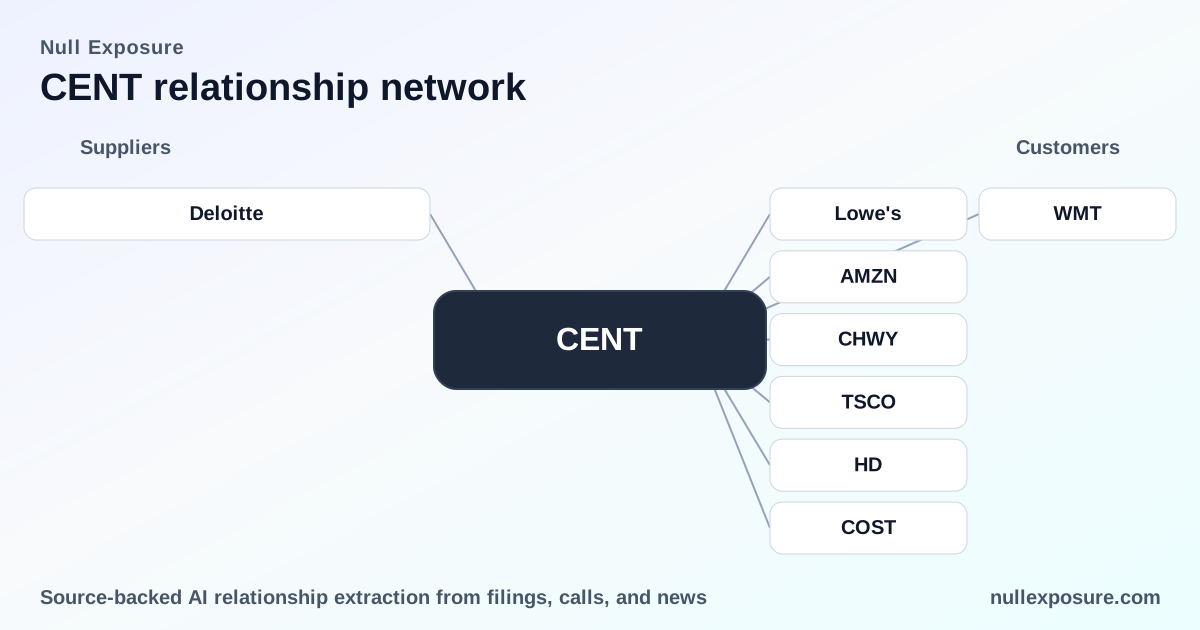
Central Garden & Pet (CENT): Supplier posture, governance relationships, and what investors should price in
Central Garden & Pet operates as a branded and private‑label manufacturer and distributor across lawn & garden and pet supply channels, monetizing through wholesale and direct retail distribution, category mix, and scale in sourcing and product development. The business converts branded recognition and distribution reach into recurring sales, with a reported trailing twelve‑month revenue of $3.09 billion and EBITDA of $345.97 million, while managing commodity exposure through fixed purchase commitments. For investors evaluating supplier and professional‑services relationships, the balance of supplier concentration, committed commodity spend, and governance continuity are the primary operational levers to monitor.
Explore further supplier insights at https://nullexposure.com/.
Why supplier relationships matter for CENT’s cash flow and margins
CENT sits in a category where input costs and distribution economics determine margin volatility. Two company‑level signals should frame any underwriting:
- Supplier concentration is moderate but non‑trivial. The company reports that roughly 5–7% of cost of goods sold in each of fiscal 2023–2025 came from the five largest suppliers, indicating that a small set of vendors can meaningfully influence COGS if disrupted.
- CENT commits material dollars to commodities in advance. As of September 27, 2025, management had fixed purchase commitments of approximately $108.1 million for commodities, a deliberate contracting posture that both limits upside from falling prices and reduces near‑term input price volatility.
These signals translate into operational characteristics: CENT uses fixed commitments as a hedging-like tool, its supplier base is diversified enough to prevent single‑vendor failure but concentrated enough that strategic suppliers are critical to procurement execution, and the company’s sourcing relationships have enough maturity to support multi‑year operational planning. Investors should treat procurement as a semi‑strategic function for CENT rather than a purely transactional cost center.
What the public record shows: governance and professional‑services relationships
CENT’s recent public coverage highlights governance continuity at the company level. Two news items captured the same corporate action—shareholder approval of auditor engagement and executive compensation—registered in March 2026.
Deloitte — Finviz (March 9, 2026)
Central Garden & Pet shareholders re‑elected directors and approved Deloitte and executive pay at the annual general meeting, per a Finviz report covering company developments on March 9, 2026. The article notes the shareholder approvals in the context of analyst commentary and investor interest: https://finviz.com/news/309351/wall-street-analysts-think-central-garden-centa-could-surge-3735-read-this-before-placing-a-bet
Deloitte — Finviz (March 9, 2026, follow‑up)
A second Finviz item on the same date repeats that shareholders re‑elected directors and approved Deloitte and executive compensation at the AGM, underscoring continuity in external audit and governance oversight noted in market coverage: https://finviz.com/news/290273/central-garden-centa-expected-to-beat-earnings-estimates-can-the-stock-move-higher
Both items indicate governance continuity through shareholder approval of Deloitte—important to investors because auditor stability reduces the risk of abrupt changes in financial reporting oversight. These are concise public confirmations rather than new commercial supply arrangements.
How these relationships and constraints shape risk and opportunity
Translate the company signals into investment implications:
- Contracting posture: The $108.1 million in fixed commodity commitments shows proactive procurement management. That reduces near‑term price volatility and supports margin planning, but it also locks the company into prices that can underperform if commodity prices fall.
- Supplier concentration and criticality: With the top five suppliers representing up to 7% of COGS, supplier disruption or renegotiation at that level could create measurable margin pressure. The company’s vendor mix appears diversified beyond that slice, limiting catastrophic single‑counterparty exposure.
- Governance maturity: Shareholder approval of auditors and directors signals stable governance practices and continuity in external oversight—a positive for investors focused on accounting quality and transparency.
- Operational predictability: The combination of committed commodity spend and a predictable supplier footprint makes CENT’s cost base more forecastable than many smaller packaged‑goods peers, which supports valuation multiple stability relative to peers.
Practical considerations for procurement and diligence teams
For institutional buyers and operational managers vetting CENT as a supplier or partner, focus diligence on three areas:
- Contract language around fixed commodity commitments and the presence of pass‑through or escalation clauses.
- Supplier substitution clauses and transition plans for the top five vendors that account for the cited percentage of COGS.
- Auditor tenure and any recent changes in audit scope or findings; continuity with Deloitte is useful but should be confirmed with the latest 10‑K and audit reports.
If you want a deeper supplier risk readout or peer benchmarking, start here: https://nullexposure.com/.
Bottom line: what investors should price into CENT today
Central Garden & Pet presents a stable revenue base and disciplined procurement posture that together moderate margin volatility. The company’s moderate supplier concentration creates a locus of operational risk that is manageable but worth monitoring; the material fixed commodity commitments are a deliberate tradeoff between price certainty and upside compression. Governance continuity—illustrated by shareholder approval of Deloitte—adds another layer of investor comfort on financial reporting oversight.
Key takeaways:
- Procurement is a strategic lever for CENT; fixed commitments reduce near‑term price risk but limit benefit from falling prices.
- Top‑supplier concentration is meaningful (5–7% of COGS) and should be monitored for renegotiation or disruption risk.
- Audit and governance continuity with Deloitte reduces reporting uncertainty and supports stable investor expectations.
For a tailored supplier risk matrix or to compare CENT’s supplier posture across peers, visit https://nullexposure.com/ and request the analysis.