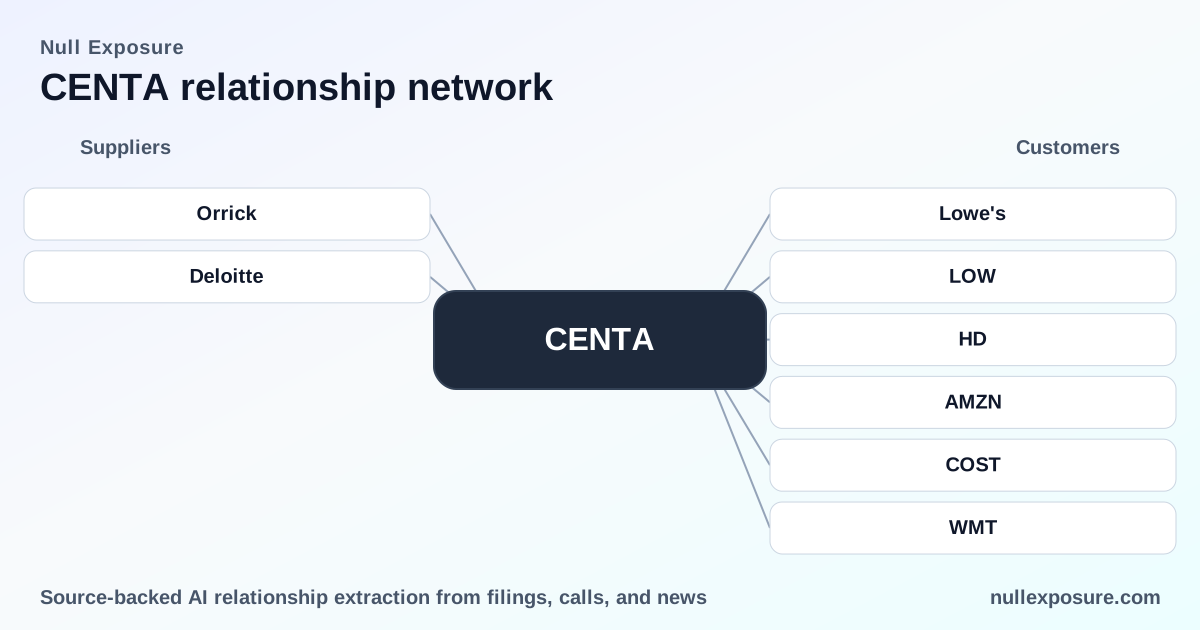
Central Garden & Pet (CENTA): Supplier Footprint and Contracting Signals that Matter to Investors
Central Garden & Pet monetizes a diversified portfolio of lawn, garden and pet care brands through wholesale and retail channels, generating revenue primarily from product sales across seasonal and consumable categories. The company's profitability is driven by branded merchandise, commodity-exposed inputs for feed and pest control products, and scale in distribution; supplier relationships and commodity contracting directly influence margins and working capital dynamics.
For focused supplier intelligence and counterparty risk profiles, visit the NullExposure homepage: https://nullexposure.com/
What the headline numbers tell you about supplier leverage
Central Garden & Pet is a mid-cap consumer-defensive operator with $3.09 billion in trailing revenue and $346 million of EBITDA, signaling a stable operating base where input costs and supplier commitments have material P&L consequences. The company reports a price-to-sales of 0.67 and an EV/EBITDA around 8x, consistent with a business that trades on steady cash generation rather than rapid growth.
Key balance between scale and exposure:
- High institutional ownership (≈97%) concentrates analyst and investor attention on supply-side disclosures.
- Thin operating margins (operating margin ~3.9%) make supplier disruptions or commodity cost pass-through significant to earnings.
- Quarterly revenue and earnings declines year-over-year enforce scrutiny of procurement and inventory strategies.
Supplier relationships observed in public coverage
The source material returned two distinct supplier/adjacent relationships in public reporting; each is summarized below with the originating citation.
-
Orrick — In a press report covering Central’s strategic acquisition activity, Orrick was disclosed as Central’s legal advisor on the transaction. This positions Orrick as the law firm executing transaction workstreams and diligence for M&A activity tied to growth initiatives. (Source: StockTitan news coverage of the acquisition, March 2026.)
-
Deloitte — Shareholder meeting disclosures show that Deloitte was ratified as Central’s independent auditor with 17,177,566 votes, underscoring Central’s choice of a Big Four auditor for financial reporting and controls. (Source: Intellectia.ai coverage of shareholder actions, FY2026.)
What these relationships imply for investors
Legal counsel and external audit appointments are not typical suppliers of materials, but they are critical governance and transaction counterparties. Orrick’s role confirms active M&A execution capability and transaction-related legal spend; Deloitte’s ratification is a governance signal aligning Central with mainstream audit rigor and public-market reporting expectations. Both relationships support operational credibility and access to capital markets or deal execution when required.
For a deeper supplier map and risk scoring on counterparties, visit https://nullexposure.com/
Company-level constraints and what they mean for procurement risk
Public excerpts reveal several authoritative signals about Central’s contracting posture and supplier exposure. Treat these as company-level operating model characteristics:
-
Contracting posture — forward, multi-year commitments. Central uses forward contracts to lock quantities and often prices for grain and seed inputs, indicating a proactive hedging posture to stabilize input cost volatility. This reduces short-term margin volatility but introduces committed spend and execution risk.
-
Counterparty mix — both large national suppliers and local small businesses. The company sources commodity grains from large national commodity companies and local grain cooperatives, indicating a mixed counterparty footprint that combines scale suppliers and localized supply channels. This duality supports supply resilience but complicates supplier management.
-
Critical single-supplier elements. One input—used in manufacturing (S)-Methoprene—is obtained from a single supplier, representing a clear single-vendor criticality that requires contingency planning or strategic sourcing to avoid production interruption.
-
Vendor concentration and manufactured goods sourcing. Approximately 5–7% of COGS in recent years came from the company’s five largest suppliers, signaling moderate concentration where the top supplier cohort exerts measurable influence over COGS.
-
Committed spend scale. The company disclosed fixed purchase commitments for commodities totaling roughly $108.1 million as of September 27, 2025, reflecting substantial forward exposure in raw-material procurement and working capital commitments.
-
Relationship role — manufacturer and buyer. Central operates both as a purchaser of finished goods and as a manufacturer/assembler for its proprietary SKUs; about 5–7% of COGS deriving from top suppliers indicates strategic supplier procurement rather than spot sourcing.
These constraints create a clear profile: Central manages material commodity exposure through forward contracting and a mixed counterparty base, but retains critical single-supplier dependencies and sizable forward commitments that are material to cash flow and continuity.
Risk translation for investors and operators
Translate the procurement signals into risk vectors relevant to valuation and operational stability:
-
Margin sensitivity: Forward contracts and commodity commitments reduce volatility but lock in cost bases that can be disadvantageous if input prices decline; conversely they protect against upside commodity shocks that would otherwise compress margins.
-
Single-source production risk: The dependency on a single supplier for (S)-Methoprene is a concentrated operational risk for product lines that use this input; loss of supply would cause immediate manufacturing disruption and potential market-share loss in affected SKUs.
-
Counterparty diversification trade-offs: The use of both national commodity firms and local cooperatives enhances supply resilience but increases procurement management complexity, contractual heterogeneity, and credit exposure across a broad vendor set.
-
Capital allocation and liquidity: $108.1 million in committed commodity purchases represents a working capital outflow that investors should model into cash conversion cycles and scenario-based liquidity stress tests.
Actionable takeaways for portfolio managers
- Prioritize counterparties flagged as critical (e.g., the single vendor for (S)-Methoprene) in operational due diligence and demand remediation plans or alternative sourcing strategies.
- Model committed commodity spend explicitly in near-term cash flow scenarios rather than treating procurement as variable line items.
- Incorporate governance signals—ratification of Deloitte and engagement of Orrick—into assessments of financial reporting quality and M&A execution capability.
For ongoing monitoring of supplier relationships and to benchmark Central’s supplier risk against peers, consult the NullExposure homepage here: https://nullexposure.com/
Final assessment
Central Garden & Pet runs a procurement-forward operating model where branded retail sales are materially influenced by commodity procurement, supplier concentration, and a mix of large and small counterparties. The company’s forward contracting discipline and large committed purchases stabilize margins at the cost of locked-in exposures that investors must model explicitly. Governance relationships with advisors and auditors strengthen execution credibility, but single-supplier chemicals exposure and top-supplier concentration remain principal sources of operational risk.
To investigate counterparty risk in greater depth or to request a supplier risk briefing tailored to portfolios, visit https://nullexposure.com/ and connect with our research team.