Cantor Equity Partners IV (CEPF): Sponsor-led SPAC relationships that define near-term optionality
Cantor Equity Partners IV, Inc. is a blank-check company that monetizes by raising capital in public markets to execute a business combination; its value accrues through the sponsor’s ability to source, close and deliver a target acquisition, and through residual public-market demand for the combined entity. The firm has no operating revenue and relies on sponsor services, capital markets access, and its listing venue for value realization. For deeper supplier relationship mapping and counterpart risk intelligence, visit https://nullexposure.com/.
How CEPF’s supplier relationships drive the transaction economics
CEPF’s commercial model is the archetypal SPAC construct: raise cash from public investors, put proceeds in trust, and leverage sponsor expertise and capital to complete a merger. Sponsor alignment and capital-market execution are the commercial levers that determine whether a SPAC converts cash into enterprise value. In CEPF’s case, the sponsor and book-runner are concentrated and functionally critical; the exchange listing provides primary liquidity and market signaling.
Sponsor and bookrunner: Cantor Fitzgerald’s central role
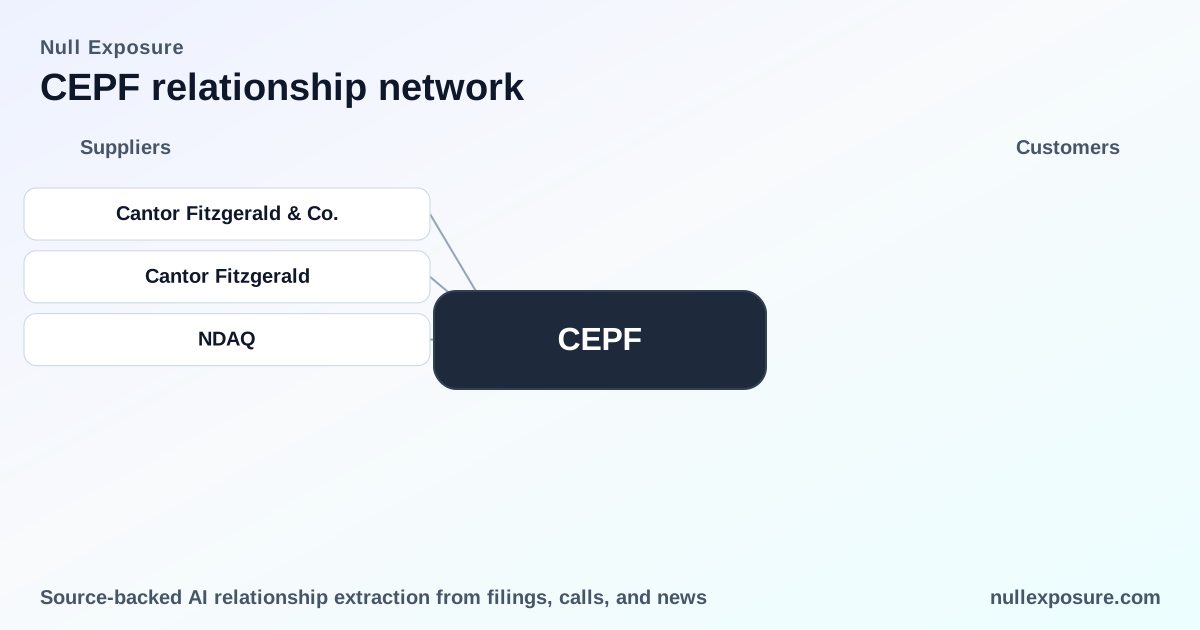
Cantor Fitzgerald and its broker-dealer affiliate, Cantor Fitzgerald & Co., occupy two distinct operational roles for CEPF. Cantor Fitzgerald is the SPAC sponsor and governance sponsor for deal origination and strategic execution, while Cantor Fitzgerald & Co. served as the sole book‑running manager on the IPO, underwriting distribution and price discovery for public investors.
- Cantor Fitzgerald as sponsor: Cantor Equity Partners IV is explicitly sponsored by Cantor Fitzgerald and led by Chairman and CEO Brandon Lutnick, which places primary sourcing, diligence and board leadership responsibility with the Cantor platform (see: Yahoo Finance coverage of the offering, FY2025 — https://finance.yahoo.com/news/cantor-equity-partners-iv-inc-201500233.html).
- Cantor Fitzgerald & Co. as bookrunner: The firm acted as the sole book-running manager for CEPF’s IPO, concentrating underwriting risk and control of the placement process within a single investment bank (see: AIJourn and Yahoo Finance reporting on the July/August 2025 offering — https://aijourn.com/cantor-equity-partners-iv-inc-announces-pricing-of-400-million-initial-public-offering/ and https://finance.yahoo.com/news/cantor-equity-partners-iv-inc-201500233.html).
Exchange relationship: Nasdaq Global Market provides market access
CEPF’s shares began trading on the Nasdaq Global Market under ticker CEPF on August 21, 2025, giving the company a standardized liquidity venue and governance overlay associated with Nasdaq’s listing regime (see: Yahoo Finance reporting, FY2025 — https://finance.yahoo.com/news/cantor-equity-partners-iv-inc-201500233.html). Listing on Nasdaq is a mandatory precondition for the SPAC’s public liquidity and future deal-market signaling.
Constraints and company-level signals that drive counterparty risk
CEPF provides no explicit third-party contractual constraints in the disclosed relationship data. Use the following company-level operating signals to assess supplier posture, concentration and maturity:
- Contracting posture: As a blank-check vehicle, contracting is sponsor-centric; the sponsor supplies management, deal-sourcing and often forward or PIPE commitments. Counterparty contracts will be standard SPAC governance and trust-account arrangements.
- Concentration: Relationships are highly concentrated — primary dependency on Cantor Fitzgerald (sponsor and bookrunner) and Nasdaq for listing and distribution.
- Criticality: Sponsor and underwriter services are operationally critical: failure or withdrawal would directly impair the SPAC’s ability to consummate a business combination.
- Maturity: CEPF is newly listed (August 2025) with no operating revenue and limited operating history, so supplier arrangements are early-stage and transaction-focused rather than long-term vendor contracts.
These signals reflect structural business-model risks for counterparties and investors evaluating supplier resilience and alignment.
What this supplier map implies for investors and operators
Two facts matter for valuation and counterparty diligence: (1) CEPF has no operating revenue and therefore all value hinges on deal execution and post-close market reception; (2) sponsor and underwriter concentration increases execution risk but can accelerate deal flow when the sponsor has deep origination capability. Institutional ownership is high (95.6% of shares held by institutions), which implies a concentrated investor base that will influence post-transaction liquidity dynamics and governance outcomes (company profile data, FY2025).
Operationally, counterparties should prioritize:
- Assessing the sponsor’s track record and balance-sheet support for PIPE or sponsor-led financing.
- Reviewing underwriting commitments and distribution mechanics put in place by Cantor Fitzgerald & Co.
- Monitoring Nasdaq-related compliance and listing covenants that could affect trading or corporate actions.
For a quick supplier risk overview and to access full relationship analytics, visit https://nullexposure.com/.
Complete relationship log (concise, source-backed)
-
Cantor Fitzgerald & Co.: Cantor Fitzgerald & Co. acted as the sole book‑running manager for CEPF’s IPO, concentrating distribution and underwriting responsibility with a single broker-dealer (reported in industry press covering the offering, FY2025 — https://aijourn.com/cantor-equity-partners-iv-inc-announces-pricing-of-400-million-initial-public-offering/; https://finance.yahoo.com/news/cantor-equity-partners-iv-inc-201500233.html).
-
Cantor Fitzgerald: Cantor Fitzgerald is the sponsor of Cantor Equity Partners IV and provides executive leadership for the blank-check vehicle, with Brandon Lutnick identified as Chairman and CEO in IPO disclosures (reported in Yahoo Finance coverage of the offering, FY2025 — https://finance.yahoo.com/news/cantor-equity-partners-iv-inc-201500233.html).
-
Nasdaq Global Market: CEPF’s listing venue is the Nasdaq Global Market, and the shares began trading under the symbol CEPF on August 21, 2025, supplying primary liquidity and regulatory listing oversight (reported in Yahoo Finance coverage, FY2025 — https://finance.yahoo.com/news/cantor-equity-partners-iv-inc-201500233.html).
Bottom line: concentrated sponsor-power creates optionality and execution risk
CEPF is a sponsor-driven SPAC with concentrated supplier relationships that are simultaneously the company’s greatest asset and its principal risk. Cantor Fitzgerald’s dual role as sponsor and sole bookrunner streamlines deal execution but centralizes counterparty dependence. Nasdaq listing delivers necessary liquidity and legitimacy, but CEPF’s lack of operating revenue means all upside requires successful deal-making and favorable market reception. Institutional holders dominate the cap table, amplifying the speed and scope of governance decisions post-transaction.
For a deeper supplier-risk assessment and to benchmark CEPF against peer SPACs, see our platform: https://nullexposure.com/.