Cantor Equity Partners I (CEPO): Supplier relationships and what they mean for investors
Cantor Equity Partners I is a blank-check acquisition vehicle (a SPAC) formed to complete a business combination; it monetizes primarily through sponsor-provided capital, underwriting and advisory arrangements, and structured fees tied to a future merger (not through operating revenue today). The company generates runway and advisory capacity via sponsor loans, monthly service fees, and a pre-agreed $7.0 million marketing fee payable on consummation of a business combination—while its shares trade on the Nasdaq Global Market under the listing arranged at IPO. For investors and operators assessing supplier risk, the profile is that of a newly organized sponsor-led vehicle with concentrated, contractually-defined supplier relationships rather than a diversified operating vendor base.
Explore more supplier intelligence at https://nullexposure.com/
Sponsor, advisor and underwriting: a concentrated Cantor group relationship
Cantor Equity Partners I was organized and sponsored by Cantor Fitzgerald and its affiliates; those same Cantor entities play multiple commercial roles with the SPAC. Cantor Fitzgerald & Co. served as sole book-running manager for the IPO, providing underwriting and capital markets services that are critical to initial liquidity and the SPAC’s public-market access. The PR Newswire release announcing the IPO pricing states the underwriting role and the Nasdaq listing plan (PR Newswire, January 2025).
The sponsor and affiliated entities also provide ongoing administrative, office and advisory services under explicit contractual arrangements. The sponsor agreed to monthly payments of $10,000 for shared office and personnel services and committed various sponsor loans and notes to fund IPO-related and pre-combination expenses; in addition the company contracted to pay CF&Co. a $7,000,000 marketing fee (3.5% of IPO gross proceeds) upon consummation of a business combination. These terms are documented in the company’s prospectus and related filings (company filing, FY2025).
Market access and listing: Nasdaq implications
The newly public shares were listed on the Nasdaq Global Market, providing standard exchange liquidity and reporting obligations. The IPO press release confirms the Nasdaq listing and the first trading date of January 7, 2025, which establishes the public trading venue and attendant regulatory regime (PR Newswire, January 2025).
From a supplier-risk perspective, the Nasdaq listing is a structural enabler—ensuring visibility and compliance requirements—but it also concentrates regulatory dependency: the SPAC’s ability to consummate a business combination and deliver shareholder value is tied to continued listing standards and public-market reception.
Operating-model constraints you need to know
The filings and release reveal several company-level constraints that shape supplier risk and contracting posture:
- Concentrated contracting posture: Cantor-related entities act as underwriter, sponsor, advisor and custodial counterparty (e.g., transfers to CF Secured), creating a tightly coupled supplier ecosystem rather than multiple independent vendors.
- Defined spend bands and material contingent fees: The company’s commercial ties include both modest recurring service payments (~$10,000/month) and large contingent fees (a $7 million marketing fee payable on deal close), implying asymmetric exposure: small ongoing spend but large one-time earnouts dependent on the business combination.
- Active and contractual relationships: The SPAC has engaged CF&Co. under a Business Combination Marketing Agreement (BCMA) and has active loan commitments from the sponsor (Pre-IPO Note, Sponsor Loan, Sponsor Note) to fund operations through the combination period (company filing, FY2025).
- Geographic and operational centration: The principal sponsor address is New York (110 East 59th Street), establishing a North American operational center and likely centralization of administrative capabilities.
These constraints signal a supplier profile that is highly strategic and concentrated—the Cantor group is both counterparty and service provider across underwriting, advisory and administrative roles—so governance and contract enforcement are central to risk management.
Explore how these supplier dynamics affect valuation and M&A execution at https://nullexposure.com/
Relationship inventory (each relationship in the results)
-
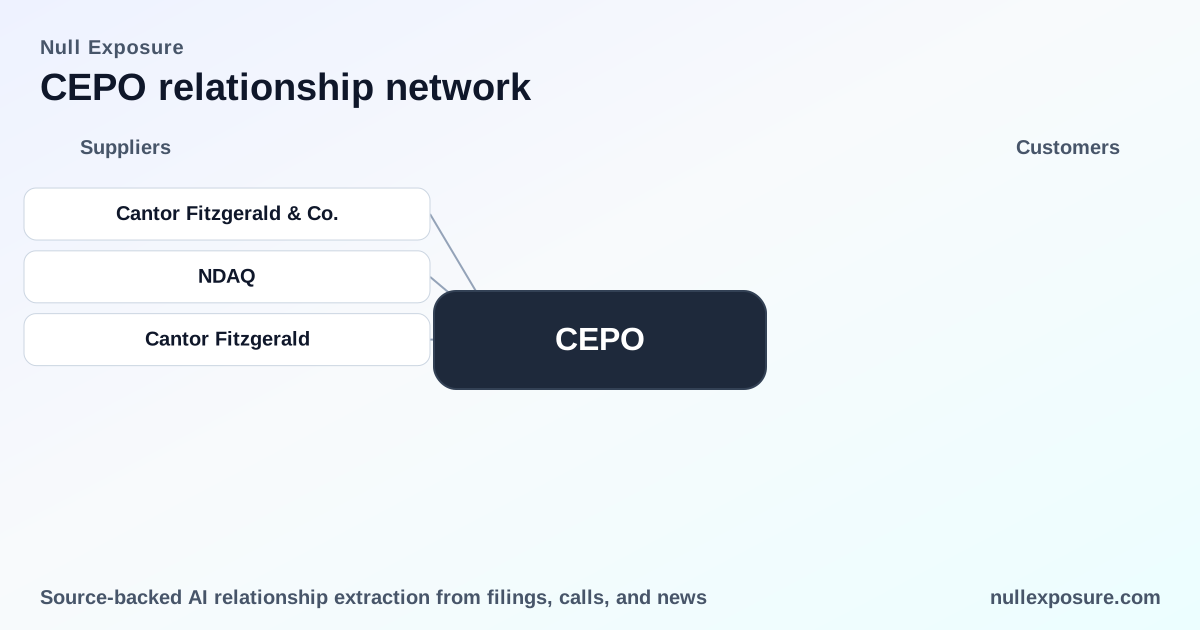
Cantor Fitzgerald & Co.: Cantor Fitzgerald & Co. acted as the sole book running manager for CEPO’s IPO, providing underwriting services vital to the offering’s execution and public listing. (PR Newswire release announcing the IPO pricing, January 2025.)
-
Nasdaq (NDAQ): The company’s shares were listed on the Nasdaq Global Market and began trading on January 7, 2025, establishing the public-market venue and ongoing exchange compliance obligations. (PR Newswire release announcing the IPO pricing, January 2025.)
-
Cantor Fitzgerald: Cantor Equity Partners I is sponsored by Cantor Fitzgerald and led by Brandon Lutnick as Chairman and CEO; the sponsor structure places Cantor affiliates at the center of capital commitments and advisory relationships for the SPAC. (PR Newswire release announcing the IPO pricing, January 2025.)
What operators and investors should track next
Investors and operating partners should prioritize three categories of monitoring:
- Contract enforcement and incentive alignment. The $7 million marketing fee, sponsor loans and monthly service payments create clear incentives for sponsor-led transaction execution; confirm contract milestones, clawbacks, and reimbursement provisions in filings and amendment disclosures.
- Counterparty concentration risk. With Cantor affiliates fulfilling underwriting, advisory and custodial roles, operational failure or reputational issues at the sponsor level would have outsized impact. Ensure governance controls, independent committee actions and transparency on related-party transactions.
- Liquidity and listing health. Maintain vigilance on share float dynamics, post-IPO trading volumes and Nasdaq compliance items—these elements materially affect ability to consummate a business combination on attractive terms.
Key takeaway: CEPO’s supplier footprint is intentionally concentrated and contractually explicit—small recurring fees underpinned by materially asymmetric contingent payouts tied to a successful business combination. That structure delivers alignment but increases single‑counterparty dependency.
Explore supplier risk scoring and comparative supplier profiles at https://nullexposure.com/
Bottom line
CEPO is a sponsor-centric SPAC that leverages Cantor Fitzgerald’s group of services to underwrite, advise and administrate the path to a business combination. For investors and acquirers evaluating supplier relationships, the story is not diversified vendor risk but a concentrated, contract-driven dependency on Cantor affiliates with both modest recurring costs and material contingent payouts. Active governance, clear transparency on contract terms, and monitoring of listing and liquidity metrics are the primary levers to mitigate supplier concentration risk and protect transaction value.