Cantor Equity Partners II (CEPT): advisors, counsel, and what supplier ties tell investors
Cantor Equity Partners II, Inc. (CEPT) is a NASDAQ-listed investment vehicle that monetizes through sponsor-led business combinations, placement of PIPE capital, and active portfolio steering via affiliated advisors. CEPT generates value by packaging a public shell, securing sponsor and PIPE commitments, and using external financial and legal suppliers to execute the business-combination lifecycle. For investors and operators evaluating counterparty risk, the composition and role of those suppliers define execution risk, conflict exposure, and the speed with which capital converts into productive assets. Visit https://nullexposure.com/ for a broader mapping of supplier relationships and transaction counterparties.
Quick baseline: capital structure and strategic posture that matter to suppliers
Understanding CEPT’s supplier footprint requires recognizing its corporate profile. Key, company-level signals include:
- Market capitalization roughly $336 million and institutional ownership at ~77.6%, which creates a predominantly professional investor base and places a premium on transaction governance and disclosure.
- Listed status on NASDAQ and classification as a 'shell' company indicates CEPT’s primary operational runway is a business combination or similar transaction, not ongoing operating cash flow.
- Low insider ownership (~2.95%) increases dependence on institutional stewardship and external advisors for deal origination and execution.
These characteristics drive CEPT’s contracting posture: high reliance on specialized advisers for discrete transaction phases, concentrated counterparty sets during a deal, and critical supplier relationships that determine time-to-close. The company’s maturity profile is that of a public shell engineered for accelerated combination activity rather than long-term standalone operations.
Deal advisers and counsel: the suppliers named in reports
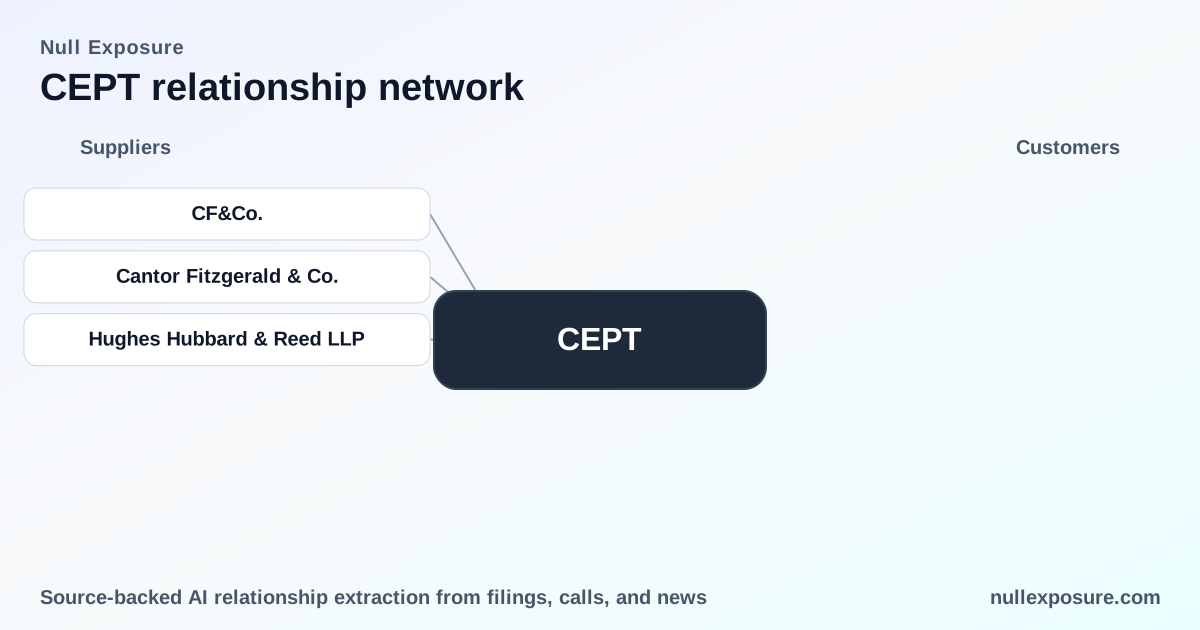
The public record for FY2025 identifies three supplier relationships tied to CEPT’s transaction execution. Each engagement speaks directly to the company’s operating model and conflict landscape.
CF&Co. — financial advisor and co-placement agent (affiliate of the sponsor)
CEPT engaged CF&Co., an affiliate of the Sponsor, to act as financial advisor for the Business Combination and co-placement agent for the PIPE investment, indicating the sponsor uses internal distribution channels to assemble capital and advise strategic direction. This information derives from a business-combination communication filed and reproduced on StockTitan for FY2025. (Source: SEC filing summarized on StockTitan, FY2025.)
Cantor Fitzgerald & Co. — external financial adviser
Cantor Fitzgerald & Co. acted as an external financial advisor to CEPT during the transaction process, providing independent market-facing advisory services that complement sponsor-affiliated advice and support valuation, syndication, and investor outreach. This role was reported in a MarketScreener article covering the reverse merger and acquisition activity. (Source: MarketScreener news report on the reverse merger, reported 2026-03-09.)
Hughes Hubbard & Reed LLP — legal advisor
Hughes Hubbard & Reed LLP provided legal advisory services to CEPT, supporting the regulatory and transactional legal work necessary for the business combination and related capital raises. The engagement is documented in the same MarketScreener coverage of the deal activities. (Source: MarketScreener news report on the reverse merger, reported 2026-03-09.)
Mid-read note: for a more complete supplier map and to benchmark counterparties across similar transactions, see https://nullexposure.com/.
What these relationships reveal about CEPT’s operating and business-model constraints
Taken together, the supplier set illuminates several operational realities that matter for investors:
- Contracting posture: CEPT contracts both sponsor-affiliated and independent advisers. The use of an affiliate (CF&Co.) for co-placement and advisory work signals a hybrid contracting model that leverages sponsor alignment for speed while retaining market-facing advisors to bolster distribution credibility.
- Concentration: The named suppliers are central to executing a single primary objective — the business combination and PIPE close — which creates concentrated counterparty risk during the transaction window. Execution failure at any supplier nexus would materially delay or derail value realization.
- Criticality: Each supplier is mission-critical: financial advisors coordinate valuation and syndication; legal counsel clears regulatory and disclosure hurdles. These are not peripheral vendors — they are determinants of whether the business combination converts into public operating value.
- Maturity and governance signal: Reliance on established firms (Cantor Fitzgerald, Hughes Hubbard) elevates procedural rigor and suggests CEPT prioritizes transaction credibility for institutional investors. Simultaneously, the sponsor-affiliate role injects related-party complexity that investors must monitor through disclosure and fee schedules.
Investor implications: risk, upside, and what to monitor now
For investors assessing CEPT exposure, the supplier ties create both execution leverage and governance focus:
- Upside: Sponsor-affiliate placement capability accelerates capital formation; high institutional ownership indicates the investor base is poised to support transactions that demonstrate clear valuation uplift.
- Risk: Related-party engagements increase potential for conflicts; concentrated supplier reliance amplifies single-point failure risk during close. Legal and disclosure rigor are non-negotiable; watch formal filings for fee disclosures and independence statements.
- Monitoring checklist (actionable):
- Track SEC filings and proxy materials for related-party transaction details and adviser compensation.
- Monitor PIPE syndication status and announced investor commitments.
- Watch legal opinions or regulatory notices that could affect deal timing or terms.
- Assess any subsequent supplier additions or replacements, which indicate execution resilience or strain.
Final read and recommended next steps
The supplier footprint documented for FY2025 shows a deliberate mix of sponsor-aligned and market-facing advisers, configured to compress time-to-close while preserving market credibility. That configuration benefits speed and distribution but requires active governance oversight to manage related-party economics and concentration risk. Investors should prioritize transparency in filings and maintain a running assessment of adviser roles through deal milestones.
For a systematic view of CEPT’s counterparties and to compare supplier concentration across issuers, visit https://nullexposure.com/. To receive ongoing supplier-mapping updates and transaction monitoring, see https://nullexposure.com/ for subscription options and deeper supplier analytics.
Key takeaway: CEPT’s named suppliers are central to converting the company’s shell status into public operating value; their composition balances speed with credibility but creates concentrated execution risk that investors must monitor through public filings and deal disclosures.