Certara (CERT) as a Supplier: What investors and operators should know
Thesis: Certara monetizes a combination of software subscriptions and professional services that embed biosimulation into drug discovery, regulatory filings, and market-access workflows; the company generates recurring revenue from platform licensing and add-on consulting while outsourcing specialized functions such as investor relations and third‑party assurance. For counterparties evaluating Certara as a supplier—either as a client, partner, or investor—you should treat the company as a software‑plus‑services vendor with regulated‑industry risk profiles and formal third‑party validation practices.
Explore more supplier intelligence at https://nullexposure.com/
How Certara makes money and why that matters to counterparties
Certara sells proprietary biosimulation software and complementary professional services to pharmaceutical and biotech customers, packaging recurring subscriptions with project-based consulting for regulatory submissions and market access. The business model blends sticky, subscription-style revenue with episodic, higher-margin services tied to clinical and regulatory milestones. Financials show a $418.8M revenue run‑rate with gross profit of $257.7M and an EBITDA of roughly $98.5M, which supports steady vendor investment in product and compliance. According to available market data, Certara’s enterprise value metrics (EV/Revenue ~2.74; EV/EBITDA ~11.2) and a forward P/E around 12.7 indicate the market prices it as a mature, cash-generative supplier in healthcare tech.
For a quick supplier assessment or to benchmark Certara against peers, visit https://nullexposure.com/
Suppliers, vendors and public-facing relationships: who’s on the roster
Certara’s public relationship traffic in the supplier context is light in the captured universe but informative.
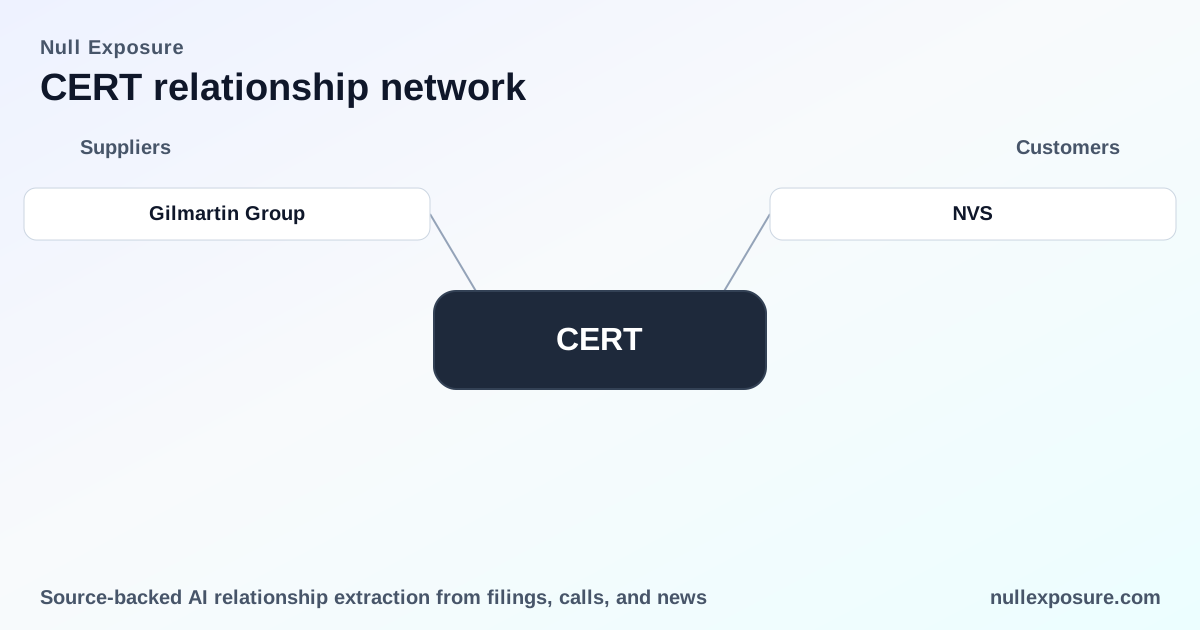
- Gilmartin Group — Listed as an investor relations contact with David Deuchler named; this is recorded in a Bitget news item dated March 9, 2026. The reference identifies Gilmartin Group as an external IR firm Certara uses to manage investor communications, signaling outsourced investor relations functions rather than in‑house handling. (Source: Bitget news, March 9, 2026)
This single explicit relationship entry should be interpreted as a representation of how Certara distributes non-core functions externally: investor relations is delegated, and additional operational assurance is run with third parties (see constraints below). The Gilmartin Group reference is small but consistent with a vendor posture that relies on specialist firms for communications and governance support.
What the constraint signals tell you about Certara’s operating model
Certara discloses that “We regularly engage third‑party assessors, service providers, consultants, and auditors to support and review our risk management processes and to provide independent validation and verification of our security posture.” This is a company-level signal, not tied to any single named partner in the available excerpts.
Implications for counterparty assessment:
- Contracting posture: Certara uses an outsourced model for assurance and specialist services, which lowers its internal headcount needs for those functions and creates a predictable vendor management requirement for counterparties.
- Criticality and maturity: Regular third‑party validation indicates a mature compliance program consistent with regulated customers (pharma and biotech) that require documented security and validation practices.
- Concentration: The disclosure reads as a broad program rather than a single‑vendor dependency, implying diversified supplier relationships for assurance tasks; concentration risk is limited on the face of the disclosure.
- Negotiation leverage: Outsourcing of non-core functions increases Certara’s ability to scale but gives counterparties leverage to require specific certifications or audits as procurement conditions.
Use this as a checklist when performing vendor due diligence: confirm which assurance partners Certara uses, request recent audit reports, and validate SLAs for consulting engagements.
Financial posture and bargaining dynamics that affect supplier risk
Certara’s revenue mix—recurring software revenue plus project services—creates a two-tier bargaining environment. For commodity subscription renewals, Certara has typical SaaS retention leverage; for high‑value regulatory consulting work, the company’s domain expertise confers pricing power and execution risk for buyers. Market capitalization (~$1.03B) and positive operating margin (around 2.1% TTM) indicate sufficient scale to maintain vendor investments, but the company’s negative EPS and modest margin profile require continued monitoring of profitability trends. Analysts collectively lean constructive (consensus target price near $9.19 with most ratings as Buy/Hold).
Quick operational due diligence checklist for counterparties
- Request the latest third‑party audit reports and evidence of independent validation referenced in Certara’s governance statements.
- Confirm the scope and SLAs for any professional services engagements tied to regulatory filings.
- Validate the point of contact for investor and governance communications (Gilmartin Group is cited as an external IR resource).
- Verify business continuity and security attestations, especially when clinical or regulatory deliverables are involved.
A concise vendor questionnaire combined with the requested audit artifacts will answer most supply‑risk questions quickly. For help structuring that questionnaire, see https://nullexposure.com/
Practical risk takeaways for investors and procurement teams
- Operational maturity is apparent. Regular engagement of assessors and auditors signals established governance pathways suitable for regulated clients.
- Outsourced communications are a fact of life. External IR support through firms like Gilmartin Group simplifies capital‑market interactions but requires verification if communications performance is material to stakeholder management.
- Concentration risk looks manageable. The company-level disclosure points to a distributed third‑party strategy rather than single‑supplier dependence.
- Service criticality is asymmetric. Core biosimulation software provides recurring stability; project services are higher margin but carry execution risk that should be contractually managed.
Final recommendation and next steps
For investors and procurement teams evaluating Certara as a supplier or partner, pursue targeted proof points: recent audit reports, a list of assurance providers, and example SLAs for regulatory engagements. Those documents determine whether Certara’s outsourced model translates into reliable, auditable delivery for mission‑critical programs.
If you need supplier intelligence or a tailored diligence pack, start here: https://nullexposure.com/
Conclusion: Certara operates as a software‑plus‑services firm with mature third‑party assurance practices and selective outsourcing (including investor relations via Gilmartin Group). The company’s model supports stable vendor performance for subscription work and premium pricing for regulated consulting, provided counterparties secure audit evidence and contractual protections.