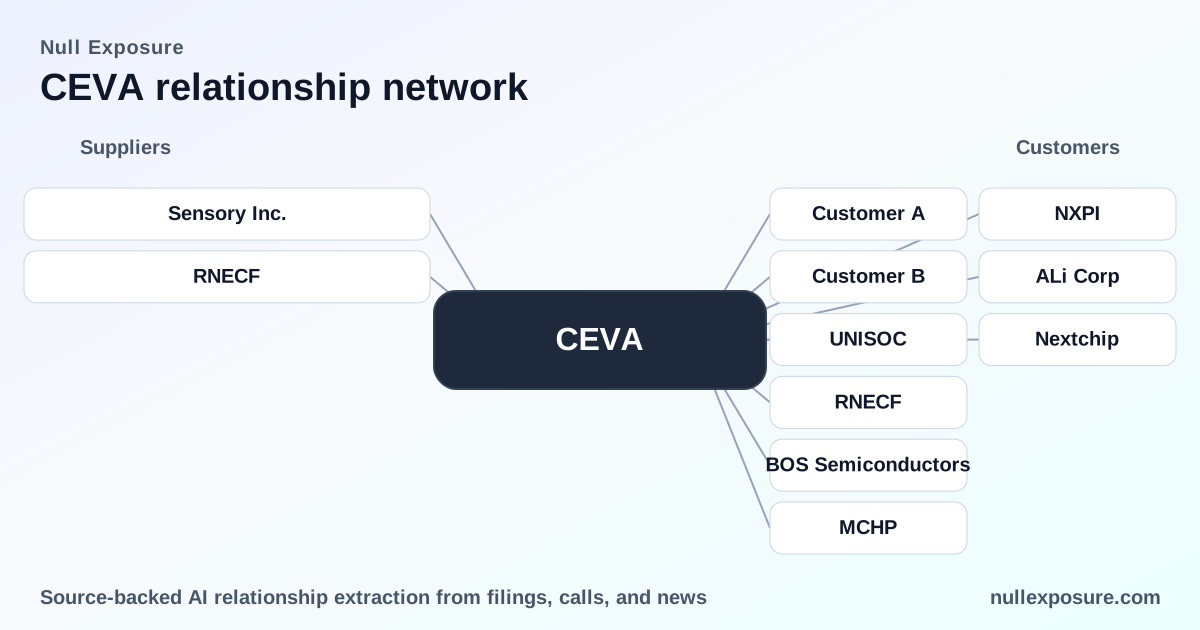
CEVA Inc.: IP licensor turning silicon relationships into recurring revenue
CEVA Inc. designs and licenses digital signal processing (DSP) cores and AI-enabled software to semiconductor and device makers and collects revenue through upfront licensing fees and downstream royalties tied to chip shipments and IP integrations. The company monetizes intellectual property and software across mobile, automotive and IoT end markets, leveraging ecosystem partnerships with silicon vendors and voice/AI middleware providers to accelerate adoption and scale royalty streams. For investors and operators, CEVA’s supplier relationships convert technology wins into visible revenue cadence and are the primary distribution vector for its IP.
Discover more supplier intelligence at https://nullexposure.com/
A compact investor snapshot you should read first
CEVA operates an asset-light, R&D-intensive model: FY2025 revenue was $109.6M with gross profit of $95.4M, reflecting the high-margin nature of IP licensing, while operating profitability and EPS remain under pressure (TTM diluted EPS -$0.44; operating margin TTM -1.27%). Market capitalization sits near $518M, with institutional ownership exceeding 92%, signaling concentrated professional ownership and active analyst coverage (consensus target $31.67; primarily buy ratings). Revenue growth is positive year-over-year (quarterly revenue growth +7.1%) and licensing momentum into Wi‑Fi/Bluetooth and AI edge is driving near-term topline expansion.
The supplier relationships you need on the radar
Sensory Inc. — voice activation integrated into NeuPro-Nano
CEVA announced a collaboration enabling Sensory’s TrulyHandsfree voice activation on its NeuPro‑Nano NPU, positioning CEVA’s edge AI ecosystem to support low‑power, always‑on voice capabilities for consumer devices. According to a Sahm Capital news release dated January 5, 2026, this is a targeted partnership to accelerate voice activation adoption on CEVA’s edge AI platform. (Source: Sahm Capital, Jan 5, 2026)
Renesas — Wi‑Fi 6 and Bluetooth IP embedded in Renesas combo MCUs
CEVA’s Wi‑Fi 6 and Bluetooth IP are powering Renesas’ first combo microcontroller units aimed at IoT and connected‑home applications, establishing CEVA as a supplier to a large MCU vendor that sells into consumer and industrial markets. Finviz reported in March 2026 that CEVA IP is integrated into Renesas’ new combo MCUs, a relationship that directly converts CEVA licensing into silicon shipments and downstream royalties. (Source: Finviz news coverage, March 2026)
Note on coverage: Finviz published multiple items during FY2026 reporting the same Renesas integration and the underlying commercial implication; both media entries reflect the same supplier relationship and chipset-level integration reported during the quarter. (Sources: Finviz, March 2026)
What these partnerships reveal about CEVA’s operating model
The supplier links to Sensory and Renesas reveal several core business characteristics investors should underwrite:
-
Contracting posture and asset intensity: CEVA’s business is fundamentally asset‑light and IP‑centric. A company disclosure that it elected not to recognize lease liabilities for leases with terms of twelve months or less signals a preference for short‑term operational commitments rather than long‑dated fixed leases. This is a company‑level signal that reinforces CEVA’s flexible, low-capex posture and ability to scale R&D and customer support without large real estate obligations.
-
Concentration and distribution: Integration with a major silicon vendor like Renesas demonstrates a classic semiconductor supplier dynamic: a small number of large OEM/IC partners can drive meaningful royalty flows. High institutional ownership (92%+) increases the odds that supplier developments are monitored closely by professional investors, which can amplify stock reactions to licensing announcements.
-
Criticality and go‑to‑market leverage: Partnerships that place CEVA IP inside MCUs (Renesas) or inside edge AI stacks with voice activation (Sensory) are commercially critical because they directly enable end‑product features that OEMs value. These relationships act as multiplier channels — a single design win at a large MCU vendor converts into many end devices over time.
-
Maturity and revenue quality: CEVA’s gross margin profile and positive revenue growth indicate high-quality licensing economics, but negative EPS and operating margin compression require discipline on R&D spend and royalties realization. The licensing model creates asymmetric upside when chip shipments scale, while fixed R&D costs create downside pressure if design wins do not convert into volume.
Mid‑analysis strategic implications for investors and operators
-
Commercial runway: The Renesas integration is evidence that CEVA’s connectivity IP is competitive in the IoT/combo‑MCU segment; that is the fastest path to recurring royalties. Monitor shipment-based royalty trends and reported design wins as the primary signal of sustainable revenue growth.
-
Ecosystem leverage: The Sensory collaboration demonstrates CEVA’s strategy of bundling complementary software capabilities (voice activation) with NPUs to broaden product appeal to OEMs focused on low‑power voice interfaces. This increases product stickiness and raises wallet share per silicon partner.
For deeper supplier analytics and to track partner-level revenue conversion, visit https://nullexposure.com/
Investor takeaways and risk checklist
- Takeaway — High-margin licensing with R&D intensity: CEVA’s business model generates gross margins consistent with IP licensing; scalability depends on converting design wins into chip volumes.
- Takeaway — Partnerships are the distribution engine: Integrations with Renesas and Sensory are strategic footholds that convert technology into recurring royalties and product-level differentiation.
- Risk — Profitability not yet stable: TTM EPS is negative and operating margins are compressed; the company must translate wins into volume to move to sustainable profitability.
- Risk — Concentration and dependence on design wins: Large silicon partners drive outsized revenue outcomes; the loss or underperformance of a major integrator would materially affect royalties.
Bottom line and recommended next steps
CEVA is a classic IP licensor: scale via design wins, monetize via licenses and royalties, and protect margins via high gross profitability. The Renesas and Sensory relationships validate both connectivity and voice/edge AI go‑to‑market plays and represent the commercial channels that will determine whether CEVA converts engineering success into recurring revenue. Investors should track quarterly royalty trends, shipment disclosures from major partners, and updates on additional MCU or AI NPU integrations.
If you evaluate supplier risk or need ongoing partner monitoring, start with a broader supplier intelligence refresh at https://nullexposure.com/ and sign up for periodic updates to follow CEVA’s licensing cadence and partner conversions.