CrossFirst Bankshares (CFB): what supplier relationships reveal about deal execution and legal backstops
CrossFirst Bankshares operates as a regional banking holding company, generating net interest and fee income from commercial and private-banking relationships and monetizing through deposit spreads, lending margins and fee income tied to business clients. CFB’s balance of asset growth and capital efficiency—$250.7M revenue TTM and roughly $789M market capitalization—makes acquisitions and advisory relationships material to its growth trajectory and risk profile. For investors assessing counterparty and execution risk, supplier disclosures in public reporting and press coverage offer a clean window into how the company sources deal advice and legal coverage. Explore strategic supplier signals and implications at https://nullexposure.com/.
How CFB executes deals and where supplier relationships fit
CrossFirst approaches expansion by combining organic loan and deposit growth with targeted acquisitions. The company’s P/L (profit margin ~31.3%, ROE ~10.6%) reflects a hybrid model where M&A and strategic advisory services act as accelerants to geographic and balance-sheet scale. Advisory and legal suppliers are not recurring operating vendors in the traditional sense; they function as episodic but high-consequence partners during transactions. That contracting posture creates two operational realities for investors: concentration of supplier importance around discrete events, and cyclical criticality tied to deal flow rather than to day-to-day banking operations.
- Contracting posture: episodic, event-driven retainer or transaction fees for M&A advisory and legal counsel.
- Concentration: limited set of specialist firms engaged per transaction; each engagement is strategically important for execution quality.
- Criticality: high during active transactions; low outside deal windows.
- Maturity: relationships are typical law/advisory engagements—short to medium term with well-defined deliverables.
If you want a regular feed of supplier signals across financial institutions, see how NullExposure collects and surfaces partner intelligence at https://nullexposure.com/.
What the public disclosures list — the full set of supplier relationships found
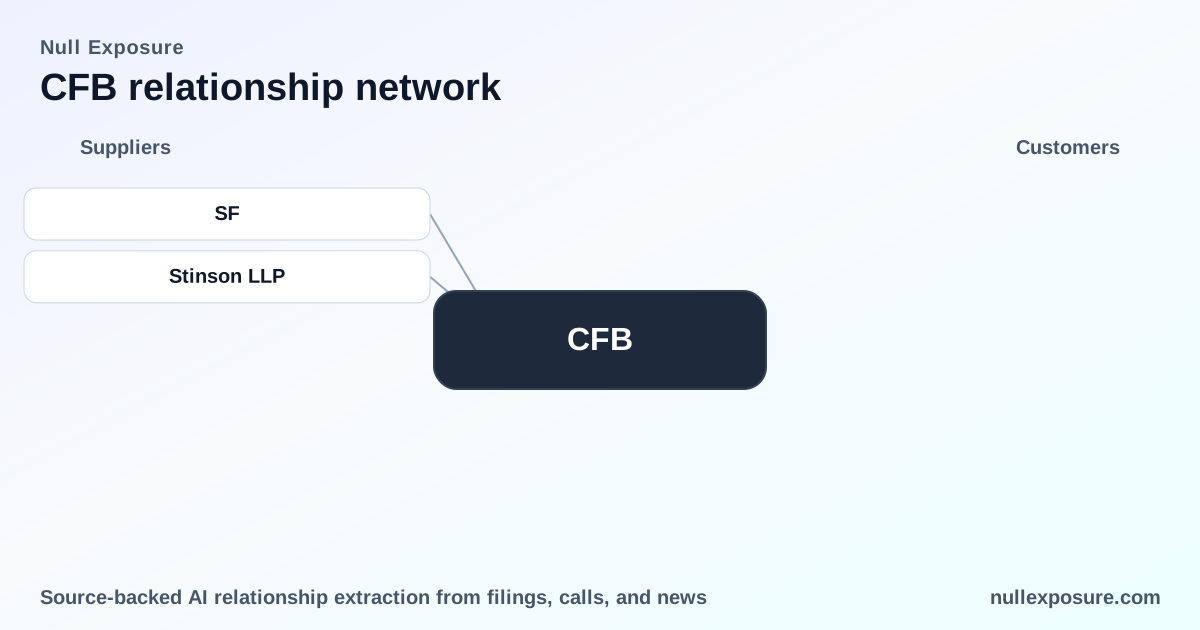
The coverage set returned two suppliers connected to the same transaction disclosure. Both relationships are present in the same news item and are material because they relate to CrossFirst’s acquisition activity.
Keefe, Bruyette & Woods, A Stifel Company
CrossFirst retained Keefe, Bruyette & Woods (KBW) as financial advisor for an acquisition that expanded CFB’s footprint into Colorado and New Mexico; KBW’s role indicates CFB used specialist banking M&A expertise to price and structure the transaction. According to a CityBiz article published March 9, 2026, KBW acted as CrossFirst’s financial advisor on the deal (CityBiz, March 2026: https://www.citybiz.co/article/278324/crossfirst-bankshares-to-enter-colorado-and-new-mexico-markets-with-acquisition-of-farmers-stockmens-bank-central-bank-trust/).
Stinson LLP
CrossFirst engaged Stinson LLP as legal counsel for the same transaction, reflecting the company’s use of regional/national law firms to cover regulatory and contract structuring requirements that accompany bank acquisitions. The same CityBiz report (March 9, 2026) names Stinson LLP as CrossFirst’s legal counsel on the deal (CityBiz, March 2026: https://www.citybiz.co/article/278324/crossfirst-bankshares-to-enter-colorado-and-new-mexico-markets-with-acquisition-of-farmers-stockmens-bank-central-bank-trust/).
What these relationships reveal about CFB’s operating model
Collectively, the suppliers disclosed in public coverage show CrossFirst’s transaction playbook: specialized financial advisory, paired with legal counsel, executed on a per-deal basis. Several firm-level signals follow:
- Execution-oriented supplier mix. The use of KBW for advisory work indicates CFB sources specialist investment-banking expertise rather than relying solely on internal corporate development teams.
- Regulatory and transactional risk management. Engagement of a dedicated law firm like Stinson measures CFB’s focus on compliance and closing certainty for bank acquisitions.
- Low vendor diversity for transactions. Public disclosure highlights a discrete advisory/legal stack for this deal; that pattern concentrates execution risk into the quality of the chosen advisors during deal windows.
No supplier constraints were flagged in the disclosure set; at the company level, this signals no public supplier-imposed contractual limitations were disclosed that would restrict CrossFirst’s operational flexibility.
Midway through monitoring an acquirer’s partnerships is critical for understanding deal risk. If you want to track which advisors and counsel are active across regional bank M&A, check NullExposure’s coverage at https://nullexposure.com/.
Investment implications and risk considerations
The supplier disclosures are short but meaningful for investors:
- Positive for deal execution credibility. Hiring KBW and Stinson signals CFB’s willingness to deploy professional advisory resources to execute acquisitions, reducing execution risk relative to deals closed without such advisors.
- Concentrated vendor reliance during critical windows. Because supplier roles are episodic and critical, failure or misalignment with a single advisor or counsel could create outsized execution or regulatory risk for a given transaction.
- Limited ongoing expense signal. These engagements represent transaction costs, not recurring operating expenses; their near-term impact is on cash outflows and deal outcomes rather than stable margin compression.
Investors should weight these supplier signals against CrossFirst’s financial cadence—TTM revenue of $250.7M, ROE ~10.6% and a trailing P/E around 10.25—to assess whether acquisitive growth justifies the execution premium.
Monitoring and next steps for investors
For governance and counterparty diligence, track three items consistently:
- Announcements and filings related to M&A where advisors are named.
- Legal or regulatory notices that might reference counsel engagements or compliance exposures.
- Changes in advisor or counsel selection patterns that could indicate a shift in execution strategy or emerging complexity.
To start monitoring these supplier relationships and get alerts on advisor and counsel activity for banking suppliers, visit https://nullexposure.com/.
Bottom line
The public supplier footprint for CrossFirst is compact and transaction-focused: KBW as financial advisor and Stinson LLP as legal counsel for a specific acquisition. That footprint signals competent access to external execution capabilities but also concentrates deal execution risk into a small set of firm engagements during acquisition windows. Investors should treat these disclosures as a positive indicator of governance and execution intent while remaining attentive to the concentrated nature of supplier reliance when evaluating M&A-driven growth assumptions.