CF Bankshares (CFBK): Supplier footprint and what it tells investors
CF Bankshares is a regional bank holding company that operates CFBank, monetizing through traditional banking channels: net interest income from loan and investment spreads, fee income from deposit and commercial services, and interest-bearing wholesale funding relationships. With a market capitalization around $146 million and trailing revenue of roughly $50.7 million, CF Bankshares runs a compact balance-sheet-driven model where branch real estate, wholesale funding access, and credit guarantees materially shape capital efficiency and earnings variability. For investors evaluating counterparty risk and supplier strategy, the supplier relationships disclosed in the company’s FY2026 reporting highlight how CFBK funds and de-risks loans and how it manages third-party operational exposure.
Explore further research and supplier maps at https://nullexposure.com/.
How CF Bankshares makes money and why suppliers are strategic
CF Bankshares operates as a deposit-centric regional lender headquartered in Ohio, generating earnings from lending margins and fee income; profitability (reported profit margin ~32% and return on equity ~9.45% on trailing figures) depends on funding cost, credit performance, and non-interest income. Wholesale funding lines and government-guaranteed loan programs are structural levers: they compress funding cost, improve liquidity, and materially affect loan loss economics when guarantees are present. Operationally, the bank also relies on third-party vendors for technology, cybersecurity, and continuity — a classic regional-bank subcontracting posture that transfers operational risk outside the franchise while retaining credit and regulatory accountability.
Visit https://nullexposure.com/ to see connected supplier profiles and expand this view.
Strategic supplier relationships called out in FY2026 reporting
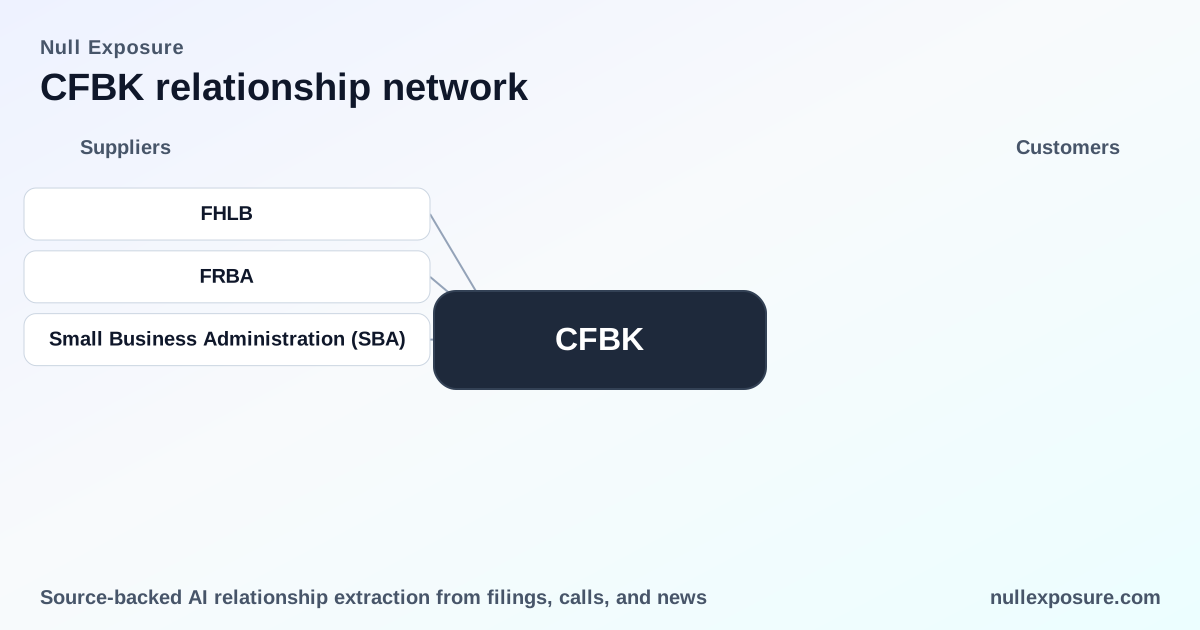
The company’s FY2026 disclosure (earnings release posted March 2026) references three distinct counterparties that shape liquidity, funding and credit economics. Each relationship below is summarized in plain English with the company’s reporting as the source.
Federal Home Loan Bank (FHLB)
CF Bankshares reported FHLB advances and other debt of $101.0 million at December 31, 2025, unchanged from the prior quarter and up from $92.7 million a year earlier, indicating sustained reliance on FHLB wholesale borrowings to fund assets. According to the company’s FY2026 earnings release on PR Newswire (March 2026), FHLB advances are a visible component of the bank’s funding mix and liquidity strategy.
Federal Reserve Bank (FRB / FRBA)
The FY2026 release references FRB balances in the context of liquidity statistics, with reported stock figures for FHLB and FRB items aggregated in the earnings tables. The PR Newswire earnings release (March 2026) lists specific balance line items for FRB-related positions, underscoring CF Bankshares’ active management of central-bank balances as part of its short-term liquidity posture.
Small Business Administration (SBA)
CF Bankshares disclosed two loans that carry a 75% guarantee from the Small Business Administration totaling $3.6 million, which materially reduces loss severity on those exposures. The FY2026 earnings release on PR Newswire (March 2026) explicitly cites the SBA guarantee amount and the related loan treatment in credit metrics.
What the constraints tell investors about CF Bankshares’ operating posture
Two company-level constraints reported in correspondence with supplier data reveal important characteristics of CF Bankshares’ operating model and contract posture:
-
Long-term leases for branches and equipment: The company discloses operating leases with weighted-average remaining lease term around 8.8 years (through 2034) and a weighted-average discount rate reported as 7.47%, indicating a long-term property footprint that anchors branch network fixed costs and reduces short-term flexibility to shrink physical presence quickly. This is a structural maturity signal for real-estate commitments and capex cadence.
-
Third-party service-provider governance: CF Bankshares maintains a third-party risk management program that performs periodic vendor reviews for cybersecurity and business continuity to enforce contractual requirements and audit testing results. This signals a contracting posture that outsources operational capabilities but enforces compliance controls — so vendor performance and cyber posture are critical operational dependencies.
These constraints collectively imply a moderately mature supplier risk program with long-lived property commitments and active vendor oversight, which influences contracting dynamics: longer negotiation horizons, emphasis on SLA and business-continuity clauses, and concentration of operational risk in key vendors rather than short-term spot suppliers.
Operational and portfolio implications for investors and counterparties
CF Bankshares’ supplier footprint drives several practical investment implications:
- Funding sensitivity: The continued use of FHLB advances (~$101 million) and FRB balance management means funding cost and access are primary levers for net interest margin and liquidity — monitor wholesale spreads and lender eligibility criteria.
- Credit mitigation via guarantees: SBA guarantees (75% on specific loans totaling $3.6 million) reduce credit volatility on those portfolios and improve capital efficiency; however, guarantee scale relative to total assets is modest and should be assessed in context.
- Operational risk concentration: The bank’s reliance on third-party vendors is mitigated by a formal oversight program, but vendor outages or cybersecurity incidents would be material operational events given the bank’s outsourced posture.
- Real-estate rigidity: Long-dated branch leases add fixed-cost stickiness that can compress margins in adverse rate or deposit environments; the weighted-average lease maturity (~8.8 years) indicates strategic commitment to a physical network.
Quick, risk-focused checklist for counterparty evaluation
- Confirm FHLB/FRB exposure trends over the recent quarters and sensitivity to higher wholesale rates.
- Quantify guarantee coverage (SBA and other programs) as a percentage of loan book to assess loss absorption.
- Review third-party vendor concentration and the results of recent vendor audits or penetration tests.
- Model lease expense under stressed deposit-run scenarios to estimate margin pressure.
For deeper supplier mapping and point-in-time relationship data, visit https://nullexposure.com/ — it’s the fastest way to convert this high-level view into an actionable due-diligence file.
What investors should do next
CF Bankshares presents as a liability-funded regional bank with explicit wholesale funding and government-guaranteed exposures, paired with a mature vendor oversight framework and long-term real-estate commitments. Investors and counterparties should prioritize monitoring wholesale funding levels, guarantee utilization, and third-party continuity risk. For a practical next step, request the latest quarter loan-level schedules, recent vendor review summaries, and updated lease roll-forward to stress-test earnings under alternative funding scenarios.
To review supplier connections across peers and expand comparative due diligence, go to https://nullexposure.com/.
Final takeaway: CFBK’s supplier relationships are conventional for a regional bank but strategically important — wholesale funding and credit guarantees materially shape earnings and capital dynamics, while long-term leases and vendor outsourcing frame operational risk and contracting posture.